By the end of this lesson
- Define deforestation and distinguish clearance from natural gap-phase disturbance in a forest.
- Explain how timber extraction, agriculture, mining, transport, settlement and HEP drive forest loss, using the Amazon as a preview of the named-rainforest case.
- Use maps to identify patterns of deforestation such as fishbone clearance along roads.
What counts as deforestation
deforestationThe clearance of forest so that land is converted to another use. is the lasting clearance of forest so that the land is converted to another use, or left in a state that cannot quickly return to forest. Selective logging that later allows regrowth is forest degradation, which still matters, but the specification’s cause list is mainly about drivers of clearance: commercial timber extractionThe harvesting of trees for sale as timber, which can reduce forest cover and disrupt ecosystems., agriculture, mining, transport, settlement and hydropowerElectricity generated by using moving or falling water to drive turbines.. Those six should appear in your revision notes as a complete set.
Tropical moist forests in the Amazon, Congo Basin and South-East Asia attract the most exam attention because of their biodiversityThe variety of living organisms, including differences within species, between species and among ecosystems. and carbon storeA part of a system in which water or other material is held for a period of time., but the same headings can apply to other forests. This course uses the Brazilian Amazon as the named rainforest for sustainableDescribes meeting present needs while protecting the capacity of future generations to meet their own needs. management, so it is honest to preview Amazonian mechanisms here while remembering that Indonesia’s oil-palm and pulp landscapes, or Congo Basin logging roads, are parallel stories if a paper gives you those maps instead.
Timber and agriculture
commercial timber extractionThe harvesting of trees for sale as timber, which can reduce forest cover and disrupt ecosystems. removes valuable hardwoods and, too often, damages many other trees in the felling and hauling. Logging itself may not clear the whole plot, but it opens access: skid trails and logging roads let farmers, ranchers and hunters enter. Illegal as well as legal timber tradeThe exchange of goods and services between people, businesses or countries. matter. When you interpret a newspaper extract about “hardwood exports”, ask who buys the wood and whether the extraction is selective or clear-fell.
Agriculture is the largest direct cause of tropical deforestationThe clearance of forest so that land is converted to another use. in many basins. In the Brazilian Amazon, cattle ranchingThe rearing of cattle over large areas of pasture, sometimes created by clearing forest. has cleared huge areas of forest for pasture, and soy cultivation — sometimes on former pasture, sometimes more directly — has been a powerful market driver, especially as global demand for animal feed grew. Small-scale slash-and-burn farming exists too and can be sustainableDescribes meeting present needs while protecting the capacity of future generations to meet their own needs. in long-fallow systems at low density; it becomes a deforestation driver when fallow shortens, when colonist settlement follows a highway, or when small clearances are later absorbed into larger ranches. In South-East Asia, oil palm and pulpwood plantations play an analogous agricultural role. Always name the crop or livestock system the figure actually supports.
Mining, transport, settlement and HEP
Mining — gold, iron ore, bauxite, oil and others depending on the basin — clears forest at the pit or well pad and, more importantly, finances and justifies roads plus spontaneous settlement. Informal gold mining can also pollute rivers with sediment and mercury, a degradation that a land-cover map may understate.
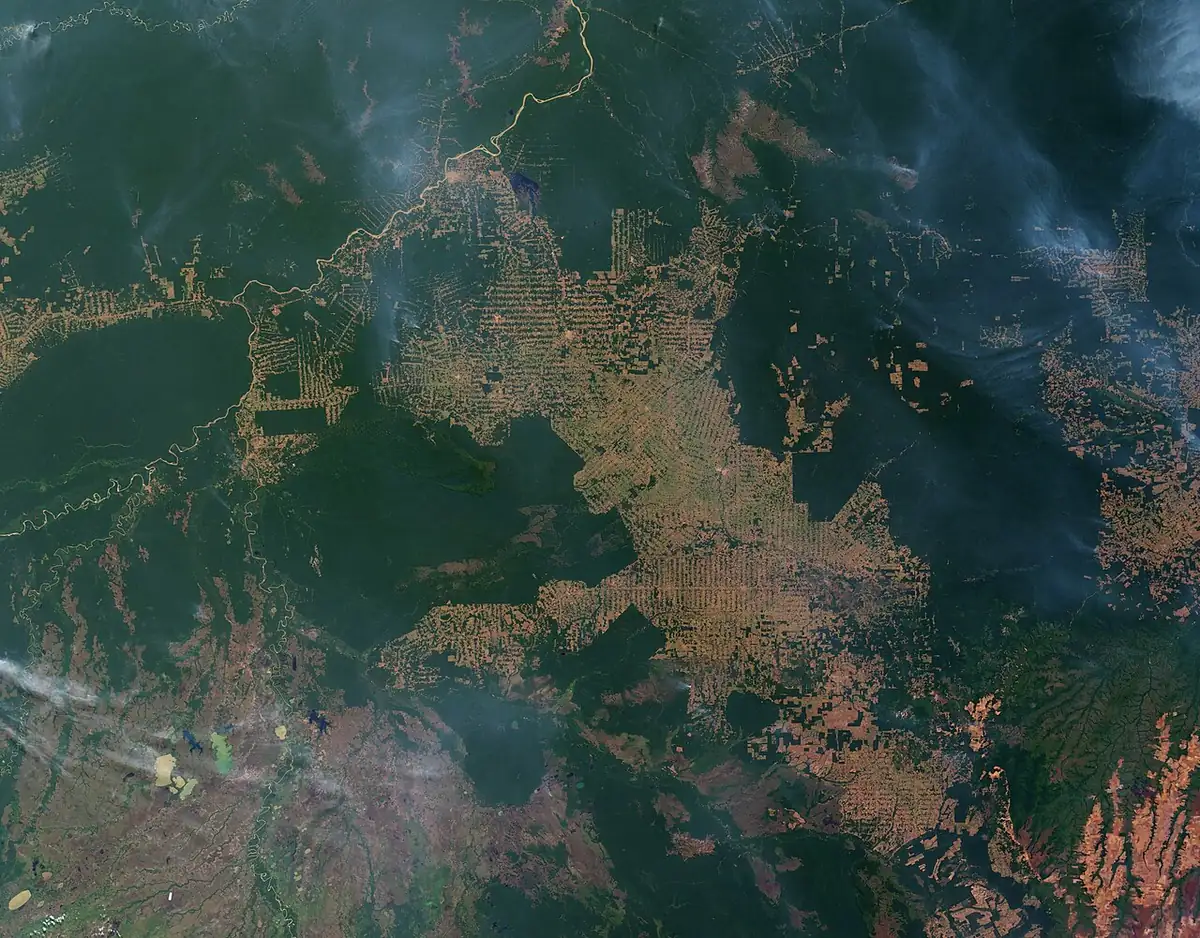
Transport, especially new highways and logging roads, is the skeleton of many deforestationThe clearance of forest so that land is converted to another use. maps. The classic fishbone pattern shows a main road with perpendicular tracks and then rectangular clearances. Once a road cuts travel time to a city or port, land that was uneconomic to ranch or farm suddenly has a market. The Trans-Amazonian and other Brazilian highways are standard illustrations; you only need the mechanism, not a memorised road number, unless the insert labels one.
Settlement follows the roads: planned colonisation schemes, spontaneous land occupation, and growing towns that need charcoal, farmland and timber. Land tenure confusion can accelerate clearance, because occupying and clearing forest is sometimes used to strengthen a claim.
hydropowerElectricity generated by using moving or falling water to drive turbines. (hydro-electric power) floods valleys when large damA barrier across a river that holds back water and regulates downstream flow. are built, drowning forest and sometimes forcing settlements onto new forest frontiers. In the Amazon, large dams such as Belo Monte on the Xingu have been widely debated for their flooded area, displaced people and uncertain climateThe average weather conditions and their variability in a place over a long period, usually at least 30 years. benefits if drowned vegetation releases methaneA powerful greenhouse gas released by sources including livestock, rice cultivation, waste and fossil fuel extraction.. Use HEP as a cause of direct flooding plus indirect frontier change, not as “electricity is bad”.
Reading deforestation maps
Skill (3) asks you to {use maps, paper and online, to identify the pattern of deforestationThe clearance of forest so that land is converted to another use.}. Look for edges: are losses concentrated along rivers, along roads, around mines, or in geometric blocks of agribusiness? Fishbones imply transport-led colonisation. Large rectangles imply mechanised agriculture. Isolated pits imply mining. A protected-area outline with little loss inside and heavy loss outside is evidence that management (coming in 7.3b) can change the map.
Worked example: a map of part of Pará or Rondônia shows a highway, fishbone side roads, and paler cleared land, with a darker indigenous territoryLand recognised as belonging to or being managed by an indigenous community, often supporting local resource stewardship. or reserve nearby. Describe the contrast. Explain: the road lowered transport costs for beef and timber; legal protection and live presence on indigenous land raised the cost of clearance inside the reserve. Do not invent a year-by-year hectare total if the map does not give one.
Distant drivers and local agents
A satisfying explanation separates the person who cuts the tree from the distant demand that makes cutting profitable. A rancher, colonist or logger is the local agent; a supermarket, iron-ore customer, timber importer or energy ministry may be the distant driver. Government policy — subsidyFinancial support that lowers production costs or prices, often used by governments to support selected industries., land reform, enforcement by agencies such as Brazil’s IBAMA, or the weakening of that enforcement — sits in between. The 2006 Amazon soy moratorium, in which major traders agreed not to buy soy grown on forest cleared after that date, is an example of a market rule changing a driver. Mention it as a preview of management, not as proof that agriculture stopped being a cause.
Exam workshop — six causes, one pattern
A 8-mark question may give a map plus a short article about cattle, soy, gold or a damA barrier across a river that holds back water and regulates downstream flow.. Name the pattern, name the matching causes from the official six, and show one interaction (roads enabling agriculture; mining enabling settlement; hydropowerElectricity generated by using moving or falling water to drive turbines. flooding forest and relocating people). Then add one evaluative clause: not all timber extraction equals wholesale clearance; not all farming is commercialDescribes farming whose main purpose is to produce goods for sale. ranching; some forests are lost to fire in droughtA prolonged period of unusually low precipitation that creates water deficits for ecosystems and people. years, which links climate changeA long-term shift in average climate conditions or their variability at regional or global scales. to deforestationThe clearance of forest so that land is converted to another use..
Misconception check: “poor farmers cause all rainforest loss” is too simple for the Amazon, where medium and large cattle and soy operations have dominated much of the cleared area in recent decades. Equally, “only big companies are to blame” can miss colonist settlement along highways. Match the agent to the map.
Exam craft for this page (f03, note 1). Return to the figure before you add another memorised sentence. Describe the pattern or the calculation that is actually printed, name the process this lesson taught, and only then evaluate what the evidence cannot show. A controlled paragraph of that kind is worth more than a longer paragraph that could have been written without looking at the insert. If the command word is compare, give one shared feature and one difference; if it is explain, give a because clause; if it is assess, end with a judgement that uses a criterion such as sustainability, equity or uncertainty. Practise saying the named specification terms out loud so they appear naturally under time pressure rather than as a panicked list at the end. Teachers can see the difference because your last sentence will answer the question that was asked, not a neighbouring question from revision notes.
Exam craft for this page (f03, note 2). Return to the figure before you add another memorised sentence. Describe the pattern or the calculation that is actually printed, name the process this lesson taught, and only then evaluate what the evidence cannot show. A controlled paragraph of that kind is worth more than a longer paragraph that could have been written without looking at the insert. If the command word is compare, give one shared feature and one difference; if it is explain, give a because clause; if it is assess, end with a judgement that uses a criterion such as sustainability, equity or uncertainty. Practise saying the named specification terms out loud so they appear naturally under time pressure rather than as a panicked list at the end. Teachers can see the difference because your last sentence will answer the question that was asked, not a neighbouring question from revision notes.
Exam craft for this page (f03, note 3). Return to the figure before you add another memorised sentence. Describe the pattern or the calculation that is actually printed, name the process this lesson taught, and only then evaluate what the evidence cannot show. A controlled paragraph of that kind is worth more than a longer paragraph that could have been written without looking at the insert. If the command word is compare, give one shared feature and one difference; if it is explain, give a because clause; if it is assess, end with a judgement that uses a criterion such as sustainability, equity or uncertainty. Practise saying the named specification terms out loud so they appear naturally under time pressure rather than as a panicked list at the end. Teachers can see the difference because your last sentence will answer the question that was asked, not a neighbouring question from revision notes.
Exam craft for this page (f03, note 4). Return to the figure before you add another memorised sentence. Describe the pattern or the calculation that is actually printed, name the process this lesson taught, and only then evaluate what the evidence cannot show. A controlled paragraph of that kind is worth more than a longer paragraph that could have been written without looking at the insert. If the command word is compare, give one shared feature and one difference; if it is explain, give a because clause; if it is assess, end with a judgement that uses a criterion such as sustainability, equity or uncertainty. Practise saying the named specification terms out loud so they appear naturally under time pressure rather than as a panicked list at the end. Teachers can see the difference because your last sentence will answer the question that was asked, not a neighbouring question from revision notes.
Exam craft for this page (f03, note 5). Return to the figure before you add another memorised sentence. Describe the pattern or the calculation that is actually printed, name the process this lesson taught, and only then evaluate what the evidence cannot show. A controlled paragraph of that kind is worth more than a longer paragraph that could have been written without looking at the insert. If the command word is compare, give one shared feature and one difference; if it is explain, give a because clause; if it is assess, end with a judgement that uses a criterion such as sustainability, equity or uncertainty. Practise saying the named specification terms out loud so they appear naturally under time pressure rather than as a panicked list at the end. Teachers can see the difference because your last sentence will answer the question that was asked, not a neighbouring question from revision notes.
Exam craft for this page (f03, note 6). Return to the figure before you add another memorised sentence. Describe the pattern or the calculation that is actually printed, name the process this lesson taught, and only then evaluate what the evidence cannot show. A controlled paragraph of that kind is worth more than a longer paragraph that could have been written without looking at the insert. If the command word is compare, give one shared feature and one difference; if it is explain, give a because clause; if it is assess, end with a judgement that uses a criterion such as sustainability, equity or uncertainty. Practise saying the named specification terms out loud so they appear naturally under time pressure rather than as a panicked list at the end. Teachers can see the difference because your last sentence will answer the question that was asked, not a neighbouring question from revision notes.
Common misconceptions
Not quite: Rainforests are cleared only by slash-and-burn peasant farmers.
Instead: In several Amazonian frontiers, cattle pasture and commercial crops have cleared more land than traditional long-fallow farming.
Not quite: Logging always means the whole forest is removed at once.
Instead: Selective logging may leave a canopy but still open roads that later bring ranching and settlement.
Not quite: Hydro-electric dams only flood a reservoir and do nothing else to forests.
Instead: They can also displace people onto new forest land and require access roads.
Exam tips
Learn the official six
{Timber, agriculture, mining, transport, settlement and HEP} are the causes the spec named. Use those words.
Roads are multipliers
Transport often enables the other five. A fishbone map is usually a {road-led} story.
Separate agent and market
Say who clears the land and {who buys the beef, soy, timber, ore or electricity}.