By the end of this lesson
- Explain environmental, economic and social impacts of deforestation using the specification’s named themes.
- Show how forest clearance can both generate economic development and undermine the resources that development depends on.
- Apply those impacts to tropical forests, previewing the Brazilian Amazon case.
Four named impacts, unpacked
The specification highlights loss of biodiversity, contribution to climate change, economic developmentAn improvement in economic capacity and living standards through changes in production, income and employment. and soil erosionThe removal of soil by water or wind, often accelerated when vegetation is cleared or land is overused.. Those four are not the only impacts — indigenous dispossession, changed rainfall downwind, river siltation and public-health changes also matter — but they should structure your first paragraph. biodiversityThe variety of living organisms, including differences within species, between species and among ecosystems. and soil erosion are mainly environmental (with social consequences). climateThe average weather conditions and their variability in a place over a long period, usually at least 30 years. contribution is environmental at global scale. Economic development is the double-edged human impact examiners most often want evaluated.
Loss of biodiversity means more than “animals die”. Tropical forests hold a very large share of terrestrial species, many of them local endemics. Clearance removes habitat; fragmentation isolates remaining patches so that animals cannot move or plants cannot disperse; hunting along new roads adds pressure. Lost species can mean lost potential medicines, lost wild foods, and lost ecological functions such as pollination and seed dispersal that farming itself may later miss.
Carbon, climate and soils
Forests storeA part of a system in which water or other material is held for a period of time. carbon in trunks, roots and soils. When they are burned or rot after clearance, much of that carbon enters the atmosphere as carbon dioxideA greenhouse gas released by processes including fossil fuel combustion and deforestation that contributes to warming when its concentration rises. (and some as methaneA powerful greenhouse gas released by sources including livestock, rice cultivation, waste and fossil fuel extraction. from wet decomposition or cattle that replace the trees). Tropical deforestationThe clearance of forest so that land is converted to another use. and forest degradation are a significant slice of global greenhouse-gas emissions — smaller than fossil-fuel energy, but large enough that “saving forests” is a real climateThe average weather conditions and their variability in a place over a long period, usually at least 30 years. policy, not a side hobby. Standing forests also influence regional rainfall through evapotranspirationThe combined transfer of water to the atmosphere by evaporation and transpiration.; large-scale clearance can make remaining forest drier and more fire-prone, a feedback already observed in parts of the Amazon’s south-eastern arc.
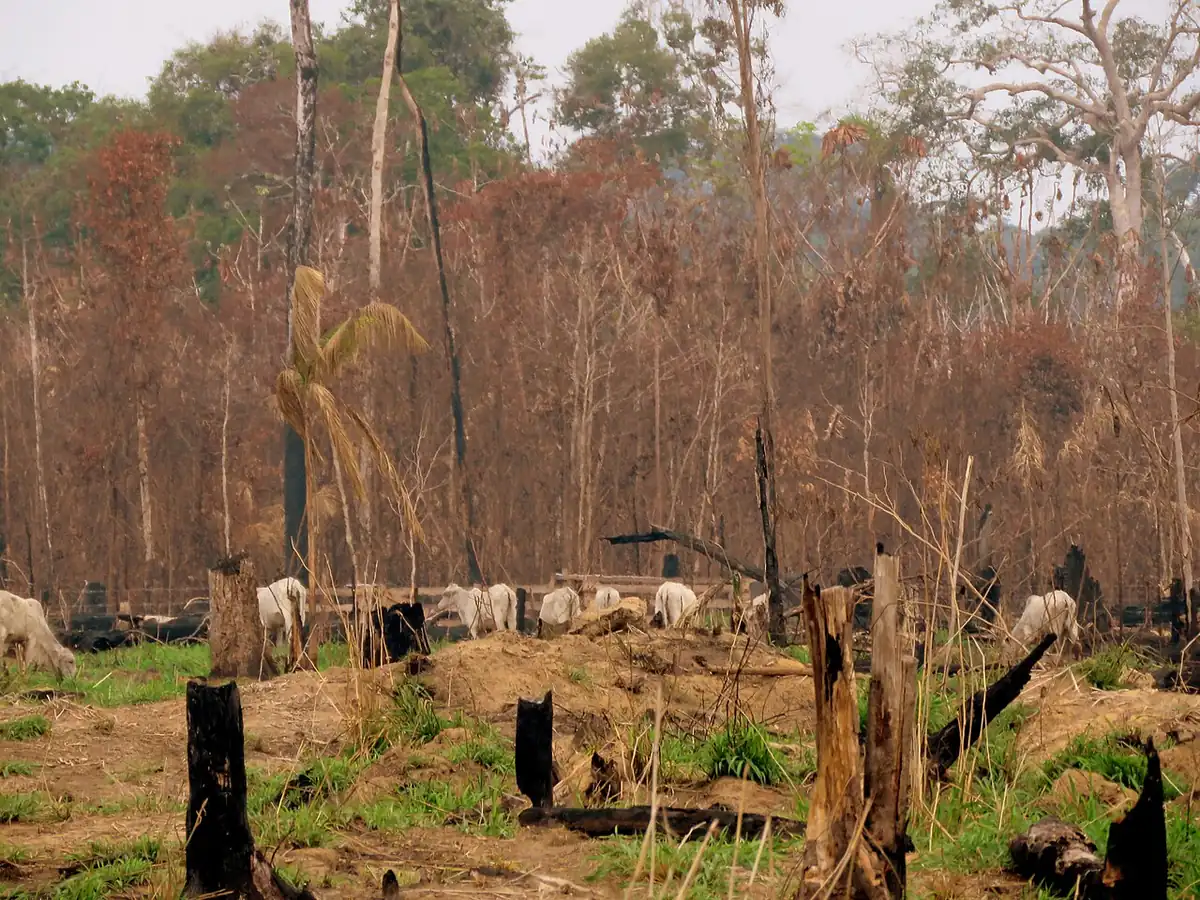
soil erosionThe removal of soil by water or wind, often accelerated when vegetation is cleared or land is overused. follows once the canopy and root mat go. Heavy equatorial rain hits bare soil, washes nutrients away, and can leave lateritic or compacted ground that is poor for both forest recovery and long-term farming. Sediment enters rivers, raising beds, harming fish and shortening the life of hydropowerElectricity generated by using moving or falling water to drive turbines. reservoirAn artificial lake used to store water for supply, power generation or flood management. — so an energy project can be undermined by the deforestation that its access roads encouraged. On slopes, erosionThe wearing away and removal of rock or sediment by moving water, ice or wind. and landslides become local hazardA potential source of harm to people, property or the environment..
Economic development — the uncomfortable positive
Clearing forest has produced real income: export beef and soy, timber and minerals, damA barrier across a river that holds back water and regulates downstream flow. electricity, land for settlers, and tax or foreign exchangeForeign currencies earned through exports, tourism or other international transactions and used to pay for imports. for governments. Towns have grown along Amazonian highways; some households have escaped worse povertyA condition in which people lack sufficient income or resources to meet basic needs or participate fully in society. than they faced as landless workers elsewhere. It would be dishonest, and poor geography, to write that deforestationThe clearance of forest so that land is converted to another use. has “no benefits”. The specification’s phrase economic developmentAn improvement in economic capacity and living standards through changes in production, income and employment. invites you to state those gains and then to ask who receives them, how long they last, and what is lost.
Often the profits are uneven. A ranch or mine may generate large revenue while nearby forest communities lose hunting land, river quality and cultural sites. Boom-and-bust logging can leave a town with a damaged hinterland and fewer jobs than the first decade promised. Soil fertility on cleared plots may decline after a few years, pushing a new wave of clearance — developmentImprovement in people's living conditions and opportunities, assessed through economic, social and political measures. that consumes its own base. That is the evaluation: not “economy good, environment bad”, but “whose economy, for how long, and with what ecological bill”.
Social impacts that sit around the four
Indigenous and traditional peoples may be displaced or exposed to disease and land conflict when roads and ranches arrive. Homicides linked to land grabbing have been a grim, well-documented feature of some Amazonian frontiers; you do not need a body count, but you should recognise conflict as a social impact. Settlers can face isolation, poor services and insecure title. Nationally, citizens gain cheaper electricity or export earnings. Downstream cities may pay for muddier water and more flood variability. Health impacts include smoke from forest fires, which in dry years has closed schools and airports in Brazilian and Indonesian cities.
The Amazon as a preview, not the only forest
In the Brazilian Amazon these impacts coexist: extraordinary biodiversityThe variety of living organisms, including differences within species, between species and among ecosystems. under pressure along the “arc of deforestationThe clearance of forest so that land is converted to another use.”; a measurable carbon contribution from fire and clearance; soil loss on cattle pasture; and a genuine national developmentImprovement in people's living conditions and opportunities, assessed through economic, social and political measures. narrative around agribusiness, mining and energy. Other basins have their own versions — peatland fires and oil palm in parts of Indonesia produce especially large carbon pulses. If the paper’s map is Congolese or Indonesian, transfer the four named impacts rather than forcing Brazilian place-names onto the wrong continent.
Exam workshop — writing a balanced impacts essay
Structure: environmental paragraph (biodiversityThe variety of living organisms, including differences within species, between species and among ecosystems., carbon, soils, maybe rainfall), economic paragraph (jobs, exports, electricity versus long-term yield decline and silted damA barrier across a river that holds back water and regulates downstream flow.), social paragraph (displacement, conflict, smoke, but also income for some settlers). Then a judgement sentence: whether the developmentImprovement in people's living conditions and opportunities, assessed through economic, social and political measures. is sustainableDescribes meeting present needs while protecting the capacity of future generations to meet their own needs. depends on how fast forest is lost and how the gains are shared. Skill-wise, a choropleth of remaining forest or a graph of annual clearance versus cattle numbers is enough to attach evidence.
Worked example: annual clearance rises while soy and beef exports rise and a graph of river sediment also rises. Describe all three. Explain agriculture as the link, erosionThe wearing away and removal of rock or sediment by moving water, ice or wind. as the environmental cost, export revenue as the economic gain. Evaluate using who captures the export revenue and whether pasture yields will last.
Misconception check: a plantation of a single tree species is not a restoration of rainforest biodiversity, even if a land-cover map turns green again. And “the Amazon produces 20% of the world’s oxygen” is a popular exaggeration you should avoid; the climateThe average weather conditions and their variability in a place over a long period, usually at least 30 years. role is mainly carbon storage and regional water cycling.
Exam craft for this page (f06, note 1). Return to the figure before you add another memorised sentence. Describe the pattern or the calculation that is actually printed, name the process this lesson taught, and only then evaluate what the evidence cannot show. A controlled paragraph of that kind is worth more than a longer paragraph that could have been written without looking at the insert. If the command word is compare, give one shared feature and one difference; if it is explain, give a because clause; if it is assess, end with a judgement that uses a criterion such as sustainability, equity or uncertainty. Practise saying the named specification terms out loud so they appear naturally under time pressure rather than as a panicked list at the end. Teachers can see the difference because your last sentence will answer the question that was asked, not a neighbouring question from revision notes.
Exam craft for this page (f06, note 2). Return to the figure before you add another memorised sentence. Describe the pattern or the calculation that is actually printed, name the process this lesson taught, and only then evaluate what the evidence cannot show. A controlled paragraph of that kind is worth more than a longer paragraph that could have been written without looking at the insert. If the command word is compare, give one shared feature and one difference; if it is explain, give a because clause; if it is assess, end with a judgement that uses a criterion such as sustainability, equity or uncertainty. Practise saying the named specification terms out loud so they appear naturally under time pressure rather than as a panicked list at the end. Teachers can see the difference because your last sentence will answer the question that was asked, not a neighbouring question from revision notes.
Exam craft for this page (f06, note 3). Return to the figure before you add another memorised sentence. Describe the pattern or the calculation that is actually printed, name the process this lesson taught, and only then evaluate what the evidence cannot show. A controlled paragraph of that kind is worth more than a longer paragraph that could have been written without looking at the insert. If the command word is compare, give one shared feature and one difference; if it is explain, give a because clause; if it is assess, end with a judgement that uses a criterion such as sustainability, equity or uncertainty. Practise saying the named specification terms out loud so they appear naturally under time pressure rather than as a panicked list at the end. Teachers can see the difference because your last sentence will answer the question that was asked, not a neighbouring question from revision notes.
Exam craft for this page (f06, note 4). Return to the figure before you add another memorised sentence. Describe the pattern or the calculation that is actually printed, name the process this lesson taught, and only then evaluate what the evidence cannot show. A controlled paragraph of that kind is worth more than a longer paragraph that could have been written without looking at the insert. If the command word is compare, give one shared feature and one difference; if it is explain, give a because clause; if it is assess, end with a judgement that uses a criterion such as sustainability, equity or uncertainty. Practise saying the named specification terms out loud so they appear naturally under time pressure rather than as a panicked list at the end. Teachers can see the difference because your last sentence will answer the question that was asked, not a neighbouring question from revision notes.
Exam craft for this page (f06, note 5). Return to the figure before you add another memorised sentence. Describe the pattern or the calculation that is actually printed, name the process this lesson taught, and only then evaluate what the evidence cannot show. A controlled paragraph of that kind is worth more than a longer paragraph that could have been written without looking at the insert. If the command word is compare, give one shared feature and one difference; if it is explain, give a because clause; if it is assess, end with a judgement that uses a criterion such as sustainability, equity or uncertainty. Practise saying the named specification terms out loud so they appear naturally under time pressure rather than as a panicked list at the end. Teachers can see the difference because your last sentence will answer the question that was asked, not a neighbouring question from revision notes.
Exam craft for this page (f06, note 6). Return to the figure before you add another memorised sentence. Describe the pattern or the calculation that is actually printed, name the process this lesson taught, and only then evaluate what the evidence cannot show. A controlled paragraph of that kind is worth more than a longer paragraph that could have been written without looking at the insert. If the command word is compare, give one shared feature and one difference; if it is explain, give a because clause; if it is assess, end with a judgement that uses a criterion such as sustainability, equity or uncertainty. Practise saying the named specification terms out loud so they appear naturally under time pressure rather than as a panicked list at the end. Teachers can see the difference because your last sentence will answer the question that was asked, not a neighbouring question from revision notes.
Exam craft for this page (f06, note 7). Return to the figure before you add another memorised sentence. Describe the pattern or the calculation that is actually printed, name the process this lesson taught, and only then evaluate what the evidence cannot show. A controlled paragraph of that kind is worth more than a longer paragraph that could have been written without looking at the insert. If the command word is compare, give one shared feature and one difference; if it is explain, give a because clause; if it is assess, end with a judgement that uses a criterion such as sustainability, equity or uncertainty. Practise saying the named specification terms out loud so they appear naturally under time pressure rather than as a panicked list at the end. Teachers can see the difference because your last sentence will answer the question that was asked, not a neighbouring question from revision notes.
Common misconceptions
Not quite: Deforestation has only negative impacts.
Instead: It has generated jobs, exports, land and electricity for some groups. The question is how those gains weigh against lasting losses.
Not quite: Once trees are planted, biodiversity is restored.
Instead: A single-species plantation is not the same ecosystem as a primary or diverse secondary forest.
Not quite: Soil in a cleared rainforest plot stays rich for generations.
Instead: Heavy rain and the loss of the nutrient-holding vegetation often produce a rapid fertility decline.
Exam tips
Lead with the named four
{Biodiversity, climate, economic development, soil erosion} should appear early, each with a mechanism.
Treat development as double-edged
State {who gains income} and {how long the soil or forest base can support that income}.
Do not recycle oxygen myths
The important global role to write is {carbon storage} (and regional rainfall), not an invented oxygen percentage.