
What you need to know
- 5.17Causes of anthropogenic climate changeClimate change caused by human activities, mainly through increased greenhouse gas emissions., including greenhouse gasA gas, such as CO₂ or methane, that absorbs infrared radiation in the atmosphere. in the greenhouse effectWarming of the Earth’s surface because gases in the atmosphere absorb infrared radiation emitted by the Earth and re-emit some of it back..
Evidence types and correlation versus cause are 5C 5–6. This lesson is the mechanism. Do not treat a glasshouse pane as identical physics.
By the end, you should be able to…
- Describe how greenhouse gases absorb outgoing long-wave infrared.
- Distinguish the natural greenhouse effect from the enhanced, anthropogenic effect.
- Link named human activities to extra carbon dioxide and methane.
Build your understanding
A habitable blanket, then a thicker one
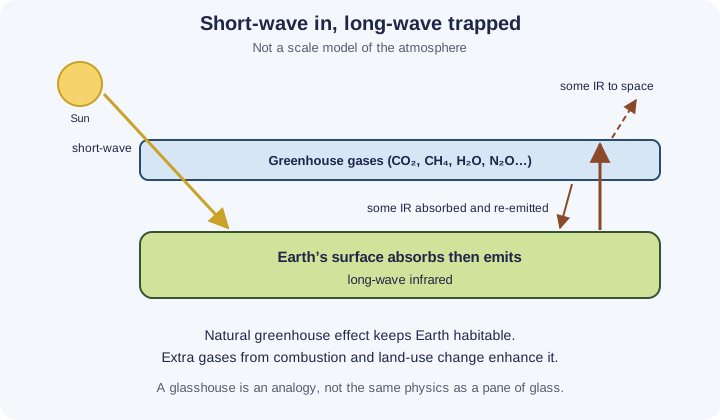
Short-wave radiation from the Sun reaches Earth’s surface. The warm surface emits long-wave infrared. greenhouse gasA gas, such as CO₂ or methane, that absorbs infrared radiation in the atmosphere. in the atmosphere — including carbon dioxide, methane, water vapour, nitrous oxide and CFCs — absorb some of that infrared and re-emit it, so less heat is lost straight to space. NASA describes this as the process that keeps the surface far warmer than it would be without those gases.
That natural greenhouse effectWarming of the Earth’s surface because gases in the atmosphere absorb infrared radiation emitted by the Earth and re-emit some of it back. is not a problem; without it the planet would be too cold for the biosphere we know. anthropogenic climate changeClimate change caused by human activities, mainly through increased greenhouse gas emissions. is extra warming from human greenhouse-gas emissions: an enhanced greenhouse effectExtra warming caused by human activities increasing the concentration of greenhouse gases..
Where the extra gases come from
Combustion of fossil fuelCoal, oil or natural gas, formed from organisms over millions of years. Burning it releases stored carbon as CO₂. and of forests adds carbon dioxide. Cement production adds more. Land-use change both emits CO₂ and removes a sink. Methane comes from ruminants, rice paddies, landfills and leaks from fossil-fuel systems. Nitrous oxide is linked to fertilisers. CFCs are industrial; many are controlled, but they are still greenhouse gases.
Water vapour is a greenhouse gas and a feedback: warmer air holds more of it. It is not treated as the primary human emission in 5.17. Do not write that “steam from cooling towers is the main cause”.
Mechanism before politics
The physics does not depend on who funded the graph. Extra greenhouse gases change the energy balance; climate is the long-term expression of that. Weather is still variable from day to day. One cold week does not falsify an enhanced greenhouse effect, and one heatwave does not by itself prove it — that evaluation is 5C 5.
“The greenhouse effect” and “the ozone hole” are different. Ozone depletion is a separate UV story. CFCs appear in both conversations; do not merge the mechanisms.
| Natural greenhouse effect | Enhanced (anthropogenic) | |
|---|---|---|
| Gases | CO₂, methane, water vapour already present | Extra CO₂, methane, N₂O, CFCs from human activity |
| Result | Earth warm enough for liquid water and life | Additional trapping of long-wave infrared |
| Timescale of the extra | Pre-industrial baseline | Industrial combustion and land-use change |
Make your reasoning visible
Name infrared
“Gases trap heat” is weaker than “they absorb outgoing long-wave radiation”.
Keep ozone separate
Unless a question links CFCs to both, do not explain climate with a hole in the ozone layer.
Avoid this misconception
The claim: The greenhouse effectWarming of the Earth’s surface because gases in the atmosphere absorb infrared radiation emitted by the Earth and re-emit some of it back. is pollution, so we should remove all greenhouse gasA gas, such as CO₂ or methane, that absorbs infrared radiation in the atmosphere..
The correction: The natural effect is why the surface is habitable. The specification concern is the extra, human-driven enhancement.
Order the greenhouse effect
The greenhouse effect is about two kinds of radiation: what arrives and what the Earth gives out. Order the chain.
Order the steps
What to do
- Reorder the cards below: drag a card (on a touch screen, drag its number), tap a card then tap where it goes, or use the ↑ and ↓ arrows at its right.
- Press Check under the cards to mark each one green (right place) or red; the count shows how many are right.
- Stuck? Hint first outlines the first wrong place, then gives a clue, then places that step for you.
- Shuffle mixes the cards again; Start again returns them to the starting order. Keyboard: Space picks up, arrow keys move, Space drops.
Put the greenhouse effect in order, from sunlight to a warmer planet.
1 of 6 in the right place
The natural greenhouse effect keeps the Earth habitable; only the enhanced effect causes the recent warming. Clouds, ice and oceans are left out.
Check your understanding
Try each question before opening the suggested answer.
Practice question
Retrieval and explanation · suggested answer
Describe the greenhouse effect.
Show suggested answer
Short-wave radiation warms the surface; the surface emits long-wave infrared; greenhouse gases absorb some of that infrared and re-emit it, reducing loss of heat to space.
Practice question
Retrieval and explanation · suggested answer
What is meant by anthropogenic climate change in 5.17?
Show suggested answer
Climate change caused by human activity, including extra greenhouse-gas emissions that enhance the greenhouse effect.
Practice question
Retrieval and explanation · suggested answer
Give two human sources of extra carbon dioxide and one of methane.
Show suggested answer
CO₂: fossil-fuel combustion and deforestation (or cement). Methane: livestock, rice, landfill or fossil-fuel leaks.
Take the idea further
Apply the same specification knowledge to an unfamiliar problem. Any extra assumptions are supplied in the question.
Stretch question
A student writes that a glasshouse stays warm because glass “is a greenhouse gas”. Correct the analogy.
Show a hint
Gases absorb infrared; glass is a different barrier.
Explore the reasoning
A horticultural glasshouse mainly reduces convection and traps warm air. Atmospheric greenhouse gases absorb and re-emit infrared. The name is an analogy. Glass is not a greenhouse gas, and 5.17 needs the radiation mechanism.
Recall this lesson
Lesson recall questions
Question 1 of 5: Compare the natural greenhouse effect with the anthropogenic (enhanced) greenhouse effect.
Anthropogenic greenhouse effect
Practice question
Retrieval and explanation · suggested answer
Compare the natural greenhouse effect with the anthropogenic (enhanced) greenhouse effect.
Lesson: 5C 4: Greenhouse Gases and Climate Change
Try this from memory first.
Put your biology to work
Explore where these ideas appear in the world. Enrichment, not extra required recall.
NASA’s blanket, with numbers left off the syllabus
5C · Greenhouse Gases and Climate ChangeNASA’s greenhouse-effect FAQ names carbon dioxide, methane, ozone, nitrous oxide, CFCs and water vapour, and notes that without carbon dioxide the terrestrial greenhouse effect would collapse. Those physical…Specification 5.17Read & use the scienceClose article
Why this matters
NASA’s greenhouse-effect FAQ names carbon dioxide, methane, ozone, nitrous oxide, CFCs and water vapour, and notes that without carbon dioxide the terrestrial greenhouse effect would collapse. Those physical claims are the context for 5.17. Their temperature offsets are enrichment, not extra recall. A climate scientist separates the natural greenhouse effect from the extra forcing caused by rising concentrations. Water vapour also responds to warming, so its role as feedback should not be confused with an unlimited source of initial forcing.
Back to the specification
Pearson Edexcel IAL Biology · Issue 2, February 2021 · Unit 4, pp. 29–32. The application extends beyond required recall.
- 5.17 understand the causes of anthropogenic climate change, including the role of greenhouse gases in the greenhouse effect
Use the science
Why is “Earth would freeze without CO₂” not an argument for unlimited emissions?
Explore a possible response
It describes the natural effect. Extra CO₂ still enhances trapping. Habitable and “more of the same is harmless” are different claims.
Explore the source
The greenhouse blanket has different threads
5C · Greenhouse Gases and Climate ChangeClimate headlines often treat every greenhouse gas as interchangeable. NASA’s explanation distinguishes carbon dioxide, methane, water vapour and other gases; they absorb outgoing infrared radiation but have different…Specification 5.17Read & use the scienceClose article
Why this matters
Climate headlines often treat every greenhouse gas as interchangeable. NASA’s explanation distinguishes carbon dioxide, methane, water vapour and other gases; they absorb outgoing infrared radiation but have different sources and behaviour. Water vapour largely responds to temperature, while human activity directly adds substantial carbon dioxide and methane. Calling the atmosphere a “blanket” is a useful image for energy retention, but no literal layer traps heat under a roof. The specification asks for the enhanced greenhouse effect and anthropogenic causes. Explaining the mechanism is stronger than repeating a dramatic temperature headline without its baseline or context.
Back to the specification
Pearson Edexcel IAL Biology · Issue 2, February 2021 · Unit 4, pp. 29–32. The application extends beyond required recall.
- 5.17 understand the causes of anthropogenic climate change, including the role of greenhouse gases in the greenhouse effect
Use the science
Why does the existence of a natural greenhouse effect not show that extra carbon dioxide is harmless?
Explore a possible response
The natural effect makes Earth habitable; increasing greenhouse-gas concentration can increase infrared absorption and alter the energy balance.