
What you need to know
- 5.13How the nicheThe role of a species in its habitat: how it uses biotic and abiotic resources and interacts with other organisms. concept accounts for distribution and abundance in a habitatThe place where an organism lives..
4C 3 defined niche and classified adaptations. This lesson uses niche to explain ecological patterns. Competitive exclusion is the idea, not a required scientist’s name. Speciation from isolation is 5C.
By the end, you should be able to…
- Restate niche as role, including resources and conditions.
- Explain abundance using niche overlap and competitive exclusionWhen two species compete for the same limited resources, the better competitor eventually removes the other from the habitat..
- Apply the idea to a gradient such as a rocky shore or woodland layer.
Build your understanding
Role explains the map
A nicheThe role of a species in its habitat: how it uses biotic and abiotic resources and interacts with other organisms. is the role of a speciesA group of organisms that can interbreed to produce fertile offspring. in its habitatThe place where an organism lives.: resources used, conditions tolerated, and interactions. 5.13 asks you to use that idea to explain distribution and abundance. If two barnacle species feed in the same way but one tolerates longer drying, they will not be equally abundant at every shore height even in the same habitat.
The fundamental niche is where abioticNon-living. Abiotic factors include light, temperature, water and soil pH. conditions would allow the species to live. The realised niche is where it actually lives once competitors, predators and other bioticLiving. Biotic factors include competition, predation and disease. factors are included. Those two extra words are useful; they are not extra specification codes. The point is that biotic factors can shrink the map inside an abiotic envelopeAn outer covering membrane. The nucleus and chloroplasts have a double-membrane envelope; some viruses, such as HIV, have a lipid envelope taken from the host cell..
Overlap and exclusion
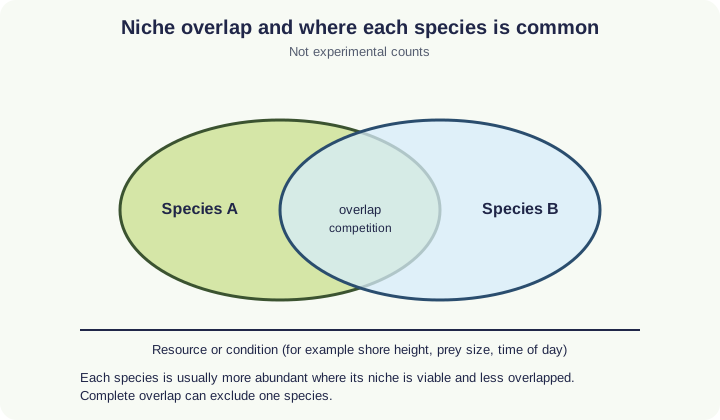
When niches overlap, interspecific competitionCompetition between individuals of different species for the same resources. increases. If overlap is almost complete and one species is a consistently better competitor, it can exclude the other — competitive exclusionWhen two species compete for the same limited resources, the better competitor eventually removes the other from the habitat.. If niches differ even slightly (prey size, feeding time, rooting depth), both can persist and each is more abundant where its own niche is a better match.
Absence is not proof of exclusion. The species may never have arrived, the abiotic factor may be wrong, or sampling may have missed a rare populationAll the individuals of one species living in one area at the same time.. Offer the niche explanation when the question gives overlapping roles, not as a default for every empty quadratA square frame of known area used to sample organisms..
Abundance follows the better match
Along a gradient, each species tends to peak where its niche is viable and less overlapped. That produces zonation: bands of different dominantAn allele that is expressed in the phenotype whenever it is present. species. Zonation is a pattern; niche plus abiotic and biotic factors is the explanation.
Humans can change niches: fertiliser alters mineral-ion availability, fishing removes a predator, trampling changes soil. Distribution then shifts without the species “choosing” a new job.
| Idea | Question it answers |
|---|---|
| Habitat | Where is the place? |
| Niche | What role does the species play there? |
| Distribution | Where in that place is it actually found? |
| Abundance | How many / how much cover is there? |
Make your reasoning visible
Finish with abundance or location
“They have different niches” is incomplete until you say who is common where, and why.
Do not recycle 4.19 types unless asked
5.13 is about maps of numbers, not listing anatomical versus behavioural.
Avoid this misconception
The claim: If two speciesA group of organisms that can interbreed to produce fertile offspring. live in the same habitatThe place where an organism lives. they must occupy the same nicheThe role of a species in its habitat: how it uses biotic and abiotic resources and interacts with other organisms., so one must die out.
The correction: A habitat can hold many niches. Exclusion is likely only if roles overlap so far that they are effectively the same.
Check your understanding
Try each question before opening the suggested answer.
Practice question
Retrieval and explanation · suggested answer
How can the niche concept explain why a species is abundant in only part of a habitat?
Show suggested answer
The species’ role — resources and tolerated conditions — matches that part better, and overlap with competitors may be lower there, so numbers peak in that zone.
Practice question
Retrieval and explanation · suggested answer
What is competitive exclusion?
Show suggested answer
When niches overlap strongly, the better competitor can eliminate the other from the habitat or from that part of it.
Practice question
Retrieval and explanation · suggested answer
Why can two insect species share one oak tree without excluding each other?
Show suggested answer
They may use different parts, prey sizes or times of day, so their niches overlap only partly and both can persist.
Take the idea further
Apply the same specification knowledge to an unfamiliar problem. Any extra assumptions are supplied in the question.
Stretch question
Species P occupies mid-shore when Q is absent, but only the lower shore when Q is present. Interpret using fundamental and realised niche language, with an assumption.
Show a hint
Q is probably shrinking P’s map.
Explore the reasoning
The mid-shore is within P’s abiotic (fundamental) niche. Q, assumed to be a stronger competitor there, restricts P to a realised niche on the lower shore. If Q is not competing but eating P, the same realised-niche shrink still holds, but the biotic factor is predation rather than competition.
Recall this lesson
Lesson recall questions
Question 1 of 5: Compare habitat with niche.
Niche, distribution and abundance
Practice question
Retrieval and explanation · suggested answer
Compare habitat with niche.
Lesson: 5B 5: Ecosystem Interactions and the Importance of the Niche
Try this from memory first.
Put your biology to work
Explore where these ideas appear in the world. Enrichment, not extra required recall.
Why the world is not one winner per habitat
5B · Ecosystem Interactions and the Importance of the NicheScitable’s account of species diversity sets the competitive exclusion principle against the fact that many species coexist. Niche differences, such as eating different seed sizes, can prevent exclusion.…Specification 5.13Read & use the scienceClose article
Why this matters
Scitable’s account of species diversity sets the competitive exclusion principle against the fact that many species coexist. Niche differences, such as eating different seed sizes, can prevent exclusion. That is the research version of 5.13: roles explain maps. Gause’s laboratory flasks are the simplified extreme, not a required practical. A niche includes resource use and environmental tolerances, not just an address. Two species can occupy the same habitat while feeding at different times or on different foods, so their population maps alone do not specify their niches.
Back to the specification
Pearson Edexcel IAL Biology · Issue 2, February 2021 · Unit 4, pp. 29–32. The application extends beyond required recall.
- 5.13 understand how the concept of niche accounts for the distribution and abundance of organisms in a habitat
Use the science
Why do laboratory flasks overstate how often exclusion happens in a dune system?
Explore a possible response
A flask is one homogeneous niche. Dunes have gradients of water, salt and disturbance, so different realised niches can sit a few metres apart.
Explore the source
- Scitable: the maintenance of species diversityNature Education