
What you need to know
- 4.20(iii)reproductive isolationWhen two populations can no longer interbreed to produce fertile offspring., accumulation of different genetic information, and potential speciationThe formation of a new species, when populations become reproductively isolated and their gene pools change..
- 4.20(ii)mutationA change in the sequence of bases in DNA. and natural selectionIndividuals with alleles that give an advantage are more likely to survive and reproduce, so those alleles become more common over generations. change allele frequencyHow common an allele is in a gene pool, as a proportion of all the alleles of that gene..
Allopatric and sympatric are useful teaching words for isolation with or without a geographic barrier; the specification’s required chain is isolation → different genetic information → potential new species. Detailed rates of speciation and named case studies are not extra recall unless a question supplies them.
By the end, you should be able to…
- State what reproductive isolation means for gene flowMovement of alleles between populations when individuals migrate and interbreed..
- Give examples of isolation mechanisms.
- Link isolation to new speciesA group of organisms that can interbreed to produce fertile offspring. using the biological species idea.
Build your understanding
Stop the alleles mixing
reproductive isolationWhen two populations can no longer interbreed to produce fertile offspring. means gene flowMovement of alleles between populations when individuals migrate and interbreed. between groups has stopped or is greatly reduced. They no longer share one freely mixing gene poolAll the alleles of all the genes in a population.. Isolation can be geographic, such as a mountain range, river or island. It can also occur in the same region: different breeding seasons, different courtshipBehaviour that lets organisms recognise and attract a mate of the same species. Different courtship can reproductively isolate populations., incompatible genitalia, or hybridA mix of two different sources: the offspring of two different species (usually infertile), or a DNA molecule with one strand from each source. that are sterile, as with horses and donkeys in 4B.
Without isolation, a new mutationA change in the sequence of bases in DNA. in one valley can spread through the whole speciesA group of organisms that can interbreed to produce fertile offspring.. With isolation, that mutation stays put. The two groups then have the chance to diverge.
Different information accumulates
Mutation still occurs in both groups, but not the same mutations. natural selectionIndividuals with alleles that give an advantage are more likely to survive and reproduce, so those alleles become more common over generations. can also differ if their habitatThe place where an organism lives. or niches differ, so allele frequencyHow common an allele is in a gene pool, as a proportion of all the alleles of that gene. change in different directions. Over generations the genetic information in each populationAll the individuals of one species living in one area at the same time. is no longer the same set.
You can detect that with Hardy–WeinbergEquations p + q = 1 and p² + 2pq + q² = 1 that predict allele and genotype frequencies in a large population that is not evolving. thinking from 4C 4: p and q in group 1 need not match group 2. Molecular comparisons, as in 4B, may later show two clusters. Isolation is the condition that allows that divergence; it is not itself a mutation.
When they have become species
If the groups can no longer interbreed to produce fertile offspring, they meet the biological species conceptDefining a species as a group of organisms that can interbreed to produce fertile offspring and are reproductively isolated from other groups.. Specification 4.20 says this can potentially lead to new species; isolation does not guarantee speciationThe formation of a new species, when populations become reproductively isolated and their gene pools change. on a school timescale, and some isolated populations still interbreed if the barrier falls.
That is why 4B and 4C belong together. classificationSorting organisms into groups based on shared features and evolutionary relationships. needs a species unit. Speciation is one process that creates those units. Asexual organisms, fossils and hybrid zones still limit a purely breeding-based story, as 4B already warned.
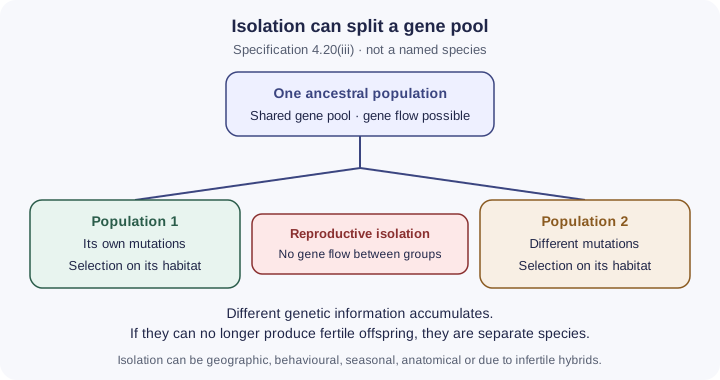
| Stage | What happens to alleles | What you might observe |
|---|---|---|
| One population | Gene flow across the range | Shared gene pool; Hardy–Weinberg may apply |
| Reproductive isolation | Gene flow stops | Geographic, behavioural, seasonal, anatomical or hybrid barriers |
| Accumulation | Mutation and selection differ between groups | Different allele frequencies and traits |
| New species (potential) | Fertile offspring no longer produced | Biological species criterion is met |
Make your reasoning visible
Name the missing gene flow
“They live far apart” is weaker than “they cannot exchange alleleA different version of the same gene, found at the same locus., so their geneA sequence of DNA bases that codes for a polypeptide or a functional RNA. pools can diverge”.
Keep fertility
A hybridA mix of two different sources: the offspring of two different species (usually infertile), or a DNA molecule with one strand from each source. that lives but is sterile still counts as isolation under the biological species conceptDefining a species as a group of organisms that can interbreed to produce fertile offspring and are reproductively isolated from other groups..
Avoid this misconception
The claim: If two populationAll the individuals of one species living in one area at the same time. look different they have already speciated.
The correction: Appearance can change inside one speciesA group of organisms that can interbreed to produce fertile offspring.. speciationThe formation of a new species, when populations become reproductively isolated and their gene pools change., on the biological definition, requires that they no longer produce fertile offspring.
Order natural selection and speciation
Natural selection changes allele frequencies. If two groups are isolated, the changes can make them separate species. Order each chain.
Order the steps
What to do
- Pick a chain with Chain, just below these steps: Natural selection or Allopatric speciation.
- Reorder the cards below: drag a card (on a touch screen, drag its number), tap a card then tap where it goes, or use the ↑ and ↓ arrows at its right.
- Press Check under the cards to mark each one green (right place) or red; the count shows how many are right.
- Stuck? Hint first outlines the first wrong place, then gives a clue, then places that step for you.
- Shuffle mixes the cards again; Start again returns them to the starting order. Keyboard: Space picks up, arrow keys move, Space drops.
The climate changes. Put natural selection in order.
0 of 5 in the right place
Speciation usually takes many generations. Sympatric speciation (for example by behaviour or polyploidy) has no geographical barrier and is not ordered here.
Check your understanding
Try each question before opening the suggested answer.
Practice question
Retrieval and explanation · suggested answer
What does reproductive isolation do to a gene pool?
Show suggested answer
It stops or greatly reduces gene flow, so the groups no longer share one freely mixing set of alleles.
Practice question
Retrieval and explanation · suggested answer
Give two different types of reproductive isolation.
Show suggested answer
Any two of: geographic barrier, different breeding season, different courtship, anatomical incompatibility, sterile hybrids.
Practice question
Retrieval and explanation · suggested answer
How can isolation lead to new species?
Show suggested answer
Different mutations and selection accumulate in each group. If they can no longer produce fertile offspring, they are separate species.
Take the idea further
Apply the same specification knowledge to an unfamiliar problem. Any extra assumptions are supplied in the question.
Stretch question
A river is diverted and two fish populations meet again after a long separation. Some hybrids are fertile. Have they speciated? What extra evidence would you want?
Show a hint
Potential gene flow versus completed isolation.
Explore the reasoning
Not fully, on the biological concept, because fertile hybrids mean gene flow can resume. You would want hybrid frequency, fitness, and whether allele frequencies remain distinct. They may be diverging populations rather than completed species.
Recall this lesson
Lesson recall questions
Question 1 of 5: In Hardy–Weinberg, 2pq is the frequency of ________.
Hardy–Weinberg, selection and isolation
Practice question
Retrieval and explanation · suggested answer
In Hardy–Weinberg, 2pq is the frequency of ________.
Lesson: 4C 4: Gene Pool and Genetic Diversity
Try this from memory first.
Put your biology to work
Explore where these ideas appear in the world. Enrichment, not extra required recall.
Speciation is evolution at the gene-pool boundary
4C · Reproductive Isolation and SpeciationNHGRI’s evolution glossary describes genomic variation, differential reproductive success and change over generations. Reproductive isolation is the extra condition that stops those changes being shared. The same genomic…Specification 4.20(iii)Read & use the scienceClose article
Why this matters
NHGRI’s evolution glossary describes genomic variation, differential reproductive success and change over generations. Reproductive isolation is the extra condition that stops those changes being shared. The same genomic processes that alter p and q inside one population can, if gene flow is cut, produce two. Geographic separation can reduce gene flow, but separation alone is not speciation. Over generations, mutation, selection and drift may change allele frequencies in different directions. Reproductive barriers must ultimately limit exchange even when populations meet again. A geneticist looks for evidence of divergence and barriers rather than deciding from a single visible difference. The source offers the broader idea of evolution; the spec point adds the explicit mechanism of isolation and accumulation of genetic differences.
Back to the specification
Pearson Edexcel IAL Biology · Issue 2, February 2021 · Unit 2, pp. 21–24. The application extends beyond required recall.
- 4.20(iii) understand that reproductive isolation can lead to accumulation of different genetic information in populations, potentially leading to the formation of new species
Use the science
Why is a fence that lasts one season unlikely to create new species?
Explore a possible response
Allele frequencies need time, mutation and selection to diverge, and gene flow can restart when the fence comes down.
Explore the source
- NHGRI: evolutionNational Human Genome Research Institute
A new plant lineage after chromosome doubling
4C · Reproductive Isolation and SpeciationResearch on Tragopogon plants documents recently formed polyploid lineages after hybridisation and chromosome doubling. Such lineages can have reproductive barriers with their parental populations, making them useful cases…Specification 4.20(iii)Read & use the scienceClose article
Why this matters
Research on Tragopogon plants documents recently formed polyploid lineages after hybridisation and chromosome doubling. Such lineages can have reproductive barriers with their parental populations, making them useful cases for studying speciation. The full genomic story is enrichment. The Unit 2 point is that restricted gene flow allows genetic differences to accumulate and can eventually establish a new species. A scientist would compare chromosome numbers, fertility and DNA across populations rather than decide from one flower’s shape. Polyploidy can create a barrier relatively quickly in plants, but a single odd chromosome count does not establish a stable species.
Back to the specification
Pearson Edexcel IAL Biology · Issue 2, February 2021 · Unit 2, pp. 21–24. The application extends beyond required recall.
- 4.20(iii) understand that reproductive isolation can lead to accumulation of different genetic information in populations, potentially leading to the formation of new species
Use the science
What evidence beyond an unusual chromosome number would support a new Tragopogon species?
Explore a possible response
A stable reproducing population, limited gene flow with parental groups, and consistent genetic or phenotypic differences would support the claim.