
What you need to know
- 2.15(i)geneA sequence of DNA bases that codes for a polypeptide or a functional RNA., alleleA different version of the same gene, found at the same locus., genotypeThe alleles an organism has for a gene., phenotypeThe observable characteristics of an organism, produced by its genotype interacting with the environment., dominance, recessiveness, codominance and zygosity.
- 2.15(ii)monohybridA genetic cross that follows the inheritance of one gene. inheritance and pedigree interpretation.
All families and examples are fictional. Pedigree deductions assume the inheritance model stated in each question; do not use these exercises to infer information about your own family.
By the end, you should be able to…
- Define genetic terms in context.
- Construct a monohybrid cross from parental genotypes.
- Use a pedigree to infer possible genotypes and state uncertainty.
Build your understanding
Separate the terms
A geneA sequence of DNA bases that codes for a polypeptide or a functional RNA. is a DNADeoxyribonucleic acid: a double-stranded polynucleotide that carries the genetic code. sequence coding for a polypeptideA chain of many amino acids joined by peptide bonds. in the definition used here. An allele is an alternative version of a gene at the same locusThe position of a gene on a chromosome.. genotypeThe alleles an organism has for a gene. describes the alleleA different version of the same gene, found at the same locus. present; phenotypeThe observable characteristics of an organism, produced by its genotype interacting with the environment. is an observable characteristic influenced by genotype and, often, environment.
A homozygousHaving two identical alleles of a gene. has two identical alleles at a locus; a heterozygousHaving two different alleles of a gene. has two different alleles. With complete dominance, the dominantAn allele that is expressed in the phenotype whenever it is present. allele determines the heterozygote phenotype and the recessiveAn allele that is expressed in the phenotype only when no dominant allele is present (when homozygous). phenotype appears when no dominant allele is present. Dominant does not mean common, beneficial or more likely to be inherited.
Work from parents to gametes to offspring
Use F for a functional allele and f for a recessive condition-causing allele in this simplified autosomal model. For Ff × Ff, each parent produces F and f gameteA haploid sex cell, such as a sperm or an egg cell. with equal probability. Combining one gamete from each gives FF, Ff, Ff and ff.
The genotype ratio is 1 FF : 2 Ff : 1 ff, and the phenotype ratio is 3 without the recessive condition : 1 with it. These are probabilities over many offspring, not a required pattern in every family of four. Each conception is a new event under the model.
Codominance shows both allele effects
In codominance, both alleles contribute distinctly to the heterozygote phenotype. The ABO example IᴬIᴮ produces both A and B antigenA molecule, often a protein or glycoprotein on a cell surface, that the immune system recognises as non-self., giving group AB. This is not a blend into a new intermediate antigen. Iᴬ and Iᴮ are each dominant to i.
For Iᴬi × Iᴮi, the four equally likely genotypes are IᴬIᴮ, Iᴬi, Iᴮi and ii: groups AB, A, B and O. Use superscripts and an explicit key so the allele symbols remain clear.
Read a pedigree using a stated model
A pedigree uses symbols and connecting lines to show family relationships and a phenotype. Read its key: a filled symbol commonly indicates the phenotype being studied, but it does not automatically identify heterozygotes. Start with individuals whose genotype is certain and use their relationships to constrain others.
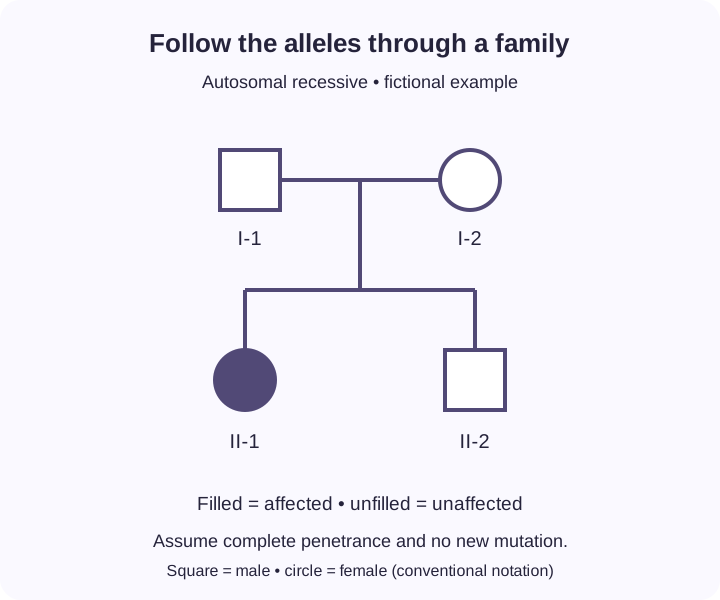
In the fictional pedigree below, two parents without an autosomal recessive condition have an affected child. Under the stated assumptions, both parents must be Ff and the affected child ff. A child without the condition could be FF or Ff; the phenotype alone cannot choose between them.
A pattern that skips generations can support recessive inheritance, but a small pedigree alone may fit several models. State assumptions such as complete penetrance, no new mutationA change in the sequence of bases in DNA. and reliable phenotype information rather than treating a pattern as proof.
NOT: dominant does not mean common, and it is not inherited more often.
- FF and Ff are unaffected if F is completely dominant
- Each conception is a new 1 in 4 chance of ff
- An unaffected child of two carriers has a 2 in 3 chance of being Ff
- Codominance, as in AB blood group, shows both allele products
Two traps this diagram blocks
- Do not say a heterozygote passes on the dominant allele more often than the recessive allele.
- Do not treat a 1 in 4 chance as a rule that one of every four children must be affected.
From the diagram alone
Question
Two carriers of an autosomal recessive allele, Ff, have a child. State the probability that the child is affected, and explain how you obtained it. [3]
Show a model answer
The probability is 1/4. Each parent produces an f gamete with probability 1/2, and the child is ff only if both gametes are f. 1/2 × 1/2 = 1/4. FF and the two Ff genotypes are unaffected if F is completely dominant.
| Gamete from one parent | F from the other parent | f from the other parent |
|---|---|---|
| F | FF | Ff |
| f | Ff | ff |
Make your reasoning visible
Show the full cross
Include alleleA different version of the same gene, found at the same locus. key, parental genotypes, gameteA haploid sex cell, such as a sperm or an egg cell., offspring genotypes and the requested probability or ratio.
Do not turn probability into a promise
A 25% chance applies to each conception in the model. Previous outcomes do not use up any genotypeThe alleles an organism has for a gene..
Keep unknown genotypes unknown
Use F_ or “FF or Ff” for an unaffected individual when both remain possible.
Key explanations
- For Ff × Ff, each parent produces F and f gametes in equal proportion. Dominance does not change that proportion.
- Random combination gives FF, Ff, Ff and ff, a genotype ratio of 1:2:1.
- These are probabilities. A family of four need not contain exactly one affected child, and earlier children do not use up the chance.
- An unaffected child of those parents may be FF or Ff. Given that the child is unaffected, the chance of being a carrier is 2/3.
Avoid this misconception
The claim: A dominantAn allele that is expressed in the phenotype whenever it is present. allele is inherited more often than a recessiveAn allele that is expressed in the phenotype only when no dominant allele is present (when homozygous). allele from a heterozygousHaving two different alleles of a gene..
The correction: A heterozygote passes each allele to approximately half its gametes; dominance describes expression, not transmission.
If both parents are carriers, will exactly one child in four be affected?
A Punnett square lists the four equally likely ways two gametes can meet. It gives probabilities for each conception, not a pattern every family must follow.
What the model shows
Parents, gametes and a Punnett square for autosomal crosses and ABO blood groups, with a pedigree and a running graph of a simulated family.
What to look for
How a small family differs from 3 : 1, and how the share settles as the family grows. What changes with Ff × ff and with Iᴬi × Iᴮi.
What it tells us
Ff × Ff gives 1 FF : 2 Ff : 1 ff and a ¼ chance of the condition per conception. Codominant Iᴬ and Iᴮ give group AB. An unaffected child of two carriers is a carrier with probability 2/3.
Be careful what you claim
A single-gene model with fictional families. Real inheritance can involve penetrance, new mutations and many genes.
Try it in the model: press Have a child four times. Do you get exactly one affected child?
Genetic crosses and pedigrees
Choose two parents, read their gametes and the Punnett square, then have children one at a time or a hundred at once. All families are fictional.
What you see
- Two parents with their genotype, chromosomes and phenotype, the gametes each can make, and a Punnett square of the four equally likely offspring.
- A pedigree of the children you have simulated, a graph of the share with the phenotype as the family grows, and the expected ratios beside the observed counts.
How to use it
- Choose a cross type, then each parent’s genotype, or press a preset from the lesson.
- Press Have a child for one conception, or add 10 or 100 children at once. In X-linked mode, the graph can follow all children or sons only.
What it shows
- Genetic terms and monohybrid crosses with complete dominance and codominance (ABO), including pedigree reasoning (2.15(i)–(ii)).
- X-linked inheritance of red–green colour vision deficiency, with probabilities among sons and among all children (2.15(iii)).
Limits of the model
- One gene with full penetrance and no new mutations. Real conditions and colour vision have more complexity than this.
- The families are fictional and random. A real family’s outcomes need a clinical genetics service, not this model.
- In autosomal and ABO mode the children’s sex is chosen at random (½ each) only to draw the pedigree.
Guided tour · step 1 of 8
- The parents are Ff × Ff.
- Read their gametes in the simulator.
- In Cross, just below these steps, press Have a child.
Each parent puts F or f into a gamete with probability ½. One gamete from each makes one of the four boxes, each with probability ¼.
Cross
Questions
Check your understanding
Try each question before opening the suggested answer.
Practice question
Retrieval and explanation · suggested answer
For Ff × ff, calculate the chance of the recessive phenotype.
Show suggested answer
Gametes are F or f from the first parent and f from the second. Half the offspring are Ff and half ff: 50% show the recessive phenotype.
Practice question
Retrieval and explanation · suggested answer
Two unaffected parents have an affected child in a fully penetrant autosomal recessive model with no new mutation. Infer their genotypes.
Show suggested answer
Both parents are heterozygous carriers Ff. Each must have supplied f while having a functional allele themselves.
Practice question
Retrieval and explanation · suggested answer
For Iᴬi × Iᴮi, what is the probability of group O?
Show suggested answer
Only ii gives group O. The chance is 1/2 × 1/2 = 1/4, or 25%.
Take the idea further
Apply the same specification knowledge to an unfamiliar problem. Any extra assumptions are supplied in the question.
Stretch question
An unaffected child of two Ff parents is selected. Under complete recessive inheritance, what is the probability that this child is a carrier?
Show a hint
Exclude the affected ff outcome before calculating the fraction.
Explore the reasoning
Among the unaffected outcomes FF, Ff and Ff, two of three are carriers. The conditional probability is 2/3, not 1/2. This applies only after knowing the child is unaffected.
Recall this lesson
Lesson recall questions
Question 1 of 5: State what is meant by codominance.
Monohybrid inheritance and sex linkage
Practice question
Retrieval and explanation · suggested answer
State what is meant by codominance.
Lesson: 2C 2: Patterns of Inheritance
Try this from memory first.
Put your biology to work
Explore where these ideas appear in the world. Enrichment, not extra required recall.
Explaining a probability clearly
2C · Patterns of InheritanceGenetic counsellors help people understand genetic conditions, testing and family implications. Their work includes communicating uncertainty and supporting informed choices. A genetic counsellor translates a model into language…Specification 2.15(i) · 2.15(ii)Read & use the scienceClose article
Why this matters
Genetic counsellors help people understand genetic conditions, testing and family implications. Their work includes communicating uncertainty and supporting informed choices. A genetic counsellor translates a model into language a family can use, including what a test can and cannot establish. If two carriers of an autosomal recessive condition have children, the usual model predicts a 25% affected probability for each conception. Earlier outcomes do not use up that probability. Real counselling also considers whether the assumed genotypes and condition are established. The skill is explaining conditional probability accurately while supporting choices, rather than telling a family what decision to make.
Back to the specification
Pearson Edexcel IAL Biology · Issue 2, February 2021 · Unit 1, pp. 15–18. The application extends beyond required recall.
- 2.15(i) understand what is meant by the terms gene, allele, genotype, phenotype, recessive, dominant, codominance, homozygote and heterozygote
- 2.15(ii) understand patterns of inheritance, including the interpretation of genetic pedigree diagrams, in the context of monohybrid inheritance
Use the science
How would you explain a 1-in-4 recurrence probability without implying that one of every four children must be affected?
Explore a possible response
Describe it as a 25% chance for each conception under the model; family outcomes can differ from the expected proportions.
Explore the source
Gattaca: a genotype is not a complete biography
2C · Patterns of InheritanceGattaca imagines a society that sorts people by genetic expectations. Real genetic information can be powerful, but the logic of a single-gene cross should not be applied uncritically…Specification 2.15(i) · 1.12 · 2.18Read & use the scienceClose article
Why this matters
Gattaca imagines a society that sorts people by genetic expectations. Real genetic information can be powerful, but the logic of a single-gene cross should not be applied uncritically to every human characteristic. A polygenic risk score combines information from many variants to estimate a probability; it does not include every environmental influence or predict a person’s complete future. The film provides a starting point for separating genotype, phenotype and social judgement. The scientific question comes first: what does a test actually measure, and with what uncertainty? Ethical decisions become distorted if a probability is presented as destiny.
Back to the specification
Pearson Edexcel IAL Biology · Issue 2, February 2021 · Unit 1, pp. 15–18. The application extends beyond required recall.
- 2.15(i) understand what is meant by the terms gene, allele, genotype, phenotype, recessive, dominant, codominance, homozygote and heterozygote
- 1.12 know how factors such as genetics, diet, age, gender, high blood pressure, smoking and inactivity increase the risk of cardiovascular disease (CVD)
- 2.18 be able to identify and discuss the ethical and social issues relating to genetic screening from a range of ethical viewpoints, including religious, moral and social implications
Use the science
Why would a Punnett square for one recessive condition be insufficient to predict an individual’s overall cardiovascular health?
Explore a possible response
A monohybrid cross addresses specified alleles at one locus. Cardiovascular health can involve multiple variants, exposure and behaviour; the cross omits those variables.
Explore the sources
- Polygenic Risk Score (PRS)National Human Genome Research Institute
- Member Picks: GattacaBritish Film Institute