
What you need to know
- 1.9(i)The role of haemoglobinA globular protein in red blood cells with four polypeptide chains, each with a haem group containing Fe²⁺ that binds one O₂. in oxygen and carbon dioxide transport.
- 1.9(ii)Oxygen dissociation curves, the Bohr effect and fetal haemoglobin.
Blood components provide context for transport. The clotting sequence is covered in 1B5 (1.11); detailed immune responses belong later in the course.
By the end, you should be able to…
- Explain reversible oxygen binding and the sigmoid dissociation curve.
- Explain carbon dioxide transport and haemoglobin’s buffering role.
- Compare adult and fetal haemoglobin and explain the Bohr effect.
Build your understanding
A fluid carrying specialised cells
plasmaThe liquid part of blood: water carrying dissolved substances such as glucose, ions, hormones and proteins. is the liquid component of blood. Its water transports dissolved substances, including nutrients, ureaThe main nitrogenous waste product made in the liver from ammonia, and excreted in urine. and hydrogen carbonate ions. Red blood cells contain haemoglobinA globular protein in red blood cells with four polypeptide chains, each with a haem group containing Fe²⁺ that binds one O₂.; white blood cells contribute to defence; plateletA cell fragment in the blood. At a damaged vessel wall, platelets stick together and release thromboplastin. are cell fragments involved in clotting.
Mature mammalian red blood cells have no nucleusThe organelle that contains the cell’s chromosomes, surrounded by a nuclear envelope with pores., leaving more space for haemoglobin. Their biconcave shape gives a large surface-area-to-volume ratio and a short diffusion distanceThe distance molecules have to travel. A shorter distance gives a faster rate of diffusion.. Their flexibility helps them pass through narrow capillaryA tiny vessel whose wall is a single layer of endothelium, giving a short diffusion distance for exchange with tissues.. These features support rapid gas exchange.
Loading and unloading oxygen
Haemoglobin has four haem groups, each capable of binding one oxygen molecule reversibly. Binding produces oxyhaemoglobin. At the high partial pressure of oxygen in the lungs, haemoglobin becomes highly saturated; in tissues with lower oxygen partial pressure, oxygen dissociates and can diffuse into cells.
An oxygen dissociation curve plots percentage haemoglobin saturation on the vertical axis against oxygen partial pressure, usually in kPa, on the horizontal axis. Saturation describes the proportion of available oxygen-binding sites occupied, not the amount of haemoglobin in the sample.
Loading and unloading oxygen (continued)
The curve is sigmoid, or S-shaped. Binding the first oxygen molecule changes haemoglobin’s shape, making subsequent oxygen binding easier: this is cooperative binding. The steep region allows a relatively small fall in oxygen partial pressure to cause substantial oxygen unloading. The plateau allows high loading across a range of high oxygen partial pressures.
Carbon dioxide and the Bohr effect
Some carbon dioxide is dissolved in plasma and some binds to the globin part of haemoglobin, forming carbaminohaemoglobin. Most is transported as hydrogen carbonate ions. In red blood cells, carbonic anhydrase catalyses the reaction of carbon dioxide with water to form carbonic acid, which dissociates into hydrogen ions and hydrogen carbonate ions.
Haemoglobin binds hydrogen ions, helping buffer changes in pHA measure of how acidic or alkaline a solution is, based on its H⁺ ion concentration. Below 7 is acidic, above 7 is alkaline.. Hydrogen carbonate ions move into plasma; chloride ions enter red blood cells to help maintain charge balance. At the lungs, the reactions reverse, regenerating carbon dioxide that diffuses into the alveoli and is exhaled.
Actively respiring tissues produce more carbon dioxide. The associated increase in hydrogen ions lowers pH and reduces haemoglobin’s oxygen affinity. At the same oxygen partial pressure, haemoglobin is less saturated and unloads more oxygen. This rightward shift of the oxygen dissociation curve is the Bohr effect: it helps supply oxygen where demand is greatest.
Fetal haemoglobin has a different affinity
Fetal haemoglobin has a higher affinity for oxygen than adult haemoglobin under comparable conditions. Its dissociation curve lies to the left: at a given oxygen partial pressure, fetal haemoglobin is more saturated.
At the placenta, oxygen diffuses from maternal blood to fetal blood. The higher affinity of fetal haemoglobin helps it bind oxygen at the relatively low partial pressures there. Maternal and fetal blood normally remain in separate circulations; oxygen crosses the exchange barrier rather than the two blood supplies mixing.
NOT: the Bohr effect does not make haemoglobin bind more O₂ in active tissues.
- Right shift: lower affinity, more unloading at the same pO₂
- Fetal haemoglobin sits to the left: higher affinity
- Some CO₂ binds globin: carbaminohaemoglobin
- That is not carboxyhaemoglobin, which involves carbon monoxide
Two traps this diagram blocks
- Compare curves at the same oxygen partial pressure. A left curve means higher affinity, not “more carbon dioxide”.
- Saturation is the proportion of binding sites occupied, not the volume of oxygen in the blood.
From the diagram alone
Question
Explain how increased carbon dioxide production in an active muscle increases oxygen unloading. [4]
Show a model answer
More carbon dioxide forms more carbonic acid and more hydrogen ions, so pH falls. Haemoglobin’s affinity for oxygen decreases and the dissociation curve shifts to the right. At the same oxygen partial pressure, percentage saturation is lower, so more oxygen dissociates and can diffuse into the muscle cells.
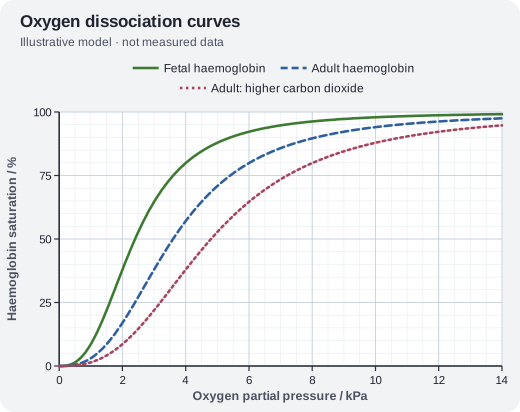
| Comparison | Saturation | Interpretation |
|---|---|---|
| Adult haemoglobin at higher CO₂: curve shifts right | Lower | Lower oxygen affinity; greater unloading |
| Fetal versus adult haemoglobin: curve lies left | Higher | Higher oxygen affinity; loading at lower partial pressure |
Make your reasoning visible
Compare at the same x-value
To compare affinities, use the same oxygen partial pressure on both curves. Read the corresponding saturations, then explain the biological consequence. A curve further left indicates higher affinity.
Saturation is not oxygen content
Two samples can have the same percentage saturation but different total oxygen contents if their haemoglobinA globular protein in red blood cells with four polypeptide chains, each with a haem group containing Fe²⁺ that binds one O₂. concentrations differ. State what the graph actually measures.
Keep the two carbon-containing compounds separate
Carbon dioxide forms carbaminohaemoglobin by binding to globin. Do not confuse this with carboxyhaemoglobin, which involves carbon monoxide.
Avoid this misconception
The claim: The Bohr effect means haemoglobin binds more oxygen in tissues with more carbon dioxide.
The correction: Higher carbon dioxide lowers oxygen affinity. At the same oxygen partial pressure, more oxygen is released to the tissues.
The oxygen dissociation curve
Drag a tissue marker along the curve to see how much oxygen haemoglobin releases, shift the curve with carbon dioxide (the Bohr effect), and compare fetal with adult haemoglobin at the placenta. Illustrative model curves, not clinical values.
What you see
- Percentage saturation of haemoglobin against the partial pressure of oxygen (kPa). The reference adult curve is blue; the tissue curve after a Bohr shift is red and dashed; fetal haemoglobin is purple.
- Markers for the lungs and a tissue, with lines to both axes, and a bracket for the fall in saturation.
- A haemoglobin glyph with four haem groups showing about how many O₂ are bound at each marker.
How to use it
- Drag the tissue marker along the curve (or use the pO₂ slider). Pick a preset: resting tissue, exercising muscle.
- Raise tissue CO₂ to shift the curve right. Halve the haemoglobin to compare oxygen content with saturation.
- Switch to the placenta view to compare maternal and fetal haemoglobin at the same pO₂.
What it shows
- The sigmoid shape from cooperative binding: a plateau for loading in the lungs and a steep section for unloading in tissues.
- The Bohr effect: more CO₂ lowers affinity, so more oxygen is released at the same pO₂.
- Fetal haemoglobin has a higher affinity (curve to the left), so it loads oxygen at the placenta.
Limits of the model
- The curves are a Hill-equation model (n = 2.8, adult P₅₀ 3.5 kPa, fetal 2.5 kPa) with a simple pH-based Bohr shift: illustrative, not clinical values.
- Temperature, 2,3-BPG and carbon monoxide also shift real curves; they are not modelled.
- Oxygen content ignores dissolved oxygen and assumes 1.34 cm³ O₂ per g of haemoglobin.
Guided tour · step 1 of 7
- Drag the tissue marker on the graph in the simulator, or in Tissue, just below these steps, drag Tissue pO₂ (0.5–13.5 kPa).
- Move it from the lungs (13.3 kPa) down to resting tissue, about 5 kPa.
- Watch the saturation and the haemoglobin glyph.
At the high pO₂ in the lungs haemoglobin is almost fully saturated; at the lower pO₂ in respiring tissue some oxygen dissociates.
Tissue
Readings
Oxygen content per 100 cm³ of blood = 1.34 × haemoglobin × saturation (bound oxygen only).
Lesson dataset
Blood arrives at a tissue at 98 % saturation and leaves at 63 % (illustrative). Make the tissue read 63 % with CO₂ at 5.3 kPa, then calculate the fall.
Explain
Check your understanding
Try each question before opening the suggested answer.
Practice question
Retrieval and explanation · suggested answer
Explain how increased carbon dioxide production in muscle helps supply that muscle with oxygen.
Show suggested answer
More carbon dioxide leads to more hydrogen ions and lower pH. Haemoglobin’s oxygen affinity falls, shifting its dissociation curve to the right. At the same oxygen partial pressure, haemoglobin releases more oxygen, which can diffuse into the muscle cells.
Practice question
Retrieval and explanation · suggested answer
In an illustrative dataset, blood arrives at a tissue at 98% saturation and leaves at 63%. Calculate the fall in saturation, and explain why this is not a volume of oxygen.
Show suggested answer
The fall is 35 percentage points. Saturation is the proportion of haemoglobin binding sites occupied. To calculate an oxygen volume, we would also need information such as the amount of haemoglobin and the volume of blood.
Practice question
Retrieval and explanation · suggested answer
Explain how fetal haemoglobin assists oxygen transfer at the placenta.
Show suggested answer
Fetal haemoglobin has higher oxygen affinity than adult haemoglobin, so it binds oxygen at the relatively low partial pressure in the placenta. This supports oxygen transfer from maternal blood across the placental exchange barrier into the separate fetal circulation.
Take the idea further
Apply the same specification knowledge to an unfamiliar problem. Any extra assumptions are supplied in the question.
Stretch question
Two equal-volume blood samples have the same saturation. Sample B has half the haemoglobin concentration of sample A. Assume equal oxygen capacity per haemoglobin molecule and ignore dissolved oxygen. Compare their oxygen contents and explain the implication.
Show a hint
Distinguish how full the carriers are from how many carriers there are.
Explore the reasoning
Sample B carries half as much haemoglobin-bound oxygen as sample A. The same fraction of sites is occupied, but there are half as many sites. A saturation reading alone therefore does not establish how much oxygen a blood sample carries.
Recall this lesson
Lesson recall questions
Question 1 of 5: Explain, in causal order, the Bohr effect when CO₂ and H⁺ rise in an active tissue.
Haemoglobin, dissociation and the Bohr effect
Practice question
Retrieval and explanation · suggested answer
Explain, in causal order, the Bohr effect when CO₂ and H⁺ rise in an active tissue.
Lesson: 1B 2: The Roles of the Blood
Build the sequence from memory first. Then reveal the model order.
Tap the steps in the order you recall. Tap a placed step to send it back.
- 01Next step
- 02Waiting
- 03Waiting
Tap to place
Put your biology to work
Explore where these ideas appear in the world. Enrichment, not extra required recall.
Why donated blood is separated
1B · The Roles of the BloodNHS Blood and Transplant manufacturing teams separate donations into components including red cells, platelets and plasma. Understanding what each component does is part of making blood products useful…Specification 1.9(i)Read & use the scienceClose article
Why this matters
NHS Blood and Transplant manufacturing teams separate donations into components including red cells, platelets and plasma. Understanding what each component does is part of making blood products useful for different clinical needs. Separation allows a clinical team to match a component to a particular need. Red cells contribute oxygen-carrying capacity; platelets contribute to clot formation; plasma contains dissolved substances and proteins. Those functions are related but not interchangeable. A laboratory scientist must therefore identify and handle the appropriate component rather than treat all red fluid as equivalent. The Unit 1 link is structure and function: a transfusion decision depends on which biological role needs support, alongside compatibility and other clinical checks.
Back to the specification
Pearson Edexcel IAL Biology · Issue 2, February 2021 · Unit 1, pp. 15–18. The application extends beyond required recall.
- 1.9(i) understand the role of haemoglobin in the transport of oxygen and carbon dioxide
Use the science
Why would a bag of plasma not have the same oxygen-carrying capacity as a red-cell preparation of equal volume?
Explore a possible response
Plasma lacks the large amount of haemoglobin inside red cells. Although a small amount of oxygen can dissolve in fluid, haemoglobin provides much greater oxygen-carrying capacity.
Explore the source
What does an oxygen reading really measure?
1B · The Roles of the BloodA pulse oximeter estimates the proportion of haemoglobin carrying oxygen using light. That useful number is not a direct measurement of how much oxygen reaches every tissue. Haemoglobin…Specification 1.9(i) · 1.16Read & use the scienceClose article
Why this matters
A pulse oximeter estimates the proportion of haemoglobin carrying oxygen using light. That useful number is not a direct measurement of how much oxygen reaches every tissue. Haemoglobin concentration and blood flow also influence delivery. Research has additionally found differences in measurement performance across skin pigmentation, prompting the FDA’s 2025 proposals for improved validation studies. This connects the biology of oxygen transport with the design of fair medical technologies. A device should be tested in people representative of those who will use it, and an apparently precise display should not hide uncertainty about the measurement.
Back to the specification
Pearson Edexcel IAL Biology · Issue 2, February 2021 · Unit 1, pp. 15–18. The application extends beyond required recall.
- 1.9(i) understand the role of haemoglobin in the transport of oxygen and carbon dioxide
- 1.16 be able to evaluate the design of studies used to determine health risk factors, including sample selection and sample size used to collect data that is both valid and reliable
Use the science
Two samples have the same oxygen saturation but different haemoglobin concentrations. Would equal volumes necessarily carry the same amount of oxygen? Explain.
Explore a possible response
No. The same fraction of a smaller amount of haemoglobin carries less bound oxygen; saturation alone does not specify oxygen content.