Learning goals
- State the fixed-mass and fixed-volume conditions.
- Calculate pressure or temperature from two states.
- Interpret a pressure–Kelvin-temperature graph.
Meaning of the relationship
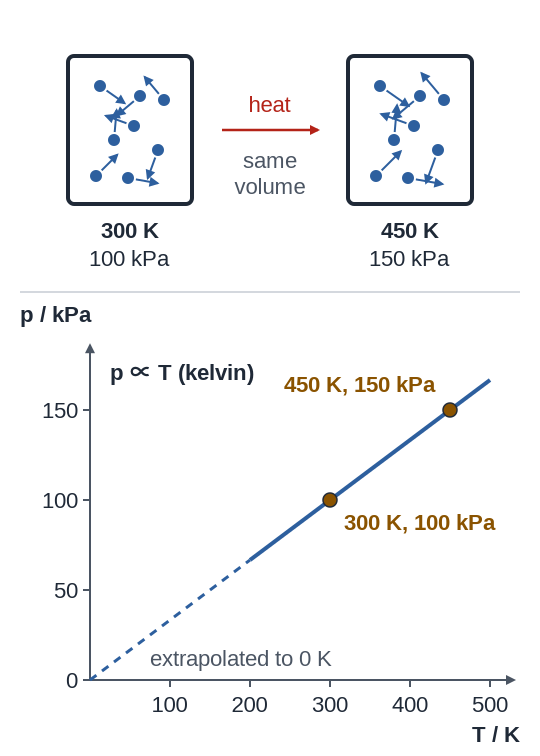
The sealed rigid container keeps the number of molecules and volume unchanged. Higher kelvinThe SI unit of thermodynamic temperature, with zero at absolute zero and intervals equal to Celsius degree intervals. temperatureA measure of how hot a system is, related to the average kinetic energy of its particles. means greater average kinetic energyThe energy associated with motion, equal to half the mass multiplied by speed squared for a moving object.; more rapid and stronger momentumThe product of an object’s mass and velocity, measured in kilogram metres per second. transfer to the walls raises pressureThe normal force exerted per unit area, measured in pascals..
Use absolute pressurePressure measured relative to a perfect vacuum, rather than relative to atmospheric pressure., measured from a vacuum. A gauge that reads pressure above the surrounding atmosphere needs that atmospheric pressureThe force per unit area exerted by collisions of air particles with a surface. added before the ratio is used. The pressure units may be Pa or kPa, provided both states use the same unit.
Worked pressure calculation
gasA state of matter whose widely separated particles move randomly, filling the available container. initially at 27 °C has absolute pressurePressure measured relative to a perfect vacuum, rather than relative to atmospheric pressure. 100 kPa. It is warmed to 177 °C in the same rigid container. Convert first: T₁ = 27 + 273 = 300 K; T₂ = 177 + 273 = 450 K.
Rearrange p₂ = p₁T₂/T₁. Substitute p₂ = 100 × 450/300 = 150 kPa. The absolute temperatureTemperature measured from absolute zero on the kelvin scale. increased by a factor 1.50, so the pressureThe normal force exerted per unit area, measured in pascals. should also increase by that factor.
Worked temperature calculation
For the same initial 100 kPa at 300 K, suppose the final pressureThe normal force exerted per unit area, measured in pascals. is 120 kPa. Rearrange T₂ = T₁p₂/p₁ = 300 × 120/100 = 360 K.
Convert the result only at the end if Celsius is requested: θ₂ = 360 − 273 = 87 °C. The ratio calculation itself uses kelvinThe SI unit of thermodynamic temperature, with zero at absolute zero and intervals equal to Celsius degree intervals..
Read a graph
An ideal plot of p against T in kelvinThe SI unit of thermodynamic temperature, with zero at absolute zero and intervals equal to Celsius degree intervals. is a straight line through the origin when volume and gasA state of matter whose widely separated particles move randomly, filling the available container. amount are fixed. The gradientThe change in the vertical-axis quantity divided by the corresponding change in the horizontal-axis quantity. is p/T. For the illustrated model, 100 kPa/300 K = 1/3 kPa/K.
The origin is a model extrapolation. It is not a measured gas state at 0 K: real gases condense and deviate from ideal behaviour before reaching that limit. A plot against Celsius would not pass through 0 °C, 0 Pa.
Check whether the model applies
Confirm that the container did not expand or leak, the gasA state of matter whose widely separated particles move randomly, filling the available container. had time to reach a uniform temperatureA measure of how hot a system is, related to the average kinetic energy of its particles., and the pressureThe normal force exerted per unit area, measured in pascals. are absolute. In a real investigation, pressure-rated apparatus and controlled temperature changes are necessary; do not improvise heating sealed containers.
If any of the constraints changes, this equation alone is insufficient.
Equations
- p₁/T₁ = p₂/T₂; p₂ = p₁T₂/T₁; T₂ = T₁p₂/p₁.
- T in K; p is absolute pressure in consistent units.
Common misconceptions
- Convert both temperatures to kelvin before taking a ratio.
- A straight p–T line through the origin uses kelvin, not Celsius.
- A zero gauge reading may still represent atmospheric absolute pressure.
- The equation requires fixed mass and volume.
Warm a fixed mass of gas at fixed volume
Connect Kelvin temperature, pressure and average molecular kinetic energy under controlled conditions.
What you see
- Labelled diagrams and numerical outputs describe the same selected state.
How to use it
- Change one control at a time, predict the outcome, then compare the readouts. All controls have keyboard-accessible sliders and step buttons.
- Reset restores every model control to its initial value. Nothing is saved.
What it shows
- At fixed gas mass and volume, p/T is constant with T in kelvin. Average molecular kinetic energy is proportional to Kelvin temperature. The ideal-model extrapolation reaches zero pressure and the classical zero-energy limit at 0 K, approximately −273 °C; it does not demonstrate a real gas at every extrapolated state.
Limits of the model
- A fixed mass of ideal gas in one sealed rigid vessel. The reference state is 300 K and 100 kPa absolute pressure.
- The operating range is 150–600 K. The dashed line towards zero is an ideal-model extrapolation; a real gas would liquefy before that limit. Celsius conversion uses the course approximation K=°C+273.
Controls
Compare states using Kelvin readings. The vessel keeps the same volume and gas mass; pressure here is absolute, not a gauge difference from atmospheric pressure.
Predict, change and explain
Compare 300 K and 600 K: predict pressure and the average molecular kinetic-energy ratio. Then compare 300 K and 450 K. Explain why a ratio of Celsius readings would be wrong and what the extrapolated zero means in the ideal model.
Connect the outcome to the Physics
At fixed gas mass and volume, p/T is constant with T in kelvin. Average molecular kinetic energy is proportional to Kelvin temperature. The ideal-model extrapolation reaches zero pressure and the classical zero-energy limit at 0 K, approximately −273 °C; it does not demonstrate a real gas at every extrapolated state.