Learning goals
- Describe the two required qualitative gas relationships.
- Explain each trend through wall collisions.
- Identify controlled quantities before predicting a change.
First identify the constraints
For a fixed amount of gasA state of matter whose widely separated particles move randomly, filling the available container., pressureThe normal force exerted per unit area, measured in pascals., volume and temperatureA measure of how hot a system is, related to the average kinetic energy of its particles. are connected. Changing one can affect the others. A statement such as heating raises pressure needs a condition: is the container rigid, or can the gas expand?
A sealed system keeps the amount fixed. If gas leaks or is added, the simple two-state comparisons here no longer describe the whole change.
Compression at constant temperature
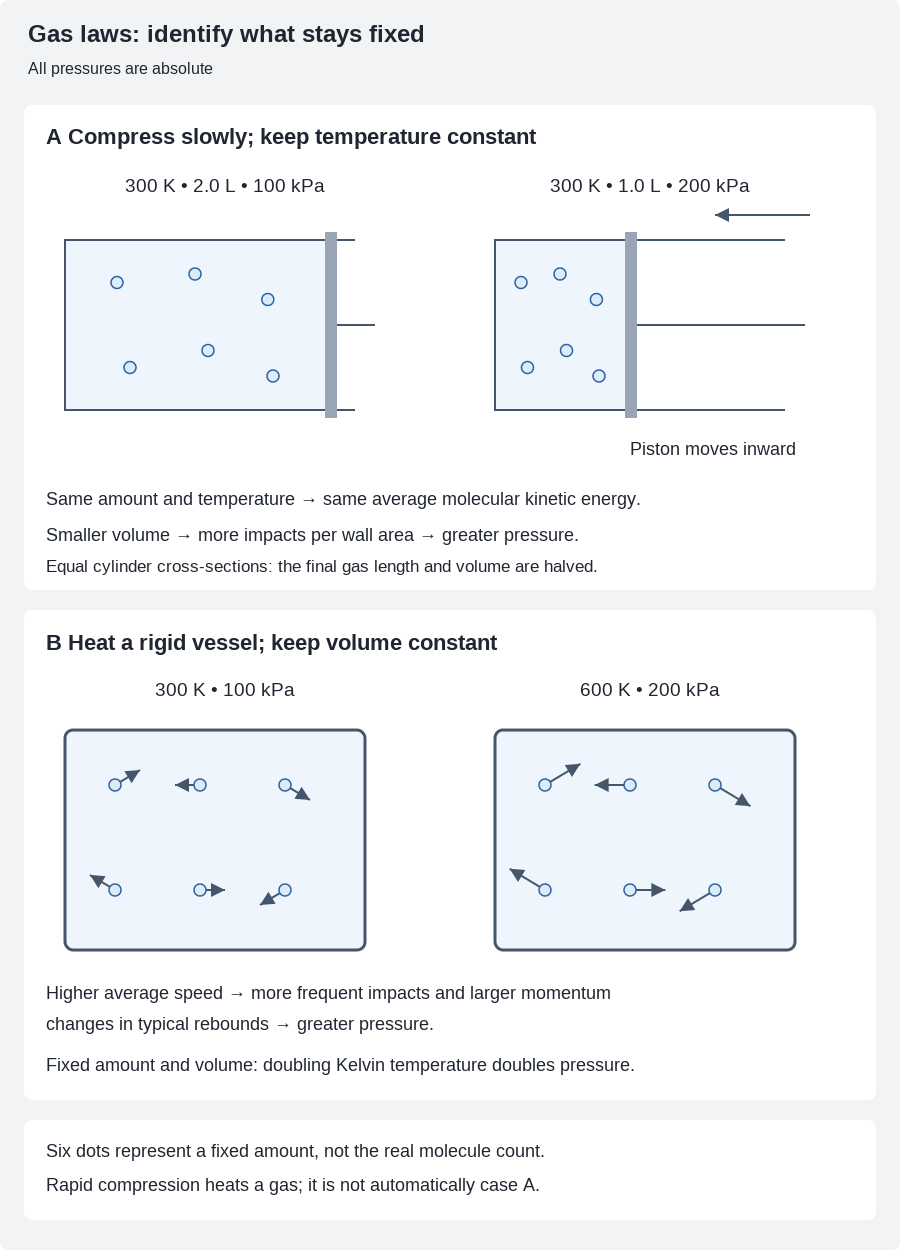
A movable piston can reduce the volume. If the gasA state of matter whose widely separated particles move randomly, filling the available container. is allowed to exchange heat with its surroundings until its temperatureA measure of how hot a system is, related to the average kinetic energy of its particles. returns to the same value, its average molecular kinetic energyThe energy associated with motion, equal to half the mass multiplied by speed squared for a moving object. and typical speedThe distance travelled per unit time, without specifying direction. are unchanged.
The same number of molecules occupies less space. Collisions with a given wall area occur more often, so the average forceA push or pull arising from an interaction between objects, measured in newtons. per unit area increases. At constant temperature, pressureThe normal force exerted per unit area, measured in pascals. is inversely proportional to volume: halving V doubles p.
Heating at constant volume
A rigid container prevents expansion. Heating a fixed amount of gasA state of matter whose widely separated particles move randomly, filling the available container. increases average molecular kinetic energyThe energy associated with motion, equal to half the mass multiplied by speed squared for a moving object. and speedThe distance travelled per unit time, without specifying direction.. Molecules collide with walls more frequently and transfer more momentumThe product of an object’s mass and velocity, measured in kilogram metres per second. in typical rebounds.
The average wall forceA push or pull arising from an interaction between objects, measured in newtons. rises, so pressureThe normal force exerted per unit area, measured in pascals. rises. For an ideal gasA model gas whose particles have negligible volume and no interactions except elastic collisions. at constant volume, pressure is directly proportional to kelvinThe SI unit of thermodynamic temperature, with zero at absolute zero and intervals equal to Celsius degree intervals. temperatureA measure of how hot a system is, related to the average kinetic energy of its particles.. Doubling T doubles p.
Why a fast compression needs care
A rapid compressionA region of a longitudinal wave where particles are closer together and pressure is higher. usually raises the gasA state of matter whose widely separated particles move randomly, filling the available container. temperatureA measure of how hot a system is, related to the average kinetic energy of its particles. because the moving piston does work on the gas. It is not automatically a constant-temperature process. Slow changes and waiting for thermal equilibriumA state in which both the resultant force and the resultant moment on an object are zero. help approach the stated constant-temperature condition.
Similarly, heating gas beneath a freely moving piston can make its volume rise while pressureThe normal force exerted per unit area, measured in pascals. stays close to the external pressure. State the constraint and then use the appropriate relationship.
Compare the illustrated cases
In the first example, gasA state of matter whose widely separated particles move randomly, filling the available container. at 300 K changes from 2.0 L at 100 kPa to 1.0 L at 200 kPa. In the second, the same volume contains a fixed amount at 300 K and 100 kPa, then 600 K and 200 kPa.
Both final pressureThe normal force exerted per unit area, measured in pascals. double, but the mechanisms and controls differ. All pressures here are absolute, measured relative to a vacuum.
Equations
- At fixed amount and temperature: p ∝ 1/V.
- At fixed amount and volume: p ∝ T, with T in K.
Common misconceptions
- A fast compression need not keep temperature constant.
- A constant temperature does not mean molecules stop moving.
- The same final pressure change can arise under different constraints.
- Gas-law pressures are absolute, not uncorrected gauge readings.
Warm a fixed mass of gas at fixed volume
Connect Kelvin temperature, pressure and average molecular kinetic energy under controlled conditions.
What you see
- Labelled diagrams and numerical outputs describe the same selected state.
How to use it
- Change one control at a time, predict the outcome, then compare the readouts. All controls have keyboard-accessible sliders and step buttons.
- Reset restores every model control to its initial value. Nothing is saved.
What it shows
- At fixed gas mass and volume, p/T is constant with T in kelvin. Average molecular kinetic energy is proportional to Kelvin temperature. The ideal-model extrapolation reaches zero pressure and the classical zero-energy limit at 0 K, approximately −273 °C; it does not demonstrate a real gas at every extrapolated state.
Limits of the model
- A fixed mass of ideal gas in one sealed rigid vessel. The reference state is 300 K and 100 kPa absolute pressure.
- The operating range is 150–600 K. The dashed line towards zero is an ideal-model extrapolation; a real gas would liquefy before that limit. Celsius conversion uses the course approximation K=°C+273.
Controls
Compare states using Kelvin readings. The vessel keeps the same volume and gas mass; pressure here is absolute, not a gauge difference from atmospheric pressure.
Predict, change and explain
Compare 300 K and 600 K: predict pressure and the average molecular kinetic-energy ratio. Then compare 300 K and 450 K. Explain why a ratio of Celsius readings would be wrong and what the extrapolated zero means in the ideal model.
Connect the outcome to the Physics
At fixed gas mass and volume, p/T is constant with T in kelvin. Average molecular kinetic energy is proportional to Kelvin temperature. The ideal-model extrapolation reaches zero pressure and the classical zero-energy limit at 0 K, approximately −273 °C; it does not demonstrate a real gas at every extrapolated state.
Compress a gas at constant temperature
Change gas volume and predict the inverse pressure change while identifying what stays fixed.
What you see
- Labelled diagrams and numerical outputs describe the same selected state.
How to use it
- Change one control at a time, predict the outcome, then compare the readouts. All controls have keyboard-accessible sliders and step buttons.
- Reset restores every model control to its initial value. Nothing is saved.
What it shows
- At fixed gas mass and temperature, pV is constant. Halving volume doubles absolute pressure; doubling volume halves it. Average molecular kinetic energy stays unchanged at the same Kelvin temperature. Individual molecules still have a range of speeds.
Limits of the model
- A fixed mass of ideal gas is compared at the same 300 K temperature after each adjustment. Reference volume is 1000 cm³ at 100 kPa absolute pressure.
- The piston shows equilibrium states, not a rapid compression process. Heating/cooling needed to maintain temperature is not calculated. The curve is restricted to 200–2000 cm³ and is not extended to zero volume.
Controls
Both pressure×volume products equal 100000 kPa cm³ before rounding. The same volume units are used for both states; displayed readouts are rounded independently.
Predict, change and explain
Change volume from 1000 to 500 cm³, then to 2000 cm³. Predict both pressures and compare pV. Explain why compression alone would not justify the prediction if the final temperature were different.
Connect the outcome to the Physics
At fixed gas mass and temperature, pV is constant. Halving volume doubles absolute pressure; doubling volume halves it. Average molecular kinetic energy stays unchanged at the same Kelvin temperature. Individual molecules still have a range of speeds.