Learning goals
- Convert between Celsius and kelvin.
- Distinguish a temperature from a temperature change.
- Use kelvin for proportional gas relationships.
Same interval, different zero
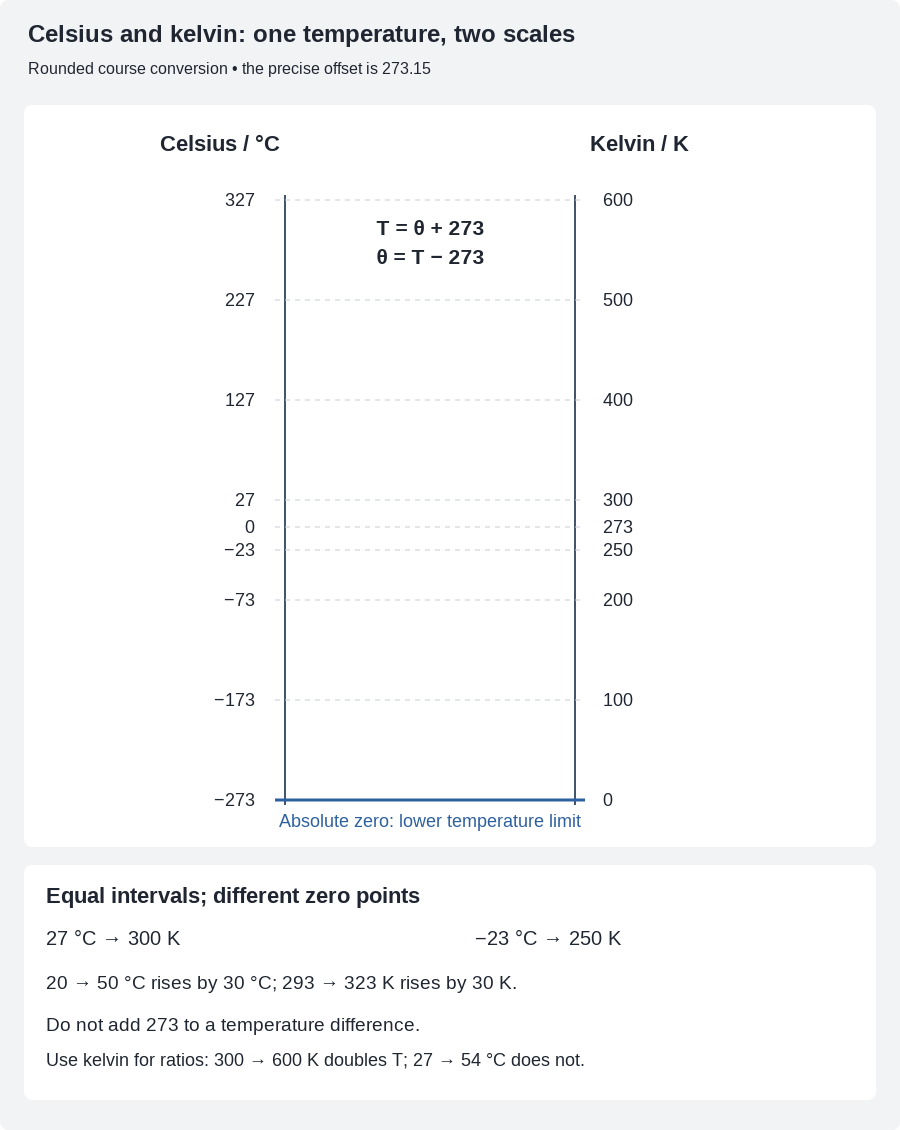
A rise of 1 K is the same size as a rise of 1 °C, but the zero points differ. kelvinThe SI unit of thermodynamic temperature, with zero at absolute zero and intervals equal to Celsius degree intervals. begins at absolute zeroThe lowest possible thermodynamic temperature, equal to zero kelvin or −273.15 °C.; Celsius places zero near the freezingThe change of state from liquid to solid as energy is removed. point of water. Write the kelvin unit as K, without a degree symbol.
Using the course approximation, T in kelvin equals θ in Celsius plus 273. To convert back, subtract 273. The aligned scales show the same physical temperatureA measure of how hot a system is, related to the average kinetic energy of its particles. at the same height.
Worked conversions
A gasA state of matter whose widely separated particles move randomly, filling the available container. at 27 °C has T = 27 + 273 = 300 K. A gas at −23 °C has T = −23 + 273 = 250 K: below zero Celsius does not mean below zero kelvinThe SI unit of thermodynamic temperature, with zero at absolute zero and intervals equal to Celsius degree intervals..
A gas at 450 K has θ = 450 − 273 = 177 °C. Check that the kelvin number is larger by 273, then include the correct unit.
Temperature differences
If a gasA state of matter whose widely separated particles move randomly, filling the available container. warms from 20 °C to 50 °C, the rise is 30 °C. Its kelvinThe SI unit of thermodynamic temperature, with zero at absolute zero and intervals equal to Celsius degree intervals. temperatureA measure of how hot a system is, related to the average kinetic energy of its particles. are 293 K and 323 K, so the rise is also 30 K. Do not add 273 to a temperature difference.
Adding the offset is necessary for an individual temperature, not for an interval. In a ratio such as T₂/T₁, use the individual Kelvin temperatures, even when the stated change is given in Celsius.
Why gas ratios need kelvin
From 300 K to 600 K, the absolute temperatureTemperature measured from absolute zero on the kelvin scale. doubles. In Celsius this is from 27 °C to 327 °C, not from 27 °C to 54 °C. gasA state of matter whose widely separated particles move randomly, filling the available container. pressureThe normal force exerted per unit area, measured in pascals. at fixed volume and average molecular kinetic energyThe energy associated with motion, equal to half the mass multiplied by speed squared for a moving object. are proportional to kelvinThe SI unit of thermodynamic temperature, with zero at absolute zero and intervals equal to Celsius degree intervals. temperatureA measure of how hot a system is, related to the average kinetic energy of its particles..
For comparison, warming from 20 °C to 40 °C changes the ratio to 313/293 ≈ 1.068. The Kelvin temperature increases by about 6.8%, rather than doubling.
Equations
- T(K) = θ(°C) + 273; θ(°C) = T(K) − 273.
- A temperature change of 1 K equals a change of 1 °C.
Common misconceptions
- Do not write degrees kelvin or °K.
- Do not add 273 to a temperature change.
- Doubling a Celsius reading does not double the absolute temperature.
Warm a fixed mass of gas at fixed volume
Connect Kelvin temperature, pressure and average molecular kinetic energy under controlled conditions.
What you see
- Labelled diagrams and numerical outputs describe the same selected state.
How to use it
- Change one control at a time, predict the outcome, then compare the readouts. All controls have keyboard-accessible sliders and step buttons.
- Reset restores every model control to its initial value. Nothing is saved.
What it shows
- At fixed gas mass and volume, p/T is constant with T in kelvin. Average molecular kinetic energy is proportional to Kelvin temperature. The ideal-model extrapolation reaches zero pressure and the classical zero-energy limit at 0 K, approximately −273 °C; it does not demonstrate a real gas at every extrapolated state.
Limits of the model
- A fixed mass of ideal gas in one sealed rigid vessel. The reference state is 300 K and 100 kPa absolute pressure.
- The operating range is 150–600 K. The dashed line towards zero is an ideal-model extrapolation; a real gas would liquefy before that limit. Celsius conversion uses the course approximation K=°C+273.
Controls
Compare states using Kelvin readings. The vessel keeps the same volume and gas mass; pressure here is absolute, not a gauge difference from atmospheric pressure.
Predict, change and explain
Compare 300 K and 600 K: predict pressure and the average molecular kinetic-energy ratio. Then compare 300 K and 450 K. Explain why a ratio of Celsius readings would be wrong and what the extrapolated zero means in the ideal model.
Connect the outcome to the Physics
At fixed gas mass and volume, p/T is constant with T in kelvin. Average molecular kinetic energy is proportional to Kelvin temperature. The ideal-model extrapolation reaches zero pressure and the classical zero-energy limit at 0 K, approximately −273 °C; it does not demonstrate a real gas at every extrapolated state.