Learning goals
- Connect heating to molecular kinetic energy and average speed.
- Explain the fixed-volume pressure effect.
- Distinguish temperature from the speed of one molecule.
Energy reaches the gas
When a warmer wall transfers energyA conserved quantity transferred between stores by working, heating, electrical processes or radiation, measured in joules. to a gasA state of matter whose widely separated particles move randomly, filling the available container., collisions can increase the energy of molecular motion. Collisions between molecules redistribute that energy. Once the gas has settled to a higher temperatureA measure of how hot a system is, related to the average kinetic energy of its particles., its average translational kinetic energyThe energy associated with motion, equal to half the mass multiplied by speed squared for a moving object. is greater.
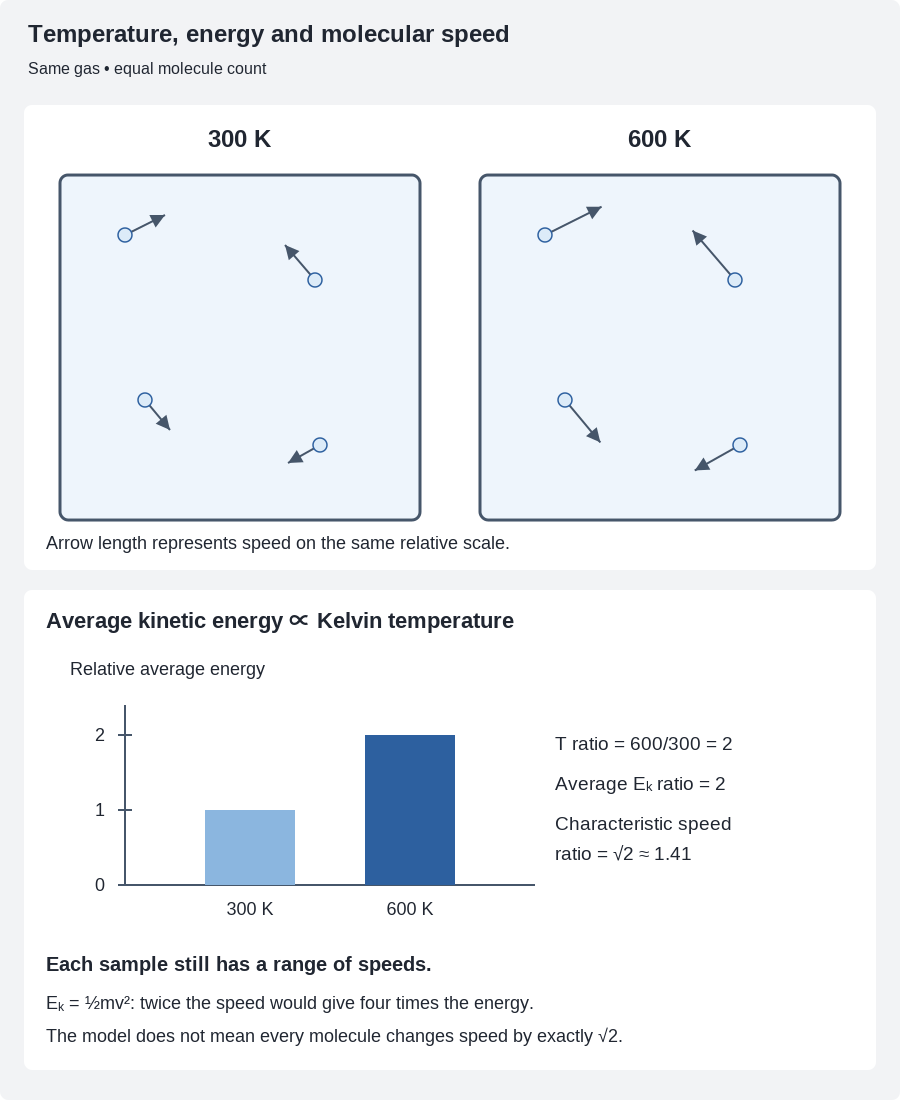
For the same molecular massThe quantity measuring an object’s inertia, expressed in kilograms., greater kinetic energy corresponds to a greater squared speedThe distance travelled per unit time, without specifying direction.. The speed distribution shifts so that average speedThe ratio of total path length to the entire elapsed time of a journey. increases; it does not give every molecule an identical speed.
Describe the average carefully
A gasA state of matter whose widely separated particles move randomly, filling the available container. sample contains molecules moving slowly and quickly at the same instant. A collision may speedThe distance travelled per unit time, without specifying direction. one molecule up and slow another down. temperatureA measure of how hot a system is, related to the average kinetic energy of its particles. describes the collective average, so one unusually fast molecule does not define the sample temperature.
The two snapshots in the figure are comparisons, not the histories of the same four molecules. Their arrows illustrate a larger range of typical speeds in the warmer sample.
Connect to pressure at fixed volume
In a rigid sealed container, faster molecules reach the walls more frequently. Their rebounds also involve larger typical momentumThe product of an object’s mass and velocity, measured in kilogram metres per second. changes. The greater rate of momentum transfer produces a greater average wall forceA push or pull arising from an interaction between objects, measured in newtons. and therefore greater pressureThe normal force exerted per unit area, measured in pascals..
The rigid-container condition matters. If a piston can move freely, heating may expand the gasA state of matter whose widely separated particles move randomly, filling the available container. instead of producing the same pressure increase. Keep gas amount and the relevant constraint clear.
Speed does not double when temperature doubles
The relation Eₖ = ½mv² makes energyA conserved quantity transferred between stores by working, heating, electrical processes or radiation, measured in joules. proportional to speedThe distance travelled per unit time, without specifying direction. squared for a given massThe quantity measuring an object’s inertia, expressed in kilograms.. Doubling a molecule's speed would multiply its kinetic energyThe energy associated with motion, equal to half the mass multiplied by speed squared for a moving object. by four.
In the ideal-gas comparison from 300 K to 600 K, average kinetic energy doubles and characteristic speeds increase by a factor √2, about 1.41. Individual molecules have a range of speeds; the factor describes the change in characteristic speeds.
Equations
- Eₖ = ½mv²; at fixed molecular mass, kinetic energy is proportional to speed squared.
Common misconceptions
- Higher temperature increases average speed, not necessarily the speed of every molecule at every instant.
- Doubling Kelvin temperature does not double molecular speed.
- Heating raises pressure in the stated fixed-volume case; an expanding gas needs separate reasoning.