Learning goals
- State absolute zero in Celsius and kelvin.
- Explain the lower limit using the ideal-gas energy model.
- Recognise the limits of extrapolating real gas behaviour.
Cooling and molecular energy
temperatureA measure of how hot a system is, related to the average kinetic energy of its particles. is related to the average kinetic energyThe energy associated with motion, equal to half the mass multiplied by speed squared for a moving object. of gasA state of matter whose widely separated particles move randomly, filling the available container. molecules. Cooling removes energyA conserved quantity transferred between stores by working, heating, electrical processes or radiation, measured in joules. from their thermal motion, reducing that average. In the classical ideal-gas model, lower temperature therefore corresponds to slower typical molecular motion.
Kinetic energy cannot be negative: Eₖ = ½mv² contains a squared speedThe distance travelled per unit time, without specifying direction.. The model has a lower limit at zero average translational kinetic energy. This motivates an absolute temperatureTemperature measured from absolute zero on the kelvin scale. scale beginning at 0 K.
Locate absolute zero
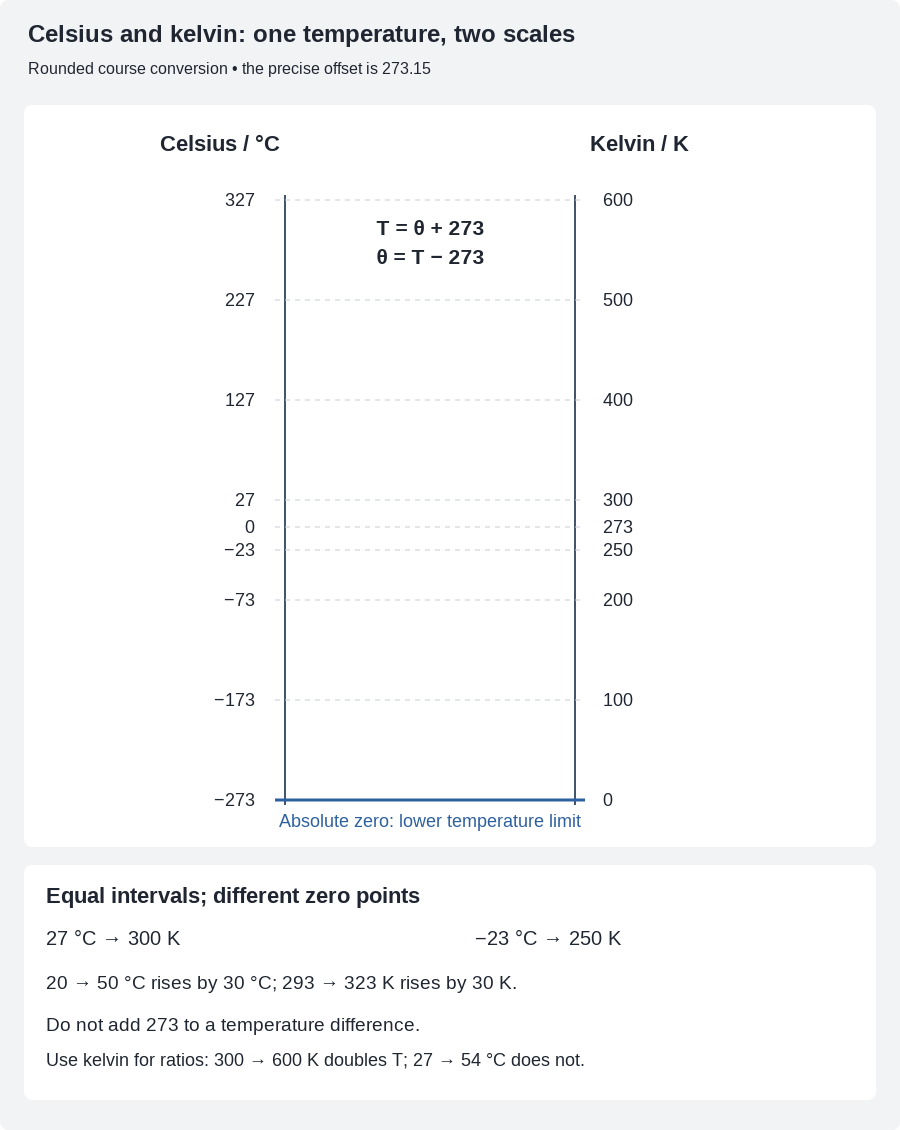
absolute zeroThe lowest possible thermodynamic temperature, equal to zero kelvin or −273.15 °C. is approximately −273 °C. This course uses the rounded conversion T = θ + 273, so −273 °C corresponds to 0 K. The more precise Celsius value is −273.15 °C; use the precisionThe closeness of repeated measured values to one another. specified in a question.
Zero Celsius is simply a reference point near the freezingThe change of state from liquid to solid as energy is removed. point of water at standard atmospheric pressureThe force per unit area exerted by collisions of air particles with a surface.. It is about 273 K and is far above absolute zero, so molecules at 0 °C still have thermal motion.
What a gas graph can and cannot show
For a fixed amount of ideal gasA model gas whose particles have negligible volume and no interactions except elastic collisions. in a rigid container, pressureThe normal force exerted per unit area, measured in pascals. falls as kelvinThe SI unit of thermodynamic temperature, with zero at absolute zero and intervals equal to Celsius degree intervals. temperatureA measure of how hot a system is, related to the average kinetic energy of its particles. falls. Extending the ideal pressure–Celsius line backwards reaches zero pressure near −273 °C, consistent with the absolute-temperature model.
A real gasA state of matter whose widely separated particles move randomly, filling the available container. usually condenses before that extrapolated limit. A dashed extensionThe increase in length of an object relative to its original unstretched length. of the gas relationship is a prediction of a model, not evidence that a laboratory kept the same gas state down to 0 K.
Avoid a misleading definition
absolute zeroThe lowest possible thermodynamic temperature, equal to zero kelvin or −273.15 °C. is a temperatureA measure of how hot a system is, related to the average kinetic energy of its particles. limit, not a synonym for an empty container or zero measured gasA state of matter whose widely separated particles move randomly, filling the available container. pressureThe normal force exerted per unit area, measured in pascals.. A vacuum contains very few particles; that does not by itself define their temperature. Likewise, a pressure gauge reading zero relative to the atmosphere is not evidence of absolute zero.
Equations
- For the course approximation: T(K) = θ(°C) + 273.
- Classical molecular kinetic energy Eₖ = ½mv² is non-negative.
Common misconceptions
- 0 °C is about 273 K, not absolute zero.
- A model extrapolation is not a measured gas sample at 0 K.
- Zero gauge pressure does not mean zero absolute pressure or absolute zero.
Warm a fixed mass of gas at fixed volume
Connect Kelvin temperature, pressure and average molecular kinetic energy under controlled conditions.
What you see
- Labelled diagrams and numerical outputs describe the same selected state.
How to use it
- Change one control at a time, predict the outcome, then compare the readouts. All controls have keyboard-accessible sliders and step buttons.
- Reset restores every model control to its initial value. Nothing is saved.
What it shows
- At fixed gas mass and volume, p/T is constant with T in kelvin. Average molecular kinetic energy is proportional to Kelvin temperature. The ideal-model extrapolation reaches zero pressure and the classical zero-energy limit at 0 K, approximately −273 °C; it does not demonstrate a real gas at every extrapolated state.
Limits of the model
- A fixed mass of ideal gas in one sealed rigid vessel. The reference state is 300 K and 100 kPa absolute pressure.
- The operating range is 150–600 K. The dashed line towards zero is an ideal-model extrapolation; a real gas would liquefy before that limit. Celsius conversion uses the course approximation K=°C+273.
Controls
Compare states using Kelvin readings. The vessel keeps the same volume and gas mass; pressure here is absolute, not a gauge difference from atmospheric pressure.
Predict, change and explain
Compare 300 K and 600 K: predict pressure and the average molecular kinetic-energy ratio. Then compare 300 K and 450 K. Explain why a ratio of Celsius readings would be wrong and what the extrapolated zero means in the ideal model.
Connect the outcome to the Physics
At fixed gas mass and volume, p/T is constant with T in kelvin. Average molecular kinetic energy is proportional to Kelvin temperature. The ideal-model extrapolation reaches zero pressure and the classical zero-energy limit at 0 K, approximately −273 °C; it does not demonstrate a real gas at every extrapolated state.