Learning goals
- Describe random molecular motion.
- Connect wall collisions to momentum change and force.
- Explain pressure using many collisions per unit area.
The ideal-gas picture
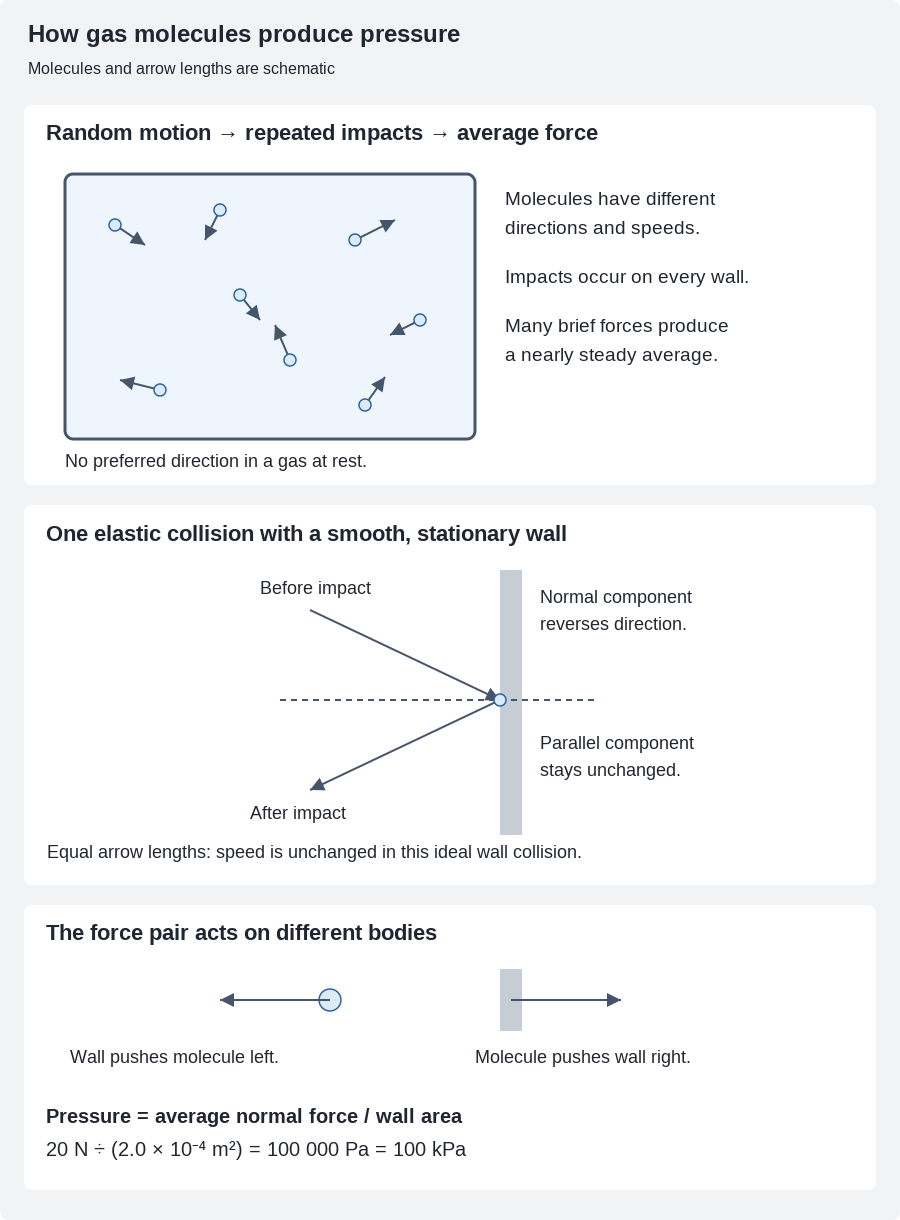
gasA state of matter whose widely separated particles move randomly, filling the available container. molecules move continuously in different directions with a range of speedThe distance travelled per unit time, without specifying direction.. Between collisions, the ideal model treats their paths as straight. Collisions with one another change their directions, so the motion has no overall preferred direction in a gas at rest.
The simple model treats molecules as very small compared with their separation, neglects forceA push or pull arising from an interaction between objects, measured in newtons. between collisions and treats collisions as elastic. It is a useful approximation for a dilute gas away from condensationThe change of state from gas to liquid as particles lose energy.; it is not a literal scale drawing of molecules.
What happens at a wall
When a molecule strikes a wall and rebounds, the component of its momentumThe product of an object’s mass and velocity, measured in kilogram metres per second. perpendicular to the wall changes direction. A forceA push or pull arising from an interaction between objects, measured in newtons. is required to produce that change. The wall exerts a force on the molecule, and the molecule exerts an equal and opposite force on the wall.
In the illustrated ideal collision, the sideways component towards a smooth wall reverses while the component parallel to it stays the same. speedThe distance travelled per unit time, without specifying direction. is unchanged for this collision with a stationary wall. The diagram shows before and after velocityThe rate of change of displacement, including the direction of motion., not two different molecules.
From impacts to pressure
A single impact is brief. The enormous number of impacts from many molecules produces an approximately steady average forceA push or pull arising from an interaction between objects, measured in newtons. on the wall. pressureThe normal force exerted per unit area, measured in pascals. is this normal reactionA contact force exerted perpendicular to a surface supporting an object. divided by the area over which it acts.
The gasA state of matter whose widely separated particles move randomly, filling the available container. pushes on all container walls, not just the floor. Pressure is not explained simply by the weightThe gravitational force acting on an object, equal to its mass multiplied by gravitational field strength. of molecules. At equilibriumA state in which both the resultant force and the resultant moment on an object are zero. in a small container, neglecting the small effect of height, the pressure is approximately the same throughout.
Worked force-per-arean example
If molecular impacts produce an average normal reactionA contact force exerted perpendicular to a surface supporting an object. of 20 N on a wall patch of area 2.0 × 10⁻⁴ m², p = F/A = 20/(2.0 × 10⁻⁴) = 1.0 × 10⁵ Pa = 100 kPa.
The forceA push or pull arising from an interaction between objects, measured in newtons. from different impacts add to the wall force. Action–reaction forces do not cancel on the wall because the opposite forces act on the molecules, which are different bodies.
Equations
- p = F/A; p in Pa, normal force F in N and area A in m².
- 1 Pa = 1 N/m²; 1 kPa = 1000 Pa.
Common misconceptions
- Gas pressure acts on side walls and the roof as well as the floor.
- Random motion does not mean every molecule has the same speed.
- The force on a wall and the opposite force on a molecule act on different bodies.