By the end of this lesson
- Describe rural Devon’s characteristics using the official eight headings.
- Explain recent changes and the strategies used to keep communities and landscapes viable.
- Evaluate successes and remaining gaps, especially housing, isolation and environmental care.
Locating the case
This in-depth case study is rural Devon, United Kingdom, including inland farming parishes, Dartmoor National Park, market towns, and heavily visited coasts. Devon sits in South West England, with granite uplands, deep wooded valleys, a mild but wet climateThe average weather conditions and their variability in a place over a long period, usually at least 30 years. on the moor, and a long tourism season on the south coast. It is a developed-country countryside: high national incomes by world standards, a tiny share of workers in farming, universal (if strained) public services, and planning law that tries to protect landscape. Inside that frame, parishes differ wildly — which is why every paragraph should say *which* Devon it is talking about.
Characteristics
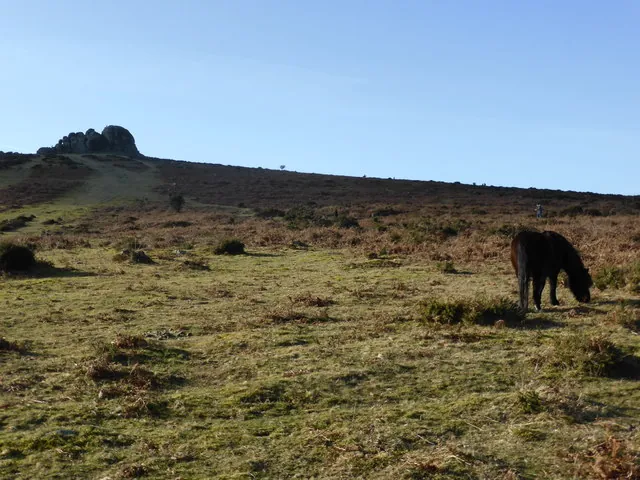
Landscape and climate: rolling pasture and arableDescribes farming that grows crops rather than rearing livestock. on softer rocks; Dartmoor’s open moor, tors and peat; a climateThe average weather conditions and their variability in a place over a long period, usually at least 30 years. wet enough for grass-based livestock and, in warming summers, experiments with vines and specialist crops in favoured spots. Settlement and population: nucleated villages, isolated farmsteads, market towns such as those serving the moor and the agricultural lowlands; many parishes have older age profiles than English cities, with pockets of younger commuter families near Exeter. Land use and employment: livestock and some dairy still dominate the look of the land; employment has shifted towards services, tourism, health and social care, construction, and commuting. accessibilityThe ease with which people, goods or services can reach a place. dual carriageways and the railway help city-edge and some corridor settlements; deep valleys and moor crossings remain isolated, especially without a car. Management: a living landscape under national planning rules, a national-park authority on Dartmoor, and competing aims of food production, wildlife, carbon in peat, and visitor enjoyment.
Changes and strategies
The six change factors all appear. Farm employment has fallen with mechanisationThe replacement or assistance of human labour by machines in production. and dairy restructuring. Isolation persists inland. Tourism presses Dartmoor and the coast. suburbanisationThe growth of outer urban areas as people and activities move from central parts of a city to its suburbs. eats rural land around Exeter and Plymouth. counter-urbanisationThe movement of people from urban areas to smaller settlements and rural areas. and second homes reshape some villages. The negative multiplier effectThe additional economic activity generated as initial spending creates income that is spent again in the local economy. threatens places that lose their shop, bus and pub together. Responses include farm diversificationThe development of additional farm income sources, such as tourism or specialist products, alongside traditional farming. (cottages, shops, leisure), some affordable-housing schemes and exception sites, broadband programmes, catchment-sensitive farming and peatland restoration, National Park planning that both blocks and shapes developmentImprovement in people's living conditions and opportunities, assessed through economic, social and political measures., and community trusts running shops or halls. Agricultural payments are being recast after the UK left the EU, with more language about paying for environmental goods — an unfinished national reform with local consequences.
What has improved, and for whom
Many visitors meet a cared-for landscape, waymarked paths and farm businesses that have survived by adding tourism income. Some villages have kept a school because new families arrived. River and peat projects show environmental management beyond slogans. Yet housing affordability in desirable parishes is a genuine social failure for many local workers; seasonal and part-time tourist jobs do not always replace lost skilled farm work; traffic and path erosionThe wearing away and removal of rock or sediment by moving water, ice or wind. are real at honeypots; and isolation for older residents without a car is a health and wellbeing issue. Socio-economic data that only show rising house prices or visitor numbers will mislead.
Who manages Devon
National government (planning law, agricultural payments, NHS frameworks, transport schemes), local government and the Dartmoor National Park Authority, parish councils, non-governmental organisationAn organisation independent of government that works towards aims such as humanitarian relief, development or environmental protection. and trusts (from wildlife groups to community land trusts), and farm households themselves. intergovernmental organisationAn organisation created by several governments to cooperate on shared international objectives. matter historically through former EU policy more than as everyday visitors. Conflicts — a needed agricultural worker’s dwelling versus landscape protection, or a tourist developmentImprovement in people's living conditions and opportunities, assessed through economic, social and political measures. versus resident parking — are the case study, not extras.
Exam workshop
Open with the place-name. Spend a short paragraph on characteristics (pick five headings), a paragraph on change (pick the factors the question names), a paragraph on strategies and who delivers them, and a judgement: landscape and some businesses have adapted; housing and deep isolation remain the sharpest social problems; environmental results depend on peat, rivers and farming practice, not only on park boundaries. If an insert gives a map of Dartmoor plus a table of house prices and farm labour, describe both before you explain.
Worked example: house prices in a coastal parish far above local wages, beside a photo of a thriving farm shop inland. Same county, different quality-of-life stories. That contrast is high-level evaluation.
Closing application (r10-1). A high-scoring rural paragraph names the place, uses at least one official specification term, and attaches it to something visible in the resource. If the resource is a map, mention a pattern such as isolated inland parishes, a city-edge estate, terraced slopes or a road towards Nairobi. If it is a table, describe the direction of change before you explain it. If it is a photograph or advert, say what is shown and what cannot be proved. quality of lifeThe overall wellbeing of people, including health, security, access to services and satisfaction with their surroundings. should be judged with more than one indicator, because house prices, yields, water access and health can move in different directions for different groups. Sustainability needs a time dimension: a strategy that raises this year's income by stripping soil or pricing out workers is not a finished success. Practice writing a final judgement sentence that uses a criterion such as fairness, environmental recovery or reversibility rather than the words good and bad alone. Teachers will see the difference because your answer will still make sense if the place-name is swapped only when the mechanism itself is truly shared.
Closing application (r10-2). A high-scoring rural paragraph names the place, uses at least one official specification term, and attaches it to something visible in the resource. If the resource is a map, mention a pattern such as isolated inland parishes, a city-edge estate, terraced slopes or a road towards Nairobi. If it is a table, describe the direction of change before you explain it. If it is a photograph or advert, say what is shown and what cannot be proved. Quality of life should be judged with more than one indicator, because house prices, yields, water access and health can move in different directions for different groups. Sustainability needs a time dimension: a strategy that raises this year's income by stripping soil or pricing out workers is not a finished success. Practice writing a final judgement sentence that uses a criterion such as fairness, environmental recovery or reversibility rather than the words good and bad alone. Teachers will see the difference because your answer will still make sense if the place-name is swapped only when the mechanism itself is truly shared.
Closing application (r10-3). A high-scoring rural paragraph names the place, uses at least one official specification term, and attaches it to something visible in the resource. If the resource is a map, mention a pattern such as isolated inland parishes, a city-edge estate, terraced slopes or a road towards Nairobi. If it is a table, describe the direction of change before you explain it. If it is a photograph or advert, say what is shown and what cannot be proved. Quality of life should be judged with more than one indicator, because house prices, yields, water access and health can move in different directions for different groups. Sustainability needs a time dimension: a strategy that raises this year's income by stripping soil or pricing out workers is not a finished success. Practice writing a final judgement sentence that uses a criterion such as fairness, environmental recovery or reversibility rather than the words good and bad alone. Teachers will see the difference because your answer will still make sense if the place-name is swapped only when the mechanism itself is truly shared.
Closing application (r10-4). A high-scoring rural paragraph names the place, uses at least one official specification term, and attaches it to something visible in the resource. If the resource is a map, mention a pattern such as isolated inland parishes, a city-edge estate, terraced slopes or a road towards Nairobi. If it is a table, describe the direction of change before you explain it. If it is a photograph or advert, say what is shown and what cannot be proved. Quality of life should be judged with more than one indicator, because house prices, yields, water access and health can move in different directions for different groups. Sustainability needs a time dimension: a strategy that raises this year's income by stripping soil or pricing out workers is not a finished success. Practice writing a final judgement sentence that uses a criterion such as fairness, environmental recovery or reversibility rather than the words good and bad alone. Teachers will see the difference because your answer will still make sense if the place-name is swapped only when the mechanism itself is truly shared.
Closing application (r10-5). A high-scoring rural paragraph names the place, uses at least one official specification term, and attaches it to something visible in the resource. If the resource is a map, mention a pattern such as isolated inland parishes, a city-edge estate, terraced slopes or a road towards Nairobi. If it is a table, describe the direction of change before you explain it. If it is a photograph or advert, say what is shown and what cannot be proved. Quality of life should be judged with more than one indicator, because house prices, yields, water access and health can move in different directions for different groups. Sustainability needs a time dimension: a strategy that raises this year's income by stripping soil or pricing out workers is not a finished success. Practice writing a final judgement sentence that uses a criterion such as fairness, environmental recovery or reversibility rather than the words good and bad alone. Teachers will see the difference because your answer will still make sense if the place-name is swapped only when the mechanism itself is truly shared.
Closing application (r10-6). A high-scoring rural paragraph names the place, uses at least one official specification term, and attaches it to something visible in the resource. If the resource is a map, mention a pattern such as isolated inland parishes, a city-edge estate, terraced slopes or a road towards Nairobi. If it is a table, describe the direction of change before you explain it. If it is a photograph or advert, say what is shown and what cannot be proved. Quality of life should be judged with more than one indicator, because house prices, yields, water access and health can move in different directions for different groups. Sustainability needs a time dimension: a strategy that raises this year's income by stripping soil or pricing out workers is not a finished success. Practice writing a final judgement sentence that uses a criterion such as fairness, environmental recovery or reversibility rather than the words good and bad alone. Teachers will see the difference because your answer will still make sense if the place-name is swapped only when the mechanism itself is truly shared.
Closing application (r10-7). A high-scoring rural paragraph names the place, uses at least one official specification term, and attaches it to something visible in the resource. If the resource is a map, mention a pattern such as isolated inland parishes, a city-edge estate, terraced slopes or a road towards Nairobi. If it is a table, describe the direction of change before you explain it. If it is a photograph or advert, say what is shown and what cannot be proved. Quality of life should be judged with more than one indicator, because house prices, yields, water access and health can move in different directions for different groups. Sustainability needs a time dimension: a strategy that raises this year's income by stripping soil or pricing out workers is not a finished success. Practice writing a final judgement sentence that uses a criterion such as fairness, environmental recovery or reversibility rather than the words good and bad alone. Teachers will see the difference because your answer will still make sense if the place-name is swapped only when the mechanism itself is truly shared.
Common misconceptions
Not quite: Devon has stopped farming.
Instead: Livestock still shapes most of the land even though few people are employed to produce it.
Not quite: National-park designation automatically solves social and economic problems.
Instead: It conserves landscape and can also constrain housing and some businesses.
Not quite: Rising visitor numbers prove that quality of life has improved for residents.
Instead: Residents and visitors can have opposite experiences of the same street.
Exam tips
Put Devon in the first sentence
Examiners need the {named developed-country rural environment} immediately.
Keep internal variety
Moor, city-edge and coast are not one story.
Judge with evidence headings
Housing, isolation, jobs and peat or rivers make a clearer judgement than “it is quite sustainable”.