
What you need to know
- 4.14(ii)Critical evaluation of new molecular data leading to new taxonomic groupings, including ArchaeaOne of the three domains: prokaryotes with distinctive membrane lipids and RNA polymerase, often found in extreme environments., Bacteria and EukaryaThe domain of organisms with eukaryotic cells: animals, plants, fungi and protoctists..
- 4.14(i)phenotypeThe observable characteristics of an organism, produced by its genotype interacting with the environment. and genotypeThe alleles an organism has for a gene. in classificationSorting organisms into groups based on shared features and evolutionary relationships..
The required domains are Archaea, Bacteria and Eukarya. Viruses are not a fourth domain here. Kingdom lists vary between books; do not treat five kingdoms as a replacement for domains. Details of archaeal membrane chemistry beyond “molecular evidence distinguishes them from Bacteria” are enrichment.
By the end, you should be able to…
- Name the three domainThe highest rank in classification. The three domains are Bacteria, Archaea and Eukarya. and place familiar groups within them.
- Explain why “prokaryote” is not a domain.
- Describe how the scientific community evaluates new taxonomic data.
Build your understanding
Why two groups were not enough
For a long time, cellular life was split by phenotypeThe observable characteristics of an organism, produced by its genotype interacting with the environment. into prokaryotes (no nucleusThe organelle that contains the cell’s chromosomes, surrounded by a nuclear envelope with pores.) and eukaryotes (nucleus). Bacteria and what we now call ArchaeaOne of the three domains: prokaryotes with distinctive membrane lipids and RNA polymerase, often found in extreme environments. both lack nuclei, so they were grouped together. That grouping was practical for microscopy; it was not a claim that they were close relatives.
Carl Woese and colleagues compared ribosomal RNARibonucleic acid: a single-stranded polynucleotide with ribose and uracil. mRNA, tRNA and rRNA take part in protein synthesis. sequences. Some prokaryotes were as different from typical bacteria as bacteria were from eukaryotes. In 1990 they proposed three domainThe highest rank in classification. The three domains are Bacteria, Archaea and Eukarya.: Bacteria, Archaea and Eucarya (now usually spelled EukaryaThe domain of organisms with eukaryotic cells: animals, plants, fungi and protoctists.). The differences were judged more fundamental than the differences between animal and plant kingdoms.
What the three names mean
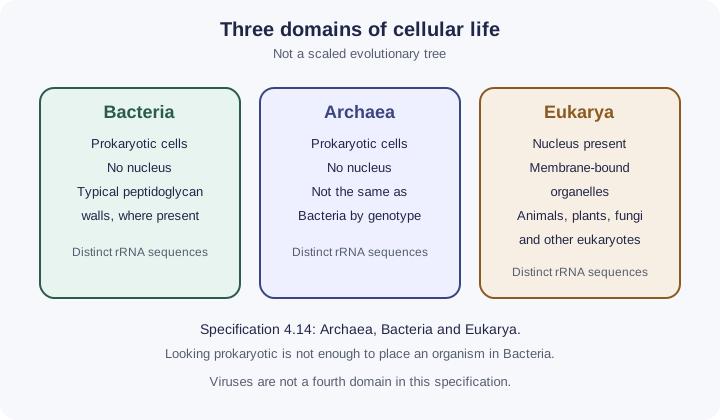
Bacteria are prokaryoticDescribes cells with no nucleus and no membrane-bound organelles, such as bacteria. Their DNA is free in the cytoplasm. cells with their own rRNARibosomal RNA: RNA that, with proteins, makes up a ribosome. signature. Many have peptidoglycan walls. Archaea are also prokaryotic in cell organisation, but their rRNA and other molecular features place them in a separate domain; they are not “odd bacteria”. Eukarya have nuclei and include animals, plants, fungi and other eukaryotes.
Looking at a cell under a school microscope and seeing no nucleus can only take you as far as “prokaryotic organisation”. Assigning Bacteria versus Archaea needs molecular evidence, or other specified biochemical features, not the absence of a nucleus alone.
Critique, then textbooks change
Specification 4.14 asks you to understand the process. A new grouping is proposed with data. Other laboratories repeat measurements, try different geneA sequence of DNA bases that codes for a polypeptide or a functional RNA., and argue about methods. Consensus forms if the pattern is robust. Databases and textbooks then update. NCBI taxonomyThe science of naming, describing and classifying organisms. is one living example of a community resource that still changes as papers appear.
Early three-domain ideas met scepticism. That is evaluation, not a scandal. A single paper does not rewrite classificationSorting organisms into groups based on shared features and evolutionary relationships. overnight. Kingdoms still exist inside domains: plants and animals are both Eukarya. Five-kingdom charts that put all prokaryotes in Monera do not match the three-domain system.
| Feature | Prokaryote / eukaryote split | Three-domain system |
|---|---|---|
| Main evidence originally | Presence or absence of a nucleus (phenotype) | Molecular sequences, especially rRNA, plus cell organisation |
| Where Archaea sit | Lumped with bacteria as prokaryotes | Their own domain, separate from Bacteria |
| Animals and plants | Both eukaryotes | Both in Eukarya, as kingdoms or equivalent groups inside that domain |
| Viruses | Not cellular | Not a required fourth domain |
Make your reasoning visible
Spell the three names
ArchaeaOne of the three domains: prokaryotes with distinctive membrane lipids and RNA polymerase, often found in extreme environments., Bacteria, EukaryaThe domain of organisms with eukaryotic cells: animals, plants, fungi and protoctists.. “Archaebacteria” as a domainThe highest rank in classification. The three domains are Bacteria, Archaea and Eukarya. name is the older wording the 1990 paper replaced.
Finish the evaluation story
Data published → independent critique → consensus → teaching resources update. “Scientists changed their minds” is incomplete without the molecular reason.
Avoid this misconception
The claim: Archaea are just bacteria that live in extreme heat.
The correction: Archaea are a separate domain defined by molecular evidence. Some live in extreme habitats, but that habitat is not the definition, and not all Archaea are extremophiles.
Check your understanding
Try each question before opening the suggested answer.
Practice question
Retrieval and explanation · suggested answer
Name the three domains.
Show suggested answer
Archaea, Bacteria and Eukarya.
Practice question
Retrieval and explanation · suggested answer
Explain why molecular evidence split the prokaryotes.
Show suggested answer
rRNA and other sequences showed that some prokaryotes were as different from typical bacteria as bacteria were from eukaryotes, so they were placed in Archaea rather than remaining one group with Bacteria.
Practice question
Retrieval and explanation · suggested answer
Why must new taxonomic groupings be evaluated by the scientific community?
Show suggested answer
A single study can be wrong or unrepresentative. Independent repetition and critique test whether the molecular pattern is real before classification is widely changed.
Take the idea further
Apply the same specification knowledge to an unfamiliar problem. Any extra assumptions are supplied in the question.
Stretch question
A blog says “microscopes prove there are only two types of cell, so three domains are ideology”. Identify the category of evidence the blog uses and the evidence it ignores.
Show a hint
Phenotype of cell organisation versus genotype of relatedness.
Explore the reasoning
The blog uses a phenotypic split (nucleus present or absent). It ignores genotypic evidence that two groups of prokaryotes are not close relatives. Classification aims to reflect relationships, so molecular data can add a rank above the microscope categories without denying that both Archaea and Bacteria lack nuclei.
Recall this lesson
Lesson recall questions
Question 1 of 5: What is classification in biology?
Classification and three domains
Practice question
Retrieval and explanation · suggested answer
What is classification in biology?
Lesson: 4B 1: Principles of Classification
Try this from memory first.
Put your biology to work
Explore where these ideas appear in the world. Enrichment, not extra required recall.
Reading the 1990 proposal
4B · Domains, Kingdoms or Both?Woese, Kandler and Wheelis argued in PNAS that molecular sequences are generally more revealing of evolutionary relationships than classical phenotypes, and that life comprises three domains. They presented…Specification 4.14(ii)Read & use the scienceClose article
Why this matters
Woese, Kandler and Wheelis argued in PNAS that molecular sequences are generally more revealing of evolutionary relationships than classical phenotypes, and that life comprises three domains. They presented it as a proposal for a formal system, not as an unchallengeable decree. Later work still debates details of the tree; the three-domain teaching framework is the specification’s required outcome of that evaluation. Comparisons of molecular sequences revealed that some microorganisms formerly grouped together were profoundly different. The three-domain framework separates Bacteria, Archaea and Eukarya and is the named model students need to know. New phylogenetic analyses continue to test deeper relationships, so the framework is a history of critical evaluation rather than a static list. In exam answers, state which new data changed the classification and how scientists judged the proposal. An unsupported claim that all prokaryotes are identical misses the point.
Back to the specification
Pearson Edexcel IAL Biology · Issue 2, February 2021 · Unit 2, pp. 21–24. The application extends beyond required recall.
- 4.14(ii) understand the process and importance of critical evaluation of new data by the scientific community leading to new taxonomic groupings, based on molecular evidence, including the three-domain system (Archaea, Bacteria and Eukarya)
Use the science
Why does calling the 1990 paper a “proposal” matter for 4.14?
Explore a possible response
It shows that classification changes through published evidence and debate, not by one laboratory issuing a finished list that everyone must accept without critique.
Explore the source
A domain diagram can change with evidence
4B · Domains, Kingdoms or Both?The three-domain model in the Pearson specification separates Bacteria, Archaea and Eukarya using molecular evidence. The Natural History Museum notes that newer analyses may place eukaryotes within an…Specification 4.14(ii)Read & use the scienceClose article
Why this matters
The three-domain model in the Pearson specification separates Bacteria, Archaea and Eukarya using molecular evidence. The Natural History Museum notes that newer analyses may place eukaryotes within an archaeal lineage, leading some researchers to discuss two top-level domains instead. Students still need to know the required three-domain framework. The real research lesson is that a classification is evaluated and revised when new data improve the explanation of evolutionary relationships. A scientist must say which sequences were compared and why the resulting tree is credible. An updated diagram is not evidence that organisms themselves suddenly changed.
Back to the specification
Pearson Edexcel IAL Biology · Issue 2, February 2021 · Unit 2, pp. 21–24. The application extends beyond required recall.
- 4.14(ii) understand the process and importance of critical evaluation of new data by the scientific community leading to new taxonomic groupings, based on molecular evidence, including the three-domain system (Archaea, Bacteria and Eukarya)
Use the science
Why can two published domain trees differ even though the organisms did not change?
Explore a possible response
They may use different molecular datasets or analytical assumptions, producing different hypotheses about ancestry. Scientists compare the evidence and methods.
Explore the source
- What is taxonomy?Natural History Museum