Learning goals
- Read the compound unit of specific heat capacity.
- Explain the effects of mass and temperature rise on energy needed.
- Check units in a simple heating example.
Read both parts of the denominator
specific heat capacityThe energy needed to raise the temperature of one kilogram of a substance by one degree Celsius without changing state. describes how much energyA conserved quantity transferred between stores by working, heating, electrical processes or radiation, measured in joules. a material needs to raise the temperatureA measure of how hot a system is, related to the average kinetic energy of its particles. of each kilogram by one degree Celsius, without a change of state. Write its unit as J/(kg °C): divide energy by both massThe quantity measuring an object’s inertia, expressed in kilograms. and temperature change. It is not joules per kilogram multiplied by the final temperature.
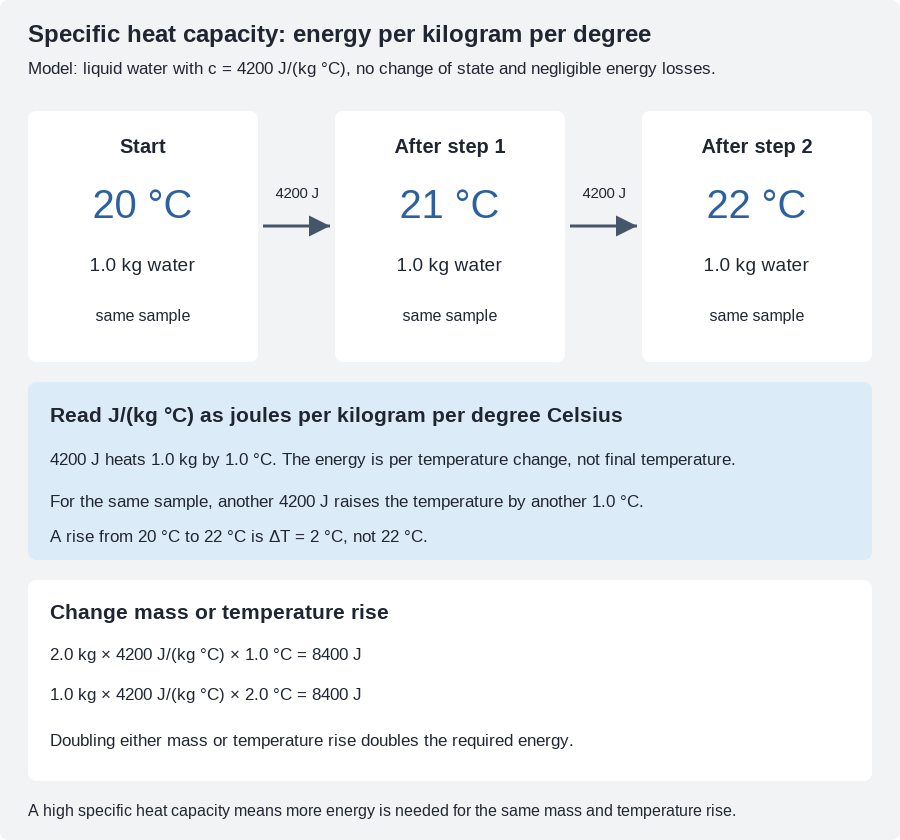
For c = 4200 J/(kg °C), 1.0 kg of liquidA state of matter with closely spaced particles moving past one another, giving a fixed volume but no fixed shape. water needs 4200 J to warm from 20 °C to 21 °C. A further 4200 J raises it from 21 °C to 22 °C if losses are negligible. Both steps are changes of 1 °C.
Scale the mass or the change
Two kilograms contain twice as much material as one kilogram. Raising 2.0 kg of this water by 1.0 °C needs 2.0 × 4200 × 1.0 = 8400 J. Raising 1.0 kg by 2.0 °C also needs 1.0 × 4200 × 2.0 = 8400 J.
The unit check is kg × J/(kg °C) × °C = J. A larger value of c means a smaller temperatureA measure of how hot a system is, related to the average kinetic energy of its particles. rise for equal energyA conserved quantity transferred between stores by working, heating, electrical processes or radiation, measured in joules. input and equal massThe quantity measuring an object’s inertia, expressed in kilograms.. The energy needed for a one-degree rise also depends on sample mass; specific heat capacityThe energy needed to raise the temperature of one kilogram of a substance by one degree Celsius without changing state. is a material property per kilogram.
Where this model applies
The comparison assumes the sample stays liquidA state of matter with closely spaced particles moving past one another, giving a fixed volume but no fixed shape. and c is approximately constant over the temperatureA measure of how hot a system is, related to the average kinetic energy of its particles. range. During meltingThe change of state from solid to liquid as energy is supplied. or boilingVaporisation throughout a liquid when its vapour pressure equals the external pressure., energyA conserved quantity transferred between stores by working, heating, electrical processes or radiation, measured in joules. can change the state without raising temperature, so these one-degree steps do not describe that interval. Energy lost to the surroundings must also be allowed for in a practical.
This unit reference is shared with Unit 2 Topic 6. The full definition, equation and practical investigation are developed in 4.12P–4.14P.
Equations
- specific heat capacity unit: J/(kg °C)
- energy change = mass × specific heat capacity × temperature change
Common misconceptions
- Use the temperature rise, not the final thermometer reading.
- A high specific heat capacity does not mean an object is already hot or contains a fixed amount of energy.