Learning goals
- Identify every unit used in the thermal and fluid topics.
- Convert squared and cubed units correctly.
- Distinguish temperature readings from temperature changes.
Quantities before calculations
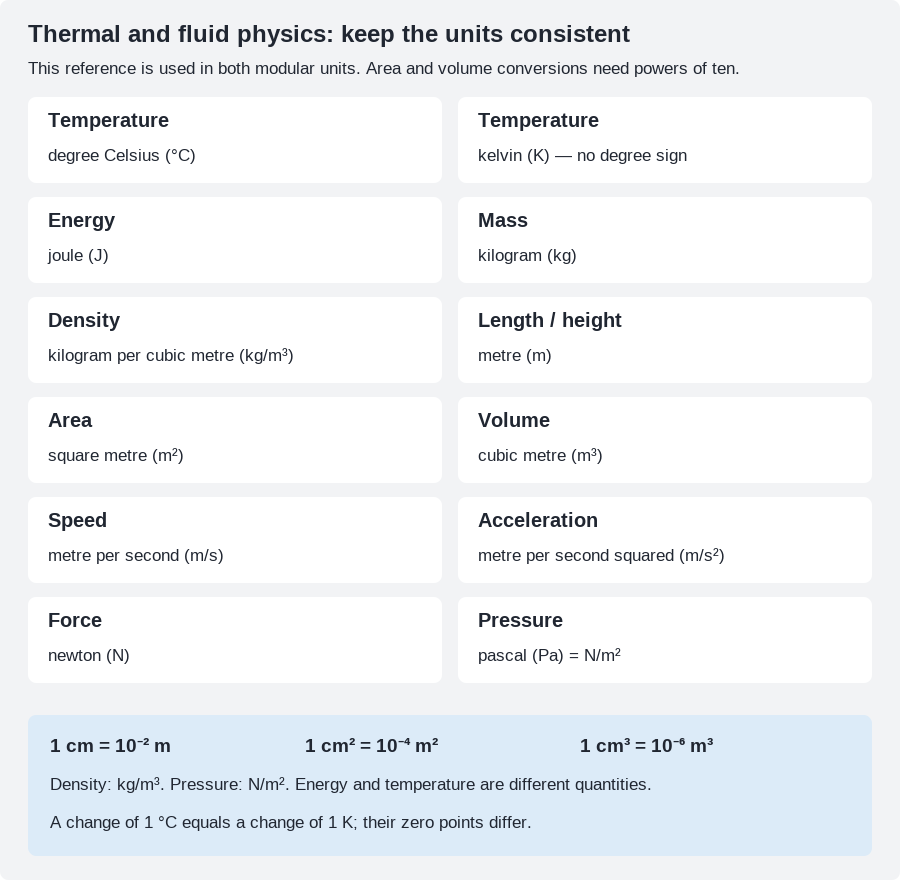
temperatureA measure of how hot a system is, related to the average kinetic energy of its particles. describes how hot a body is and is measured in degrees Celsius (°C) or kelvinThe SI unit of thermodynamic temperature, with zero at absolute zero and intervals equal to Celsius degree intervals. (K). energyA conserved quantity transferred between stores by working, heating, electrical processes or radiation, measured in joules. transferred is measured in joules (J); it is a different quantity from temperature. A large massThe quantity measuring an object’s inertia, expressed in kilograms. can receive much more energy than a small mass for the same temperature rise.
Use kilogram (kg) for mass, metre (m) for length or height, square metre (m²) for area, cubic metre (m³) for volume and kilogram per cubic metre (kg/m³) for densityThe mass of material per unit volume, measured in kilograms per cubic metre in SI units.. speedThe distance travelled per unit time, without specifying direction. is in metres per second (m/s), accelerationThe change in velocity per unit time, measured in metres per second squared. in metres per second squared (m/s²), forceA push or pull arising from an interaction between objects, measured in newtons. in newtons (N) and pressureThe normal force exerted per unit area, measured in pascals. in pascals (Pa). One pascal is one newton per square metre.
Why area and volume conversions are different
One centimetre is 0.01 m. A square 1 cm on each side therefore has area 0.01 × 0.01 = 0.0001 m². A cube with 1 cm edges has volume 0.01 × 0.01 × 0.01 = 0.000001 m³. Square or cube the conversion factor as well as the length unit.
For example, 50 cm² = 50 × 10⁻⁴ = 0.0050 m², while 300 cm³ = 300 × 10⁻⁶ = 0.000300 m³. Since 1 g = 0.001 kg, a densityThe mass of material per unit volume, measured in kilograms per cubic metre in SI units. of 1 g/cm³ is 0.001/0.000001 = 1000 kg/m³.
Celsius readings and kelvin readings
The kelvinThe SI unit of thermodynamic temperature, with zero at absolute zero and intervals equal to Celsius degree intervals. and Celsius steps have the same size but their zero points differ. Use T(K) ≈ temperatureA measure of how hot a system is, related to the average kinetic energy of its particles.(°C) + 273 at this course precisionThe closeness of repeated measured values to one another.: 20 °C is about 293 K. The kelvin symbol has no degree sign.
A rise from 20 °C to 25 °C is 5 °C; the corresponding rise from 293 K to 298 K is 5 K. Temperature differences can therefore have the same numerical value in either unit. Ratios of gasA state of matter whose widely separated particles move randomly, filling the available container. temperatures must use kelvin, as developed in Unit 2. This units page is also part of the Topic 6 pathway.
Equations
- 1 Pa = 1 N/m²
- 1 cm² = 10⁻⁴ m²; 1 cm³ = 10⁻⁶ m³
- 1 g/cm³ = 1000 kg/m³
Common misconceptions
- Dividing by 100 converts centimetres to metres, but areas require division by 10 000 and volumes by 1 000 000.
- A temperature of 20 °C is not 20 K; only temperature changes have equal numerical sizes.