Learning goals
- Identify the units Nm and kg m/s.
- Connect each unit to its physical quantity.
- Use units to check whether an answer is plausible.
Two quantities with different meanings
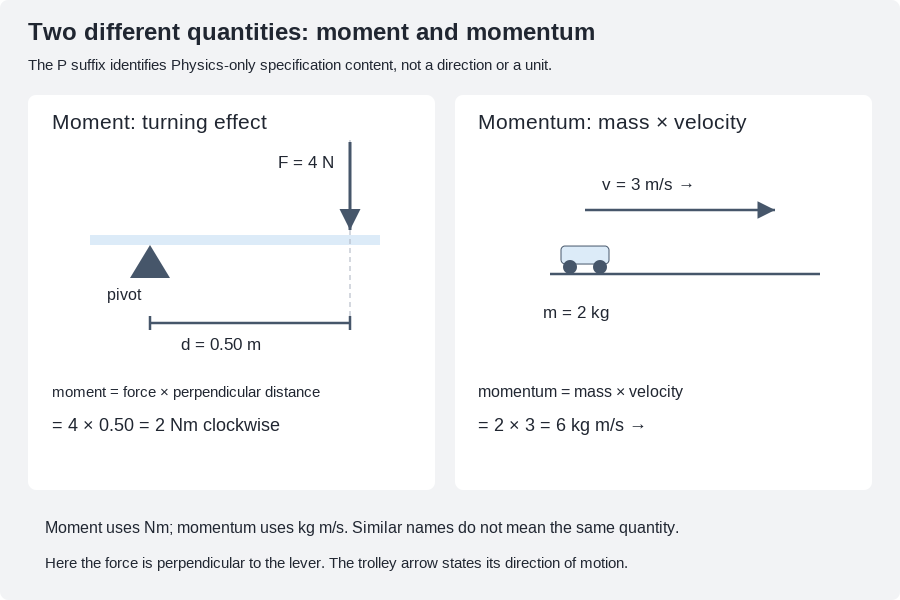
A momentThe turning effect of a force about a point, equal to force multiplied by perpendicular distance from that point to its line of action. describes the turning effect of a forceA push or pull arising from an interaction between objects, measured in newtons. about a pivotA fixed point or axis about which an object turns.. Its unit is the newton metre, written Nm or N m. momentumThe product of an object’s mass and velocity, measured in kilogram metres per second. combines an object’s massThe quantity measuring an object’s inertia, expressed in kilograms. and velocityThe rate of change of displacement, including the direction of motion.; its unit is kilogram metre per second, kg m/s. Similar names do not mean that moment and momentum are interchangeable.
The P suffix identifies additional Physics-only specification content. Both these units are taught and assessed within their assigned modular unit; P is not a separate unit number.
Build the unit from a turning example
A 4 N downward forceA push or pull arising from an interaction between objects, measured in newtons. acts with a perpendicular distanceThe shortest distance from a point to a line, measured at a right angle to that line. of 0.50 m from a pivotA fixed point or axis about which an object turns.. Its momentThe turning effect of a force about a point, equal to force multiplied by perpendicular distance from that point to its line of action. is 4 × 0.50 = 2.0 Nm clockwise. The unit is N multiplied by m. The distanceThe length of a path travelled, without regard to direction. must be perpendicular to the line along which the force acts.
Doubling this perpendicular distance doubles the turning effect for the same force. Although Nm has the same base-unit dimensions as the joule, report a moment in Nm: it measures a turning effect, not energyA conserved quantity transferred between stores by working, heating, electrical processes or radiation, measured in joules. transferred.
Build the momentum unit
A 2 kg trolley moving right at 3 m/s has momentumThe product of an object’s mass and velocity, measured in kilogram metres per second. 2 × 3 = 6 kg m/s to the right. Multiplying massThe quantity measuring an object’s inertia, expressed in kilograms. by velocityThe rate of change of displacement, including the direction of motion. gives the compound unit and the direction. The same trolley moving left has opposite momentum.
These are introductory unit examples. Later momentum and momentThe turning effect of a force about a point, equal to force multiplied by perpendicular distance from that point to its line of action. pages explain conservation, changes of momentum and balancing turning effects. For now, identify the quantity first, then choose its unit.
Equations
- moment = force × perpendicular distance from pivot; unit Nm
- momentum = mass × velocity; unit kg m/s
Common misconceptions
- Nm is not automatically the same physical quantity as joules, even though the units can be written in equivalent base-unit form.
- Momentum is not the same as speed: it depends on mass as well as velocity.