Learning goals
- Recall the SI units named in the specification.
- Choose a suitable unit for a measured quantity.
- Explain why unit consistency matters in calculations.
Name the quantity before choosing a unit
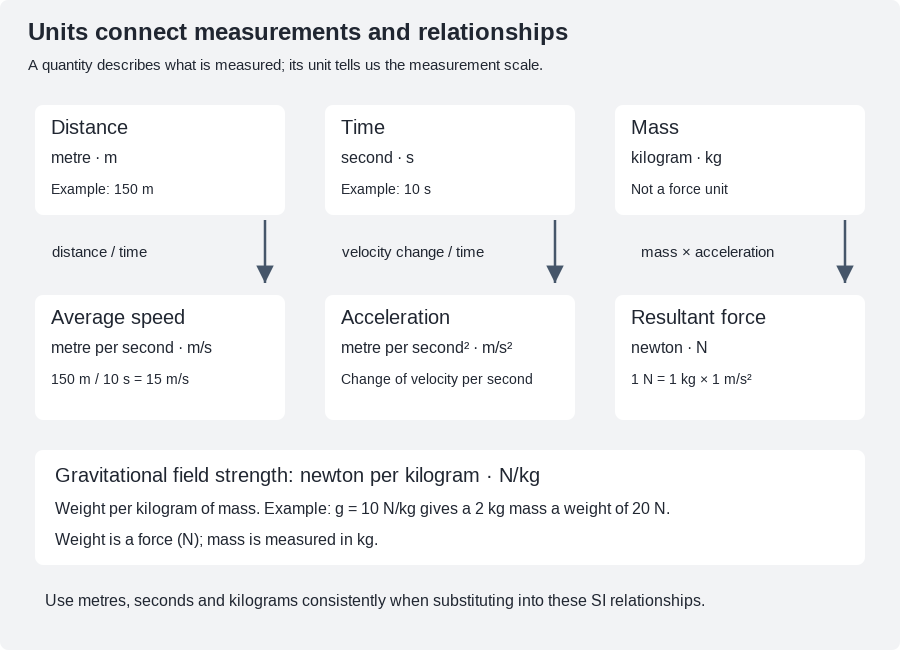
A physical quantity is something measurable, such as massThe quantity measuring an object’s inertia, expressed in kilograms. or time. A measurement combines a number with a unit: 12 m is a distanceThe length of a path travelled, without regard to direction., whereas 12 s is a time. Mass uses kilograms (kg), distance metres (m), and time seconds (s). speedThe distance travelled per unit time, without specifying direction. uses metres per second (m/s); accelerationThe change in velocity per unit time, measured in metres per second squared. uses metres per second squared (m/s²).
A forceA push or pull arising from an interaction between objects, measured in newtons. is measured in newtons (N). gravitational field strengthThe gravitational force per unit mass at a point, measured in newtons per kilogram. uses newtons per kilogram (N/kg): a field of 10 N/kg exerts 10 N of weightThe gravitational force acting on an object, equal to its mass multiplied by gravitational field strength. on each kilogram. These units describe different quantities, even when an answer happens to have the same number.
Read compound units
A speedThe distance travelled per unit time, without specifying direction. of 15 m/s means 15 metres travelled each second at constant speed. An accelerationThe change in velocity per unit time, measured in metres per second squared. of 2 m/s² means velocityThe rate of change of displacement, including the direction of motion. changes by 2 m/s each second in the stated direction. It does not mean velocity is squared, or multiplied by two.
A newton is the forceA push or pull arising from an interaction between objects, measured in newtons. needed to give a 1 kg massThe quantity measuring an object’s inertia, expressed in kilograms. an acceleration of 1 m/s². Thus N is equivalent to kg m/s². Keeping the units in a calculation helps expose mistakes such as dividing a distanceThe length of a path travelled, without regard to direction. by a mass to find speed.
Convert, calculate, check
A distanceThe length of a path travelled, without regard to direction. of 0.150 km is 150 m, and 10 s needs no conversion. average speedThe ratio of total path length to the entire elapsed time of a journey. = 150 m / 10 s = 15 m/s. Using 0.150 with seconds would instead give km/s, not m/s.
Useful conversions are 1 km = 1000 m, 1 m = 100 cm, 1 kg = 1000 g and 1 min = 60 s. For example, 250 g = 0.250 kg. Convert before substituting into an equation and include the final unit.
Equations
- average speed = distance ÷ time
Common misconceptions
- A newton is a unit of force, not mass; mass is measured in kilograms.
- m/s² means a change in speed of m/s every second; it is not m/s multiplied by 2.