By the end of this lesson
- Define top-down and bottom-up development and locate the Three Gorges Dam (China) and Grameen/BRAC-style rural programmes (Bangladesh) as contrasting projects.
- Explain advantages and disadvantages of each project for economy, welfare, environment and power over decisions.
- Evaluate when a large state project or a local household programme is the better tool, without inventing client counts or precise costs.
Two methods, two countries, two projects
top-downDescribes development planned and directed by governments or large organisations, with limited local control. developmentImprovement in people's living conditions and opportunities, assessed through economic, social and political measures. is planned and funded by a central authority — a national government, a state company or a large development bank — and delivered at a large scale. Ordinary people are mainly recipients (or, sometimes, people who must make way). bottom-upDescribes development led by local communities, responding to their priorities and involving them in decisions. development starts with local needs and local organisations. Households, villages or community groups help to design and run the project; the scale of each action is small, even if the organisation later becomes large.
This course compares a top-down flagship in an emerging country with a bottom-up tradition in a developing or emerging neighbour: the Three Gorges Dam on the Yangtze (Chang Jiang) in China, and microfinanceSmall-scale financial services, including loans and savings, offered to people excluded from conventional banking. plus BRAC’s rural development work in Bangladesh. The specification also asks for top-down and bottom-up projects in a named developed country. China and Bangladesh do not supply that half of the pairing on their own, so the next lesson adds a United Kingdom comparison: the London Docklands Development Corporation as a top-down project and the Eldonians in Liverpool as a bottom-up one. Learn this China–Bangladesh pair in depth first; then use the UK pair so you can judge the same methods across development levels.
Exam tip: define {top-down} and {bottom-up} in a sentence each, then locate {Three Gorges, China} and {Grameen or BRAC, Bangladesh} before you list any advantages.
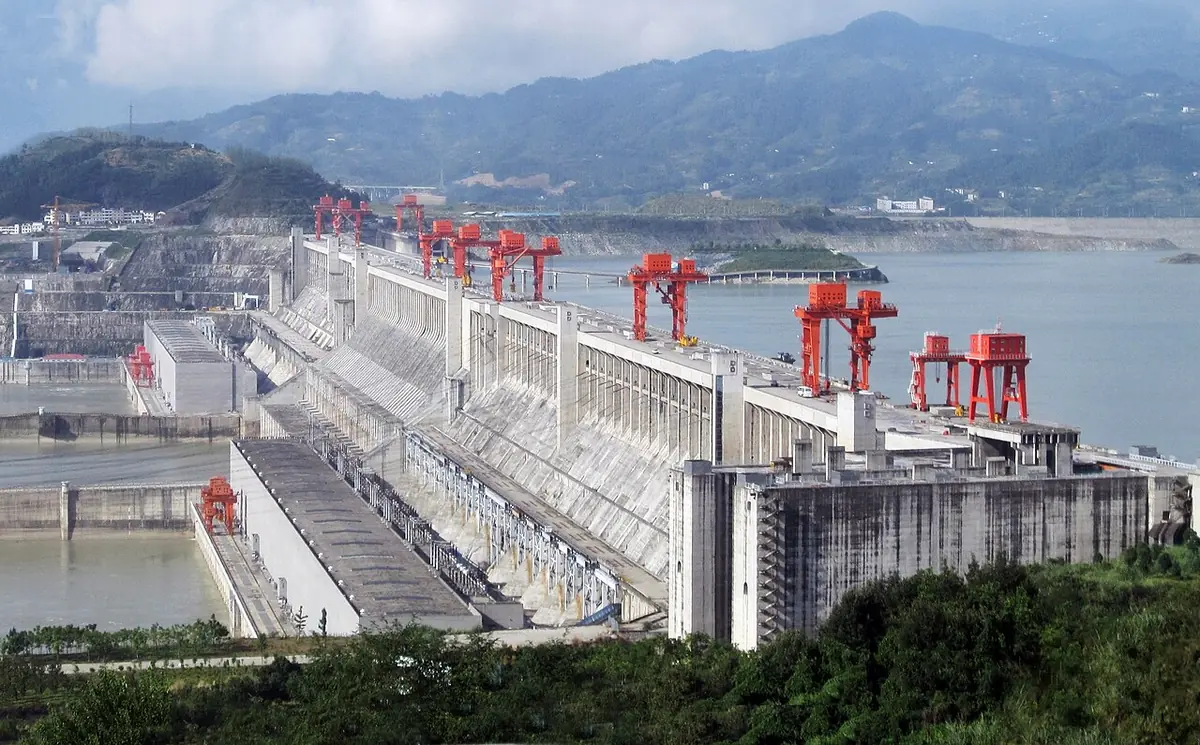
Three Gorges as a top-down project
The Three Gorges Dam stands on the Yangtze in central China, upstream of the densely settled middle and lower basin. Construction of the modern damA barrier across a river that holds back water and regulates downstream flow. began in the 1990s; the dam structure was completed in 2006, and the full set of generating units came into operation over the following years. It is a multi-purpose scheme: hydropowerElectricity generated by using moving or falling water to drive turbines., flood control, and improved navigation for ships heading toward the Chongqing region through what had been a more difficult gorgeA narrow, steep-sided valley, often left as a waterfall retreats upstream. section. Installed generating capacity is on the order of 22.5 gigawatts, which makes it the world’s largest hydroelectric power station by capacity. Those physical facts explain why a central state chose a top-downDescribes development planned and directed by governments or large organisations, with limited local control. route. No village committee can build a dam of that size.
Intended developmentImprovement in people's living conditions and opportunities, assessed through economic, social and political measures. benefits are national and regional. Electricity from a non-fossil source supports industry and cities, which links to Topic 4’s energy security. Flood-control storage aims to reduce the kind of catastrophic Yangtze flooding that has drowned low-lying towns and farmland in the past (the serious 1998 river floodAn event in which river discharge exceeds channel capacity and water spreads onto surrounding land. are part of the political memory that justified the project). Deeper navigation can cut transport costs and tie interior cities more closely into coastal export circuits — an attempt to reduce some of China’s own coastal–interior unevenness.
Because the decision, engineering and funding were central, the project displays classic top-down advantages: speed once approved, ability to mobilise huge capital and expertise, and a chance to supply national public goods (power, flood protection, a shipping channel) that markets and microloans cannot provide.
Three Gorges — costs, displacement and evaluation
The disadvantages are as structural as the advantages. Creating the reservoirAn artificial lake used to store water for supply, power generation or flood management. drowned towns, farmland and cultural sites along a long stretch of the Yangtze valley and required the resettlement of a very large population. A widely cited figure is {about 1.3 million people} displaced; treat that as an approximate, contested order of magnitude rather than a census you counted yourself, and note that critics and officials have argued over the true total and over the quality of resettlement. Losing ancestral land, graves and social networks is a welfare and political cost even when new apartments are offered. Some relocated households moved to less productive land or into urban labour markets they were not prepared for.
Environmental costs are debated in the scientific and campaign literature and should be taught as riskThe combination of the likelihood of harm and the seriousness of its consequences., not as invented certainties: sediment trapped behind the damA barrier across a river that holds back water and regulates downstream flow., downstream channel and delta changes, water-quality problems in the reservoir, pressure on species that used the free-flowing river, and concern about landslides on reservoir slopes. The dam does not “solve” climateThe average weather conditions and their variability in a place over a long period, usually at least 30 years. risk or remove the need for careful operation during extreme rainfall. There is also an opportunity-cost argument: the same money and political attention might have gone to many smaller efficiency, irrigation or social projects.
Evaluate with criteria. On energy and navigation, Three Gorges scores strongly as a national infrastructureThe basic networks and facilities, such as roads, water supply and electricity, that support an economy and daily life. success. On flood control, it adds storage but cannot be treated as a guarantee against every flood. On human welfarePeople's wellbeing, including their health, security and ability to meet basic needs. for inundated communities, the record is mixed to poor where displacement was involuntary and livelihoods were not rebuilt. On politics, local people had limited power to refuse. That last point is the heart of the top-downDescribes development planned and directed by governments or large organisations, with limited local control. critique: developmentImprovement in people's living conditions and opportunities, assessed through economic, social and political measures. done *to* a place rather than *with* it.
Grameen-style microfinance and BRAC as bottom-up work in Bangladesh
Bangladesh is a lower-income, densely populated country where rural povertyA condition in which people lack sufficient income or resources to meet basic needs or participate fully in society., flood exposureThe presence of people, property or livelihoods in places where a hazard can occur. and gender inequality have been central developmentImprovement in people's living conditions and opportunities, assessed through economic, social and political measures. problems — and where some of the world’s best-known bottom-upDescribes development led by local communities, responding to their priorities and involving them in decisions. organisations grew. Grameen Bank grew from a 1970s experiment by Muhammad Yunus in providing very small loans to people, many of them women, who were ignored by commercial banks. The bank was formally established in 1983. The model uses microcreditSmall loans provided to people with limited access to conventional banking, often to support livelihoods or small businesses.: small loans for a goat, a stall, a sewing machine or another household enterprise, often with a group-lending method in which neighbours support (and socially guarantee) one another. Yunus and Grameen Bank were awarded the Nobel Peace Prize in 2006. Do not memorise a current borrower total; the figure changes, and unofficial numbers in textbooks go stale.
BRAC began in 1972, after Bangladesh’s independence war, as a relief organisation and grew into a wide rural-development non-governmental organisationAn organisation independent of government that works towards aims such as humanitarian relief, development or environmental protection.. Its programmes have included education (non-formal schools), health (including work on oral rehydration, tuberculosis treatment and basic maternal care), microfinanceSmall-scale financial services, including loans and savings, offered to people excluded from conventional banking., and targeting of the ultra-poor. BRAC is often described as one of the world’s largest NGOs. Again, avoid invented client counts. What matters is the method: start with household and village constraints, combine credit with services, and scale up by repeating a local model rather than by pouring concrete across a gorgeA narrow, steep-sided valley, often left as a waterfall retreats upstream..
Bottom-up advantages follow. Projects can match local needs more closely. Women, who often manage household welfare but lack collateral, can gain a financial foothold. Failures are smaller: a failed stall hurts a family; a failed megadam transforms a region. Social capital — groups, schools, health volunteers — can remain after a particular loan cycle ends. Political legitimacy can be higher because participation is part of the design.
Bottom-up limits, and comparing the two
bottom-upDescribes development led by local communities, responding to their priorities and involving them in decisions. programmes have real limits, and honest teaching includes them. Small loans do not build a national power grid, a trunk road or a flood-control reservoirAn artificial lake used to store water for supply, power generation or flood management.. Interest rates and group pressure have been criticised where households became over-indebted or borrowed from one lender to pay another. The poorest people may be excluded if they seem too risky, which is why BRAC-style ultra-poor programmes try to add grants, training or health support rather than credit alone. Microenterprises can saturate a village market (too many similar stalls). non-governmental organisationAn organisation independent of government that works towards aims such as humanitarian relief, development or environmental protection. success can depend on charismatic founders and donor fashion. And “community” is not automatically fair: local elites can capture a committee just as national elites can capture a damA barrier across a river that holds back water and regulates downstream flow. contract.
Now compare. Three Gorges supplies energy, navigation and a flood-control tool at a scale Bangladesh’s village groups cannot match; it also imposed displacement and environmental riskThe combination of the likelihood of harm and the seriousness of its consequences. from the centre. Grameen and BRAC improve household opportunity, women’s participation and some health and education outcomes at a fine grain; they cannot, by themselves, protect Dhaka or coastal districts from a cyclone surge or generate China’s industrialDescribes an economy with a substantial manufacturing sector as production expands beyond primary activities. electricity. The better question is not “which is good?” but “which missing factor is this place trying to supply?” A country may need both: household welfare programmes *and* carefully governed infrastructureThe basic networks and facilities, such as roads, water supply and electricity, that support an economy and daily life..
China is not without bottom-up or local experiments, and Bangladesh has top-downDescribes development planned and directed by governments or large organisations, with limited local control. flood embankmentA raised bank built beside a river or coast to keep floodwater away from land behind it., export-zone policy and donor-funded infrastructure. Teach the named pair as clear examples of method, not as the only thing each country ever does.
Writing the 8-mark comparison
Build a grid before you write: purpose; who decides; who pays; scale; economic gains; welfare gains; environmental effects; who loses; whether the change lasts. Fill it for both projects, then write. A strong paragraph pair might be: “The Three Gorges Dam is top-downDescribes development planned and directed by governments or large organisations, with limited local control. because… Its advantages are… Its disadvantages are… By contrast, Grameen-style lending is bottom-upDescribes development led by local communities, responding to their priorities and involving them in decisions. because… It helps households by… It cannot…” Finish with a judgement tied to a criterion: energy security versus involuntary resettlement; women’s household income versus national flood control.
If the insert shows a photograph of a damA barrier across a river that holds back water and regulates downstream flow. wall, a reservoirAn artificial lake used to store water for supply, power generation or flood management. town, a women’s borrowing group, or a village school, start there. Use cautious numbers only: construction through the 1990s and 2000s, dam completed 2006, about 1.3 million displaced, Grameen formalised in 1983, Nobel Prize 2006, BRAC founded 1972. Do not invent the dam’s total cost in a particular currency, the exact length of the reservoir, or how many million clients either Bangladeshi organisation currently has.
The topic as a whole now has a complete arc. You can define and measure developmentImprovement in people's living conditions and opportunities, assessed through economic, social and political measures., explain why it is uneven globally and inside India, read demographic evidence, judge international strategies and competing views, and test two very different projects against welfare as well as growth. In the exam, pick the part of that arc the question actually asks for. An 8-mark item about top-down and bottom-up is not an invitation to retell the entire topic — it is an invitation to use China and Bangladesh as disciplined evidence, and to bring in the UK pair when the question asks about a developed country or wants contrast across development levels.
Carry the method test into unseen projects too. A high-speed railway, a state housing programme or a large irrigation canal is usually top-down. A community forest group, a cooperative dairy or a local sanitation committee is usually bottom-up. The named cases train your criteria; they are not the only places those criteria apply.
Governance quality decides how either method performs. A top-down project in a capable, relatively accountable state can deliver a port or a vaccine campaign that millions use. The same method in a weakly accountable system can become a monument that leaks money and serves a political elite. A bottom-up project in a setting with trusted local organisations can compound into national coverage, as BRAC’s growth suggests; the same label in a divided village can become a private club. When you evaluate, therefore, do not stop at “top-down” or “bottom-up”. Add a sentence about transparency, complaint routes and whether losers were heard.
Gender is a fair extra criterion on both sides of the comparison. Grameen-style lending made women’s participation part of the model, which is one reason it is taught as a welfare strategy rather than only as small-business finance. Large dams and industrialDescribes an economy with a substantial manufacturing sector as production expands beyond primary activities. schemes often employ men on construction and then provide electricity that households, including women, do use — but the losses of farmland and the search for new water points after resettlement often fall heavily on women. Asking “what happened to women’s time, income and safety?” stops an answer from treating a population as one male worker plus dependents.
History also explains why these two countries became textbook examples. China’s central state has long used large hydraulic works as nation-building tools, so a multi-purpose Yangtze dam fitted an existing political style. Bangladesh, born in 1971 after war and cyclone disasterA serious disruption causing losses beyond an affected community's ability to cope using its own resources., had a weaker fiscal state and a dense rural population that official banks rarely served, so non-governmental organisationAn organisation independent of government that works towards aims such as humanitarian relief, development or environmental protection. and household credit found space to grow. The methods match those starting points. Copying either project into a different political setting without that context is how case studies turn into slogans.
Top-down and bottom-up projects in China and Bangladesh
Both projects aim to promote development, but they supply different missing factors and distribute power very differently.
| Theme | Three Gorges Dam, China (top-down) | Grameen / BRAC, Bangladesh (bottom-up) |
|---|---|---|
| What it mainly supplies | Hydropower, flood-control storage, improved Yangtze navigation | Small credit, women’s economic participation, rural education and health services |
| Who decides | Central state and large agencies | Local groups and NGO programmes, with borrowers especially women in the Grameen model |
| Scale | National infrastructure; one huge site on the Yangtze | Household and village actions repeated across many places |
| Clear advantage | Can deliver public goods no microloan can fund | Matches local needs; failures are smaller; can reach women ignored by commercial banks |
| Clear disadvantage | About 1.3 million people displaced; environmental and livelihood controversies | Cannot build national energy or major flood-control infrastructure; debt and exclusion risks |
| Best evaluative question | Did national gains justify involuntary resettlement and ecological risk? | Do household gains last, reach the poorest, and add up without public infrastructure? |
Common misconceptions
Not quite: Top-down projects are always wasteful and bottom-up projects are always kind.
Instead: Large projects can supply power and flood storage; small projects can exclude people or create debt.
Not quite: A microloan programme can replace national infrastructure.
Instead: Household credit and a multi-purpose dam solve different missing factors.
Not quite: Everyone displaced by Three Gorges was fully compensated and content, or alternatively that no official benefit occurred.
Instead: National energy and navigation gains coexist with serious, contested resettlement costs.
Exam tips
Define the method, then name the places
{Top-down: Three Gorges, China}. {Bottom-up: Grameen/BRAC, Bangladesh}.
Judge with several criteria
Energy, floods, income, women’s welfare, environment and who had a voice.
Keep numbers cautious
Use {about 1.3 million} displaced, {2006} for dam completion and the Nobel Prize, {1983} for Grameen Bank, {1972} for BRAC’s origins.