By the end of this lesson
- Locate the 12 January 2010 Haiti earthquake and describe the physical and human setting that made it so deadly.
- Outline short-term relief and longer-term rebuilding, including problems of coordination and land tenure.
- Evaluate management using careful figures, including the disputed death toll.
Locating the 2010 earthquake
On 12 January 2010 at 16:53 local time, a magnitudeA measure of an event's size, expressed for earthquakes using the energy released at the source. 7.0 earthquakeA sudden shaking of the ground caused by the release of stored strain energy, usually along a fault. ruptured close to Haiti’s capital. The epicentreThe point on Earth's surface directly above an earthquake's focus. was near Léogâne, about 25 kilometres west of Port-au-Prince, and the focusThe point within the Earth where an earthquake begins and seismic energy is released. was shallow. The fault system involved is usually identified as the Enriquillo–Plantain Garden zone, a strike-slip boundary in the complex meeting of the Caribbean and North American plates. Shaking was violent in a densely peopled, poorly built urban region. Unlike Tōhoku, there was no great tsunamiA series of long waves generated by sudden displacement of a large volume of water, often by an undersea earthquake. as the main killer; the killer was collapsing buildings.
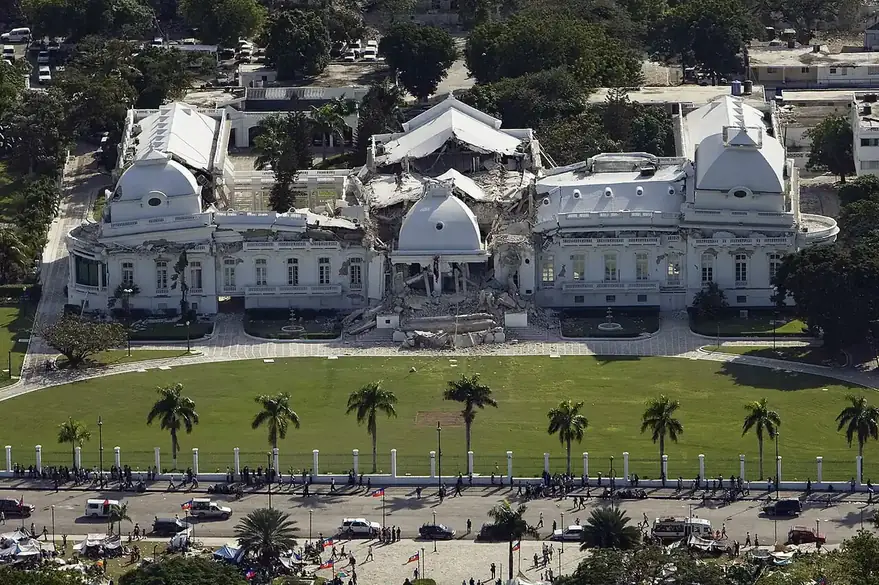
Haiti was, and is, a low-income country with a long history of political instability, inequality, and weak public services. Port-au-Prince had grown rapidly with widespread informal concrete and masonry construction and little effective enforcement of seismic codes. Many government buildings themselves failed, including the presidential palace and parts of the justice system. The United Nations mission headquarters collapsed, killing the mission chief and many staff, which also destroyed a layer of coordination the country had been relying on.
What had not been prepared
In the language of lesson 3.3a, almost every heading was thin. There was no nationwide earthquakeA sudden shaking of the ground caused by the release of stored strain energy, usually along a fault. early-warning culture comparable to Japan’s, little public drill practice for urban shaking, and no effectively enforced building code for the housing in which most people lived. hazard mappingThe mapping of areas potentially affected by hazards to guide warnings, planning and protection. existed in scientific papers more than in regulated land useThe purpose for which land is used, such as housing, farming, industry or recreation.. People lived at riskThe combination of the likelihood of harm and the seriousness of its consequences. because the capital offered work and services that the rest of a poor country did not — the 3.2a point — and they were vulnerable because of povertyA condition in which people lack sufficient income or resources to meet basic needs or participate fully in society., housing quality and governance — the 3.2b point.
This is not a claim that Haitians “did not care” about safety. It is a claim that the state and the economy had not been able to turn knowledge of the fault into safer masonry, trained inspectors, and practised household plans at national scale. Management case studies have to look at that pre-disaster reality, or the death toll looks like bad luck rather than geography.
Short-term relief
Search and rescue began with neighbours digging by hand. Professional Haitian responders were themselves bereaved and under-equipped; many police and medical facilities had been damaged. International urban-search-and-rescue teams flew in, and some people were pulled from voids days later, but as this topic has already stressed, most survivable rescues happen early. The airport became a bottleneck as aircraft competed to land; the United States helped to run air-traffic operations. The port was damaged. Roads were blocked by rubble and by informal settlements that had never been designed for emergency access.
About 1.5 million people were displaced into camps and informal sites in the following weeks, a commonly cited figure. Water, food, tarpaulins and medical care arrived in huge quantities from governments and non-governmental organisationAn organisation independent of government that works towards aims such as humanitarian relief, development or environmental protection., and also piled up behind logistical and coordination jams. Security fears and rumours complicated distribution. Field hospitals treated crush injuries and trauma in desperate conditions. The loss of government buildings meant that the “customer” for coordinated aidResources transferred to support people or places, including emergency relief and longer-term development assistance. — the Haitian state — was itself a casualty. That fact explains much of what television audiences interpreted only as chaos.
Longer-term planning and the cholera shadow
Rebuilding was slow. Land ownership in Port-au-Prince was often unclear, which made it hard to decide who had the right to a plot or a grant. Rubble clearance itself took a long time. Camps persisted for years in some places. International pledges were very large; the share converted quickly into safer permanent housing was much smaller, a gap that later inquiries and journalists documented in different ways. Some planned relocation settlements were far from jobs, repeating the worldwide error that safer land without livelihoods will not hold people.
From October 2010 a cholera epidemic spread, later linked to poor sanitation associated with an international peacekeeping camp — a bitter secondary disaster. Cholera killed several thousand people in the following years (a commonly cited order of magnitude is around 10,000 deaths across the outbreak’s main years). It was not caused by shaking; it was caused by contaminated water in a relief and reconstruction landscape. Mention it as a longer-term, human-made sequel that management should have been able to prevent, not as an earthquakeA sudden shaking of the ground caused by the release of stored strain energy, usually along a fault. hazardA potential source of harm to people, property or the environment. in the physical sense.
Death tolls, evaluation and comparison
How many people died on 12 January and in the immediate aftermath? The Haitian government later published a figure of more than 300,000. Several independent surveys and reviews have suggested lower, though still vast, totals, often in the range of about 100,000 to 160,000. You should not pretend there is one agreed number. Write that at least about a hundred thousand people died, that some official figures are much higher, and that the uncertainty itself is a symptom of weak data systems. Using 316,000 as if it were a laboratory measurement is as unwise as ignoring the scale of the slaughter.
Evaluation: successes were real but narrow — individual rescues, dedicated Haitian and foreign medical work, the later gradual closure of many camps, and the hard lesson that codes and land records are disasterA serious disruption causing losses beyond an affected community's ability to cope using its own resources. policy. Limitations were structural: almost no effective pre-event preparation of the housing stock; a decapitated government; logistical bottlenecks; a rebuilding process that left many people in unsafe conditions years later; and a cholera epidemic that added a second wave of deaths. Compared with Tōhoku, the energy released was far smaller and the deaths far more concentrated in collapsed buildings. The comparison teaches vulnerabilityThe susceptibility of people or assets to harm from a hazard because of their physical, social or economic conditions., not a morality play.
Exam tip: locate with {12 January 2010, Mw 7.0, near Léogâne / Port-au-Prince}, then manage under {little preparation, difficult relief, slow rebuilding}, and treat the death toll as {large and disputed}.
Port-au-Prince’s hillside districts matter in any spatial evaluation. Many informal houses stood on steep slopes that were hard for vehicles to reach even before the earthquakeA sudden shaking of the ground caused by the release of stored strain energy, usually along a fault.. Afterward, rubble narrowed paths further, so relief that arrived at the airport did not automatically arrive at those slopes. If a resource photograph shows a dense hillside settlement, use it: physical access is part of economic and social vulnerability, and part of why ‘aidResources transferred to support people or places, including emergency relief and longer-term development assistance. was sent’ is not the same sentence as ‘aid was received’.
Land tenure deserves its own developed sentence in rebuilding answers. Without an accepted title, a household may be unable to prove that a ruined house was theirs, unable to get a grant, and unable to stop someone else claiming the cleared plot. Programmes that try to rebuild ‘the city’ without sorting those claims stall, or they build on the only land the state can easily seize, which may be far from work. This is longer-term planning as law, not as architecture.
International aid after Haiti became a case study in the aid world itself: very large pledges, many non-governmental organisationAn organisation independent of government that works towards aims such as humanitarian relief, development or environmental protection., variable coordination with Haitian institutions, and a reconstruction that did not match the television promise of a transformed city. You do not need to prosecute any single organisation in an International GCSE answer. You do need to say that money announced is not the same as safer housing completed, and that a weakened state struggled to steer the flood of actors. That is an evaluative mechanism, not a rant.
When death-toll controversy appears in a source, treat it as data literacy. A government figure released months later, a household survey with confidence intervals, and a media estimate from week one are different kinds of number. Examiners will not require you to adjudicate the academic debate. They will reward you for not using a single figure with false confidence. ‘Many tens or hundreds of thousands of people died; published totals disagree because records and methods differ’ is a strong, honest sentence.
Write one comparison paragraph you can reuse only when invited: ‘Both Haiti 2010 and Tōhoku 2011 were deadly earthquakes in densely inhabited places, but Haiti’s Mw 7.0 struck weak urban buildings and a fragile state at close range, while Japan’s Mw 9.0 was managed with codes and warnings yet still killed more than 18,000 people by tsunamiA series of long waves generated by sudden displacement of a large volume of water, often by an undersea earthquake.. Haiti’s management story is mostly about what had not been built or coordinated beforehand and how slowly rebuilding proceeded; Japan’s is about a high-capacity system meeting a wave larger than some of its plans.’ Then stop. Extra anecdotes will not gain extra marks.
A final 8-mark habit: if the figure is a ruined government building, talk about the state as victim and as needed coordinator. If it is a camp aerial photograph from 2011 or 2012, talk about displacement lasting into the longer term. If it is a table of pledged versus disbursed funds, talk about the gap between announcement and rebuilding. Let the resource pick your paragraph, then support it with two or three anchored Haiti facts from this lesson.
Keep the cholera paragraph ethically precise. The epidemic caused immense extra suffering and was tied to sanitation failures associated with an external military camp, a finding that later became public and politically explosive. In this course it illustrates how short-term water and sanitation choices become longer-term life-and-death planning. It is not an excuse to write that ‘all aid is harmful’; clean water provided by many teams also saved lives. Evaluate particular systems, not the abstract idea of help.
Another anchored fact cluster for your card: date 12 January 2010; magnitudeA measure of an event's size, expressed for earthquakes using the energy released at the source. 7.0; shallow; epicentreThe point on Earth's surface directly above an earthquake's focus. near Léogâne about 25 km from Port-au-Prince; Enriquillo–Plantain Garden fault zone; building collapse as the main killer; about 1.5 million displaced; death toll disputed (about 100,000–160,000 in several independent estimates, over 300,000 in a Haitian government figure); cholera from October 2010 as a separate sanitary disaster; rebuilding slowed by rubble, weak institutions and land-tenure confusion. If a card adds precise dollar pledges or names every NGO, you will not remember them accurately under timed conditions.
You have now closed Topic 3’s taught sequence: what hazardA potential source of harm to people, property or the environment. are and where they occur; why cyclones and tectonic events happen; why people stay and why vulnerability differs; located impacts of Tōhoku, Eyjafjallajökull and Haiyan; generic earthquake management; and two contrasting earthquake case studies. The physical-geography half of the course’s optional topics is ready to sit beside Rivers and Coasts. Fieldwork for hazardous environments will later ask you to treat an extreme-weather enquiry with the same care you have just applied to these named events.
If a later skills page asks you to evaluate secondary sources about disasters, Haiti 2010 is a demanding example: numbers disagree, images are distressing and easily decontextualised, and English-language media often spoke about Haitians rather than with them. Practise describing what a source can reliably show — a collapsed palace, a camp layout, a table of displaced people — and what it cannot. That habit will serve unseen-data questions in Section B as well as these case-study essays.
With that caution in place, you can write about Haiti 2010 with both horror and precision, which is what this case study demanded of you.
Precision here means located facts, cautious numbers, and mechanisms rather than slogans.
Those three habits will also protect you on an unseen paper.
Write unseen answers the same way.
Common misconceptions
Not quite: Haiti’s earthquake was stronger than Japan’s in 2011.
Instead: It was much smaller in magnitude (7.0 against 9.0) but far closer to fragile urban housing.
Not quite: The death toll is known exactly.
Instead: Records were destroyed and methods differ. Use a cautious range and say why figures disagree.
Not quite: Cholera was a direct physical impact of the shaking.
Instead: It was a later water-borne epidemic linked to sanitation failures in the post-disaster landscape.
Exam tips
Locate the shallow urban earthquake
{12 January 2010}, {Mw 7.0}, {near Léogâne, ~25 km from Port-au-Prince}, {collapsing buildings as the main killer}.
Be honest about numbers
Write {at least about 100,000 deaths, with some official figures over 300,000} rather than one fake-neat total.
Compare mechanisms with Japan
Haiti: {housing and institutions}. Tōhoku: {tsunami exceeding defences}. Different events, different management failures.