By the end of this lesson
- Locate the 2011 Tōhoku disaster and outline how Japan had prepared for earthquakes and tsunamis.
- Describe short-term relief and longer-term reconstruction choices after 11 March 2011.
- Evaluate successes and limitations, especially the contrast between shaking and tsunami losses.
Locating a developed-country megathrust disaster
This course’s developed-country earthquake-management case study is Japan’s response to the Tōhoku earthquake and tsunami of 11 March 2011. A magnitudeA measure of an event's size, expressed for earthquakes using the energy released at the source. 9.0 rupture along the Japan Trench, east of northern Honshu, generated a tsunamiA series of long waves generated by sudden displacement of a large volume of water, often by an undersea earthquake. that killed most of the more than 18,000 people who died or remain missing. The shaking itself, though violent, caused relatively few collapses by global standards because of decades of building-code developmentImprovement in people's living conditions and opportunities, assessed through economic, social and political measures.. Management therefore has to be judged against two different hazardA potential source of harm to people, property or the environment. that arrived together: seismic shaking, which Japan was exceptionally well prepared for, and a tsunami that in places exceeded what many walls and maps had assumed.
A locate sentence: “On 11 March 2011 a Mw 9.0 megathrustA very large fault at a subduction zone where one tectonic plate is forced beneath another. earthquakeA sudden shaking of the ground caused by the release of stored strain energy, usually along a fault. off Tōhoku, Japan, generated a tsunami that inundated the Sendai plain and riaA drowned river valley forming an inlet after a relative rise in sea level. coasts of Iwate and Miyagi, and triggered the Fukushima Daiichi nuclear accident.” Then manage, do not merely repeat the impact lesson.
What was already in place
Japan had among the world’s most complete preparation packages: a dense seismic network and earthquakeA sudden shaking of the ground caused by the release of stored strain energy, usually along a fault. early-warning system run by the Japan Meteorological Agency; automatic actions that could slow high-speed trains and cut some gas supplies; regular school and community drills; tsunamiA series of long waves generated by sudden displacement of a large volume of water, often by an undersea earthquake. sirens and marked evacuation hills in many coastal towns; and building standards that had been tightened after previous disasterA serious disruption causing losses beyond an affected community's ability to cope using its own resources., including Kobe in 1995. Many communities had seawalls and breakwaters, some of them symbols of local pride. GISA computer system for storing, mapping and analysing spatial data in linked layers. and inundation modelling informed official hazardA potential source of harm to people, property or the environment. maps, although those maps would later be criticised where the 2011 water went further.
This package saved lives on the day, especially from shaking and, in some towns, from people who ran uphill without waiting. It also created a dangerous faith in walls. Residents who believed “our wall is high enough” lost minutes that they did not have. Preparation that is excellent on average can still fail a design event. That is the central evaluative idea of this case study.
Short-term responses
Warnings went out within seconds to minutes. Television, mobiles and sirens carried earthquakeA sudden shaking of the ground caused by the release of stored strain energy, usually along a fault. and then tsunamiA series of long waves generated by sudden displacement of a large volume of water, often by an undersea earthquake. alerts. Many children, trained at school, moved to higher ground. The tsunami still arrived quickly on nearby coasts — in some places in well under half an hour — and overtopped or destroyed defences. The Japan Self-Defence Forces launched one of the country’s largest ever peacetime operations: search, body recovery, water, food, medical care and debris clearance. Police, fire services and local governments worked inside a functioning national system, even where their own town halls had been wrecked. The United States supported logistics in Operation Tomodachi. Inland Japan’s intact transport and manufacturing base could send help towards the coast, unlike a disasterA serious disruption causing losses beyond an affected community's ability to cope using its own resources. that destroys a whole country’s core at once.
Limits were obvious on the ground. Isolated riaA drowned river valley forming an inlet after a relative rise in sea level. settlements waited because roads were gone. Fuel ran short. The nuclear emergency at Fukushima Daiichi forced additional evacuations, some of people who had already fled the wave, and absorbed political and technical attention. Mass-fatality management — identifying thousands of drowned victims — stretched local capacity for months. High-income status did not make those tasks dignified or easy; it made them possible at scale.
Longer-term planning and rebuilding
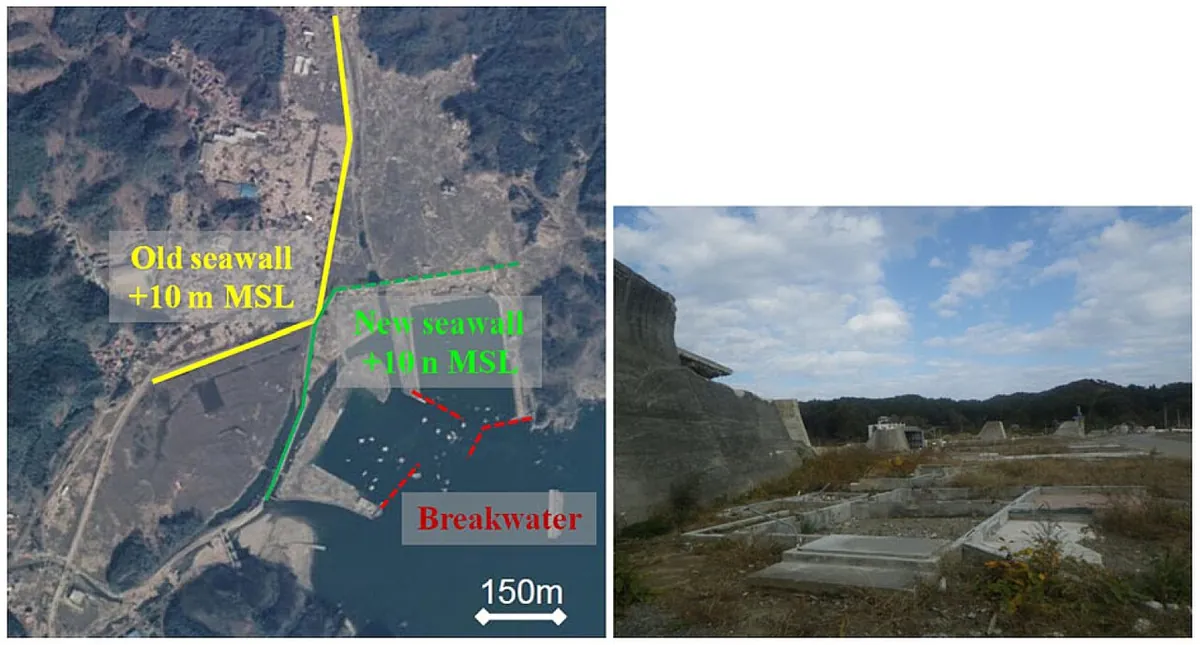
A national Reconstruction Agency was established in 2011 to coordinate a multi-year programme. Municipalities chose combinations of higher seawalls, raised land, and relocation of housing onto terraces or inland sites, with some former shorelines turned into parks or buffer zones. New inundation maps were drawn from the surveyed water levels. Building standards and tsunami-evacuation thinking were revised again. Along the coast you can still read the strategy in the landscape: a taller concrete wall, a raised highway that doubles as a barrier, a row of new houses looking down on empty lots where the old town stood.
Costs have been enormous, consistent with Tōhoku’s ranking among the most expensive natural disasterA serious disruption causing losses beyond an affected community's ability to cope using its own resources. recorded. Some towns have not regained their pre-2011 populations; an ageing Japan would have shrunk some of them anyway, but the disaster accelerated departure. Debates continue about whether very high walls protect or imprison, and about the long shadow of Fukushima for energy policy, farming and trust. Those are longer-term management outcomes, not just impacts.
Evaluating success
Successes: building codes prevented a Kobe-style collapse catastrophe from shaking; early warningThe communication of timely hazard information so people can take action before an event causes harm. and drills saved an unknown but real number of people; a capable state delivered relief and a funded reconstruction programme; many communities now sit higher or behind more conservative maps. Limitations: more than 18,000 people still died or vanished, mostly by drowning; some defences and maps were treated as guarantees; the nuclear plant’s sea-wall and backup-power assumptions failed; reconstruction has been slow and socially uneven; demographic recovery is incomplete. A fair judgement is that Japan managed the earthquakeA sudden shaking of the ground caused by the release of stored strain energy, usually along a fault. it had trained for better than the tsunamiA series of long waves generated by sudden displacement of a large volume of water, often by an undersea earthquake. that exceeded many plans, and that wealth plus institutions made recovery possible without making the event anything other than a national tragedy.
Exam tip: judge Tōhoku against {shaking versus tsunami}, and use {prepare / respond / rebuild} as your paragraph frames.
When you use Tōhoku in an 8-mark resource answer, pick the strand the figure actually shows. A photograph of an intact high-rise and a flattened harbour tells the shaking-versus-tsunami story. A map of new hillside housing tells the relocation story. A graph of municipal population since 2010 tells the longer-term social outcome. Bolting on Fukushima when the figure is about timber houses on a terrace wastes the resource. The nuclear accident is essential when the figure or question touches energy, evacuation zones or secondary hazards; otherwise a clause is enough.
Compare, do not copy-and-paste, when Haiti appears in the same question. Japan had codes, drills, a warning system and a reconstruction agency; Haiti did not have those at anything like the same coverage. Japan’s death toll was still terrible because of water. Haiti’s death toll was terrible because of buildings and institutions as well as shaking. The comparison is about mechanisms, not about awarding a gold star to one country and a fail mark to the other.
A revision card for this case should hold no more than ten anchored facts: date and magnitudeA measure of an event's size, expressed for earthquakes using the energy released at the source.; Japan Trench megathrustA very large fault at a subduction zone where one tectonic plate is forced beneath another.; tsunami as main killer; 18,000 dead or missing; early warning and codes; SDF relief; Reconstruction Agency; mixed wall-and-relocate strategies; Fukushima as secondary; evaluation split between shaking success and tsunami/nuclear limits. If your card is longer than that, you are collecting magazine detail that you will not have time to use.
School stories from 2011 are not decoration; they are evidence about preparation. In some towns, children who had practised ‘tsunami tendenko’ — the idea that each person should flee to high ground without first searching for family — survived in high proportionA part of a total expressed as a fraction, decimal or percentage., and their practiced independence became part of later education policy discussions. In other places, people died in designated evacuation buildings that the water still reached, which forced a redesign of what counts as a safe refuge. When a question asks you to evaluate warning and evacuation, these two outcomes should both appear: drills work, and a refuge below the actual waterline does not.
Seawall politics after 2011 are a gift for evaluate items. Supporters argue that a higher wall buys time and protects the remaining harbour industry on the low land that relocation cannot entirely empty. Opponents argue that walls are visually brutal, ecologically damaging to the nearshore, extremely expensive to maintain, and psychologically dangerous if they recreate the old sense of safety. A geographical judgement uses a criterion: for a dense fishing port with no nearby hill, a wall plus vertical evacuation may be the least-bad mix; for a spread-out plain, relocation and a sacrificial buffer may be better. ‘Walls bad, hills good’ is too simple for Tōhoku’s varied coasts.
Fukushima Daiichi needs a calm management paragraph. The plant’s designers had modelled tsunamis, but the 2011 wave exceeded the site’s protective assumptions and flooded backup generators. Loss of cooling led to core damage and radioactive releases. Evacuation zones emptied towns that the tsunami itself had not destroyed. Nationally, reactors were taken offline for checks, and Japan’s energy mix shifted towards fossil fuels and efficiencyThe proportion of an energy input converted into the intended useful output, improved by reducing energy losses. in the following years — a longer-term energy-management consequence you can mention without turning the lesson into physics. The management failure was one of design assumptions and regulation as well as of wave height.
International comparisons of cost can mislead. Tōhoku’s multi-hundred-billion-dollar bill reflects destroyed ports, factories, farmland, housing and energy plant in a high-value economy, plus a funded reconstruction state able to spend. A cheaper reconstruction bill elsewhere may mean less was rebuilt, not that less was suffered. When a table shows Japan at the top of a ‘costliest disasterA serious disruption causing losses beyond an affected community's ability to cope using its own resources.’ list, say what the money measures. Deaths, missing people, and towns that did not refill measure something else.
If you have time in an evaluate question, add one sentence about ageing. Many of the worst-hit riaA drowned river valley forming an inlet after a relative rise in sea level. municipalities already had a high share of older residents. Some could not run uphill quickly; some later chose not to return to prefabricated hillside units far from clinics. Management that ignores age structure will design stairs and distances that look fine on a GISA computer system for storing, mapping and analysing spatial data in linked layers. layer and fail on a Wednesday afternoon. That is social vulnerabilityThe susceptibility of people or assets to harm from a hazard because of their physical, social or economic conditions. returning inside a developed-country case, which stops the case study becoming a cartoon of perfect Japanese efficiency.
Close revision by rehearsing one 100-word judgement you can adapt: ‘Japan’s 2011 management shows a developed country applying world-leading codes, warnings and a national relief machine to a megathrust it had long expected, thereby limiting shaking deaths; the same country lost more than 18,000 people to a tsunami that overtopped defences and maps, and suffered a nuclear secondary crisis at Fukushima Daiichi. Reconstruction has been extensiveDescribes farming with relatively low inputs of labour or capital per unit area of land. but socially uneven, with higher walls, some relocation, and towns that have not regained their populations. Success is therefore real and incomplete.’ That is the tone examiners can reward.
A last practical warning about facts: run-up heights near 40 metres describe particular ria locations, not the entire Tōhoku coast, where many places saw much lower but still lethal water. Death-and-missing totals around 18,400 combine confirmed deaths of about 15,900 with roughly 2,500 missing, and they have been revised slightly over time. Using ‘about’ and attaching numbers to the right place is part of taking this case study seriously, just as you did with Maldives tsunami deaths versus the wider Indian Ocean total.
The Haiti case study that follows will feel like a different planet of management, but you should carry the same three headings across: what had been prepared, what relief looked like in the first weeks, and what rebuilding achieved over the following years. The contrast is the pedagogy. The respect you owe both places is the same.
If a question asks only about a developed country, stay in Japan; do not drag Haiti in just because you revised them as a pair. Pairing is a tool, not an obligation.
Use the pair only when the command word invites comparison.
Comparison needs a reason.
Common misconceptions
Not quite: Japan was not prepared, which is why so many people died.
Instead: Japan was highly prepared for shaking and for many tsunamis. This tsunami exceeded a number of local defences and assumptions.
Not quite: Seawalls made the disaster worse everywhere and should never be built.
Instead: Some walls were overtopped and some people trusted them too much, but defences still have a role when paired with evacuation and honest maps.
Not quite: The nuclear accident was a separate, coincidental event.
Instead: It was a secondary technological failure triggered when the tsunami disabled cooling at Fukushima Daiichi.
Exam tips
Locate, then manage
{11 March 2011, Mw 9.0, Japan Trench, tsunami, Fukushima as secondary}. Then {warning, codes, SDF, reconstruction}.
Split the judgement
{Codes and warning succeeded against shaking}. {Walls and some maps were exceeded by the tsunami}.
Use conservative numbers
More than {18,000 dead or missing}; tsunami run-up about {40 m} in a few ria locations; costs of {hundreds of billions of dollars}.