Learning goals
- Match the seven specified quantities to SI units.
- Convert distances and orbital periods before calculation.
- Distinguish weight, mass, field strength and acceleration.
Quantities before numbers
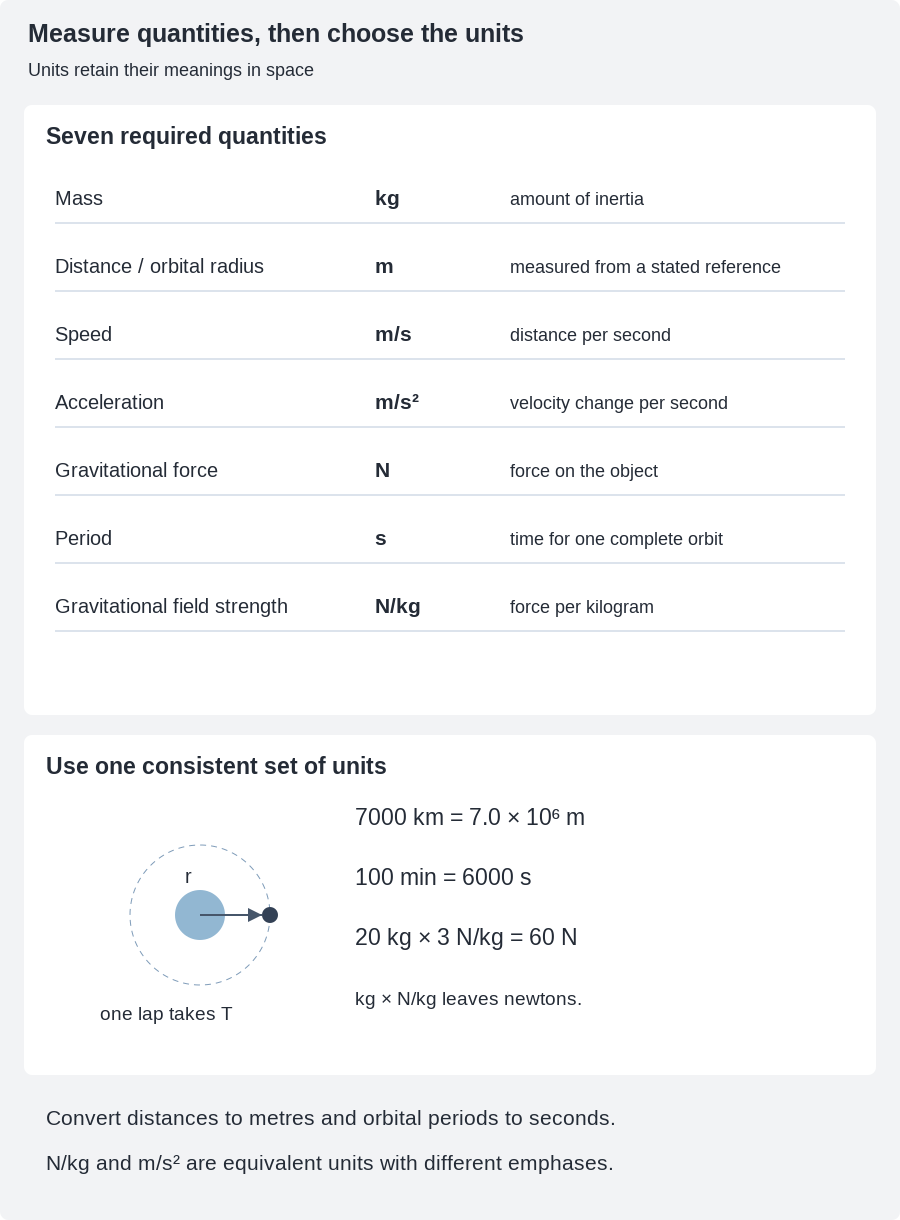
massThe quantity measuring an object’s inertia, expressed in kilograms. measures inertiaThe tendency of an object to retain its velocity unless acted on by a resultant force. and is recorded in kilograms (kg). distanceThe length of a path travelled, without regard to direction. and orbital radiusThe distance from the centre of the attracting body to the centre of an orbiting body in a circular orbit. use metres (m); time and periodThe time taken for one complete oscillation or repeating cycle. use seconds (s). speedThe distance travelled per unit time, without specifying direction. is distance travelled per second, in m/s. accelerationThe change in velocity per unit time, measured in metres per second squared. is change in velocityThe rate of change of displacement, including the direction of motion. per second, in m/s²: a direction change in an orbitThe curved path of a body moving around another under gravity. counts.
Gravitational forceA push or pull arising from an interaction between objects, measured in newtons. or weightThe gravitational force acting on an object, equal to its mass multiplied by gravitational field strength. uses newtons (N). gravitational field strengthThe gravitational force per unit mass at a point, measured in newtons per kilogram. g is force per kilogram, in N/kg. A field of 10 N/kg gives a 1 kg object a weight of 10 N. N/kg and m/s² are equivalent units, but the quantities emphasise force per mass and velocity change respectively.
Convert before substituting
One kilometre is 1000 m; one minute is 60 s and one hour is 3600 s. An orbital radiusThe distance from the centre of the attracting body to the centre of an orbiting body in a circular orbit. of 7000 km is 7.0 × 10⁶ m. A 100 min periodThe time taken for one complete oscillation or repeating cycle. is 6000 s. Dividing a distanceThe length of a path travelled, without regard to direction. in metres by this time gives m/s, not km/min.
Standard form keeps large distances manageable. Use supplied conversion factors to put distances and times into consistent units.
Check the meaning of the result
For a 20 kg instrument in a stated field of 3 N/kg, W = mg = 20 × 3 = 60 N. The kilograms cancel in kg × N/kg. Reporting 60 kg would confuse forceA push or pull arising from an interaction between objects, measured in newtons. with massThe quantity measuring an object’s inertia, expressed in kilograms.; changing location changes weightThe gravitational force acting on an object, equal to its mass multiplied by gravitational field strength., not the amount of matter.
Equations
- W = mg
Common misconceptions
- N measures force; kg measures mass.
- The square in m/s² belongs to seconds in the denominator.