Learning goals
- Match current, voltage and power to A, V and W.
- Explain what each quantity measures.
- Use units and prefixes in an electromagnetism example.
Current and voltage are different quantities
electric currentThe amount of electric charge passing a point per unit time, measured in amperes. I is the rate of flow of electric chargeA property of particles responsible for electrical interactions, measured in coulombs., measured in amperes (A). A current of 2 A means 2 C of charge passes a point each second. An ammeterAn instrument connected in series to measure electric current. measures current in series with the component.
potential differenceThe energy transferred per unit charge between two points, measured in volts. V is the energyA conserved quantity transferred between stores by working, heating, electrical processes or radiation, measured in joules. transferred per unit charge, measured in volts (V). A potential difference of 12 V means 12 J is transferred for each coulomb passing through the component. A voltmeterAn instrument connected in parallel to measure potential difference. connects across its two terminals.
Power tells us the rate of energy transfer
powerThe energy transferred or work done per unit time, measured in watts. P is measured in watts (W). One watt is one joule transferred each second. Electrical input power is not automatically the useful output power: a motor also warms its surroundings and may transfer energyA conserved quantity transferred between stores by working, heating, electrical processes or radiation, measured in joules. by soundA mechanical wave produced by vibrations and transmitted through a material medium..
A motor uses electrical input to produce mechanical output. A generatorA device transferring mechanical energy to electrical energy by electromagnetic induction. transfers mechanical input to electrical output. A transformerA device using electromagnetic induction between coils to change alternating voltage. changes alternating potential differenceThe energy transferred per unit charge between two points, measured in volts. and electric currentThe amount of electric charge passing a point per unit time, measured in amperes.; it does not supply extra energy. These applications use the same three electrical units.
Worked motor example
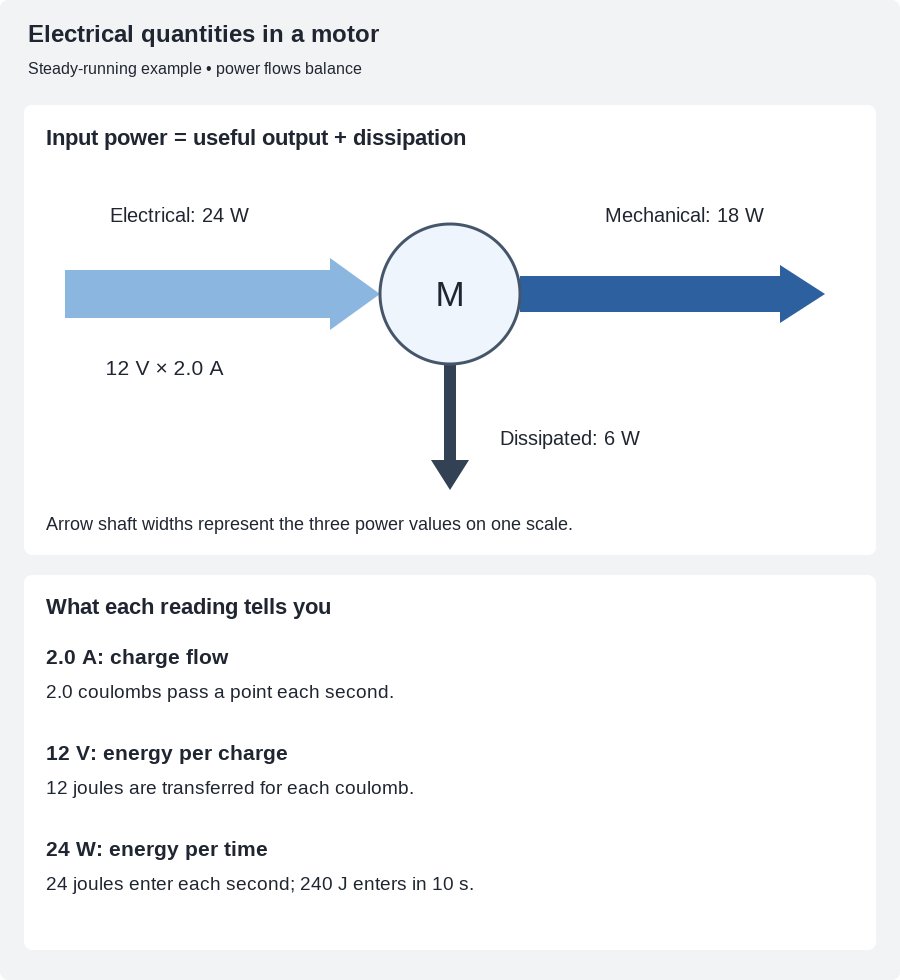
A motor takes a steady electric currentThe amount of electric charge passing a point per unit time, measured in amperes. of 2.0 A at 12 V. Its electrical input powerThe energy transferred or work done per unit time, measured in watts. is P = VI = 12 × 2.0 = 24 W. In 10 s it receives E = Pt = 24 × 10 = 240 J.
In the diagram, useful mechanical output is 18 W and dissipationTransfer of energy to less useful stores, usually spread through the surroundings by heating. is 6 W. These add to the 24 W input; in 10 s the corresponding energyA conserved quantity transferred between stores by working, heating, electrical processes or radiation, measured in joules. are 180 J and 60 J. electric chargeA property of particles responsible for electrical interactions, measured in coulombs. flows through the circuit while energy is transferred.
Check the unit before using the number
Convert 250 mA to 0.250 A before multiplying by a potential differenceThe energy transferred per unit charge between two points, measured in volts.. At 12 V this gives 3.0 W, not 3000 W. Conversely, 2.4 kW is 2400 W.
The unit V can mean volts, while the italic quantity symbol V represents potential difference in these equations. A magnetic fieldA region where magnets, magnetic materials or moving charges experience magnetic forces. is not a voltage or a electric currentThe amount of electric charge passing a point per unit time, measured in amperes.; A, V and W are the specified electrical units for this topic.
Equations
- P = VI; P in W, V in V and I in A.
- E = Pt; E in J and t in s. 1 A = 1 C/s; 1 V = 1 J/C; 1 W = 1 J/s.
Common misconceptions
- Amperes, volts and watts are not interchangeable.
- Current is not used up by a motor; energy is transferred.
- Input power need not equal useful output power.
- Convert mA to A before substitution.