Learning goals
- Use degrees, hertz, metres, metres per second and seconds.
- Distinguish frequency from period and wavelength.
- Convert common wave units before calculation.
Five units and the quantities they measure
An angle is measured in degrees (°), for example between a light ray and the normalA reference line or direction perpendicular to a surface or plane. to a surface. frequencyThe number of complete oscillations or wave cycles per second, measured in hertz. f is measured in hertz (Hz): one hertz means one complete oscillationOne complete repeated motion about an equilibrium position. or cycle per second. A 5 Hz source makes five cycles each second.
distanceThe length of a path travelled, without regard to direction., including wavelengthThe shortest distance between two successive points in phase on a wave. λ and displacementThe straight-line change in position from a starting point, with a specified direction. amplitudeThe maximum displacement from the equilibrium position in an oscillation., are measured in metres (m). wave speedThe distance a wave disturbance travels per unit time, equal to frequency multiplied by wavelength. v is measured in metres per second (m/s), while time and the periodThe time taken for one complete oscillation or repeating cycle. T of one cycle are measured in seconds (s). The same distance unit can describe different quantities, so always identify what was measured.
Read the horizontal axis
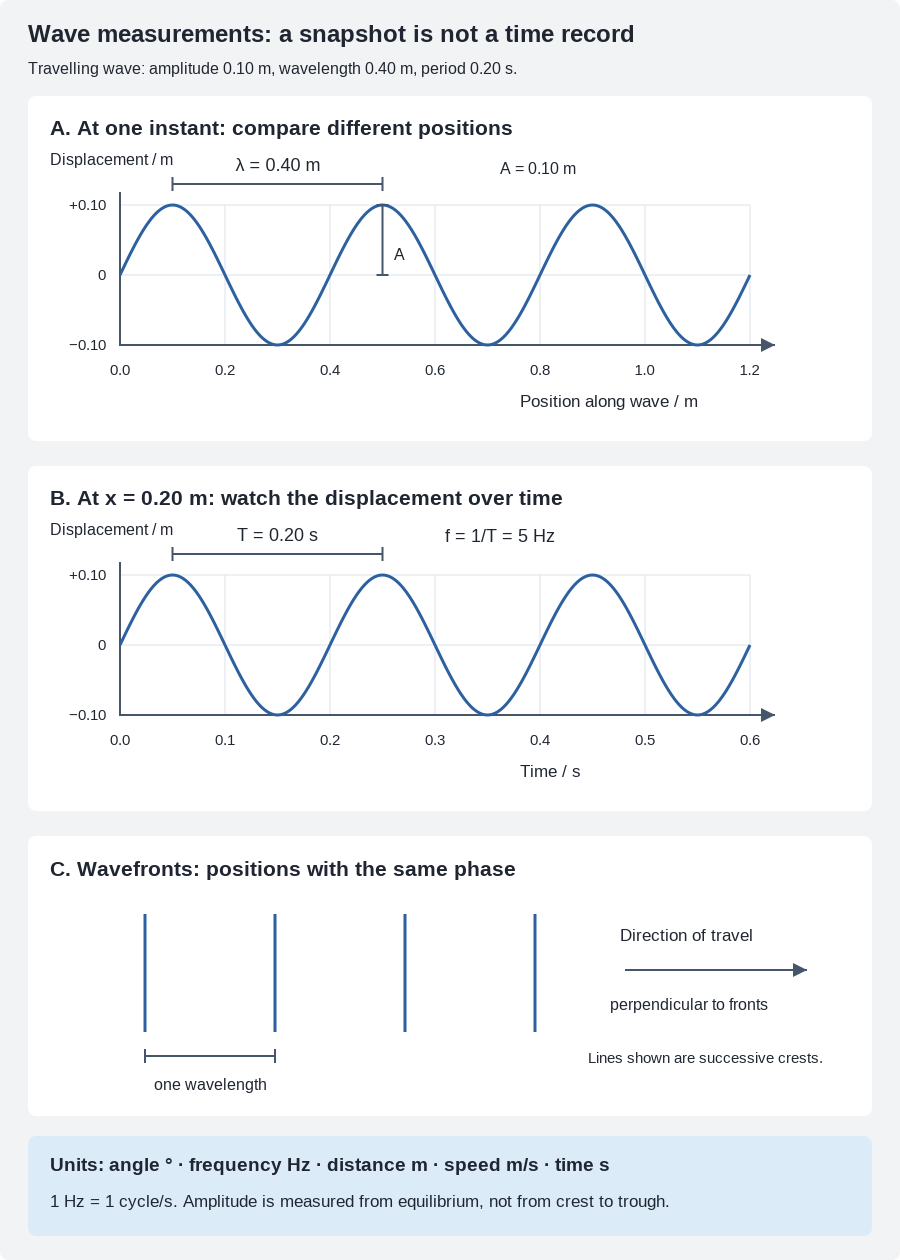
The top graph in the figure is a snapshot of displacementThe straight-line change in position from a starting point, with a specified direction. at different positions. Its horizontal axis is in metres; the distanceThe length of a path travelled, without regard to direction. between adjacent crestA point of maximum positive displacement on a transverse wave. is a wavelengthThe shortest distance between two successive points in phase on a wave., 0.40 m. The vertical displacement from equilibriumA state in which both the resultant force and the resultant moment on an object are zero. to a crest is the amplitudeThe maximum displacement from the equilibrium position in an oscillation., 0.10 m.
The second graph watches one fixed position over time. Its horizontal axis is in seconds; adjacent crests are separated by one periodThe time taken for one complete oscillation or repeating cycle., 0.20 s. Those are different measurements even though the two graph shapes look similar. Five periods fit into one second, so the frequencyThe number of complete oscillations or wave cycles per second, measured in hertz. is 5 Hz.
Convert before substituting
Use 1 cm = 0.01 m, 1 mm = 0.001 m, 1 ms = 0.001 s, 1 kHz = 1000 Hz and 1 MHz = 1 000 000 Hz. For example, 40 cm = 0.40 m and 200 ms = 0.200 s. Keep the unit with every intermediate value.
A frequencyThe number of complete oscillations or wave cycles per second, measured in hertz. of 5 Hz and wavelengthThe shortest distance between two successive points in phase on a wave. 0.40 m give a speedThe distance travelled per unit time, without specifying direction. of 2.0 m/s, as developed in 5.5. Hertz means per second, so multiplying hertz by metres gives metres per second. Angles in this course are in degrees; check the calculator mode when later using trigonometry.
Equations
- 1 Hz = 1 cycle per second
- 1 ms = 10⁻³ s; 1 kHz = 10³ Hz; 1 MHz = 10⁶ Hz
Common misconceptions
- A period is measured in seconds, not hertz. Frequency is a number of cycles per second.
- A horizontal distance between crests is a wavelength only on a graph whose horizontal axis is position.