Learning goals
- Match the eight specified quantities to SI units.
- Distinguish energy, work and power.
- Convert quantities before substitution.
Quantities and their units
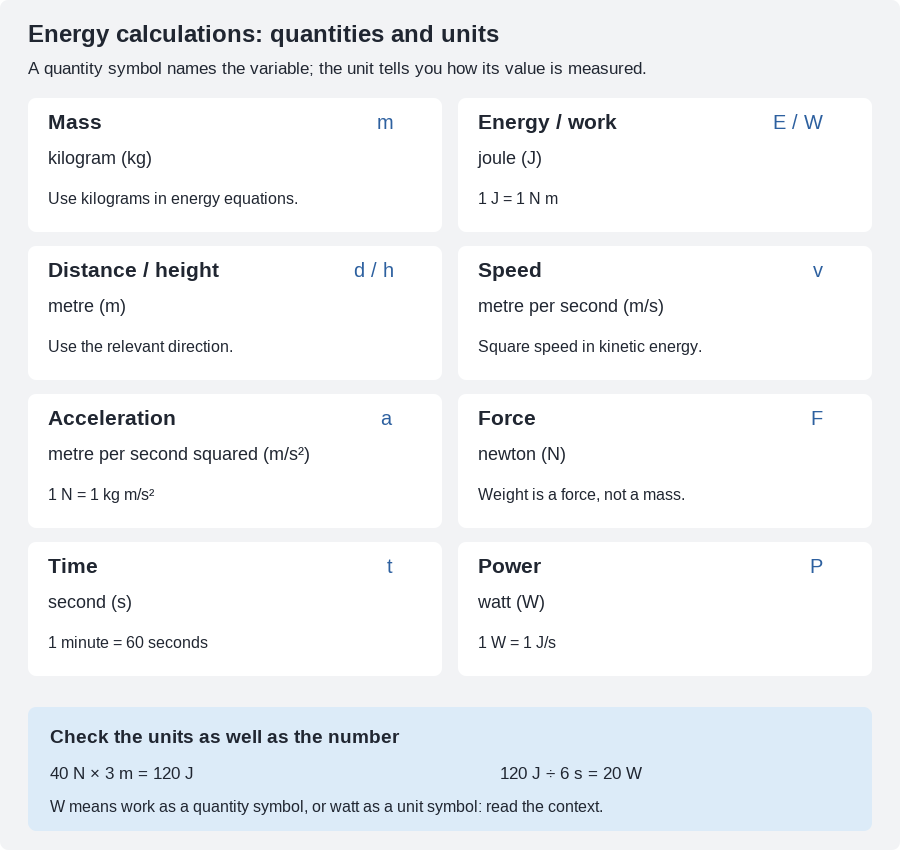
massThe quantity measuring an object’s inertia, expressed in kilograms. is measured in kilograms (kg), forceA push or pull arising from an interaction between objects, measured in newtons. in newtons (N), distanceThe length of a path travelled, without regard to direction. and height in metres (m), time in seconds (s), speedThe distance travelled per unit time, without specifying direction. in metres per second (m/s), and accelerationThe change in velocity per unit time, measured in metres per second squared. in metres per second squared (m/s²). energyA conserved quantity transferred between stores by working, heating, electrical processes or radiation, measured in joules. and work are both measured in joules (J); powerThe energy transferred or work done per unit time, measured in watts. is measured in watts (W).
These units connect: one joule is the work doneThe energy transferred by a force acting through a distance in its direction. by a one-newton force through one metre in its direction. One watt means one joule transferred each second. A device rated 20 W does not contain 20 J: it transfers energy at a rate of 20 J/s.
Use context to interpret symbols
W can represent work doneThe energy transferred by a force acting through a distance in its direction. as a quantity symbol, while W after a number is the unit watt. For example, work W = 120 J and powerThe energy transferred or work done per unit time, measured in watts. P = 20 W describe different quantities. The figure separates variable symbols from unit names.
The unit N m for work has the same dimensions as the momentThe turning effect of a force about a point, equal to force multiplied by perpendicular distance from that point to its line of action. unit, but work and moment describe different physical ideas. Write an energyA conserved quantity transferred between stores by working, heating, electrical processes or radiation, measured in joules. or work result in joules; use N m for a turning moment.
Check a worked chain
A constant 40 N forceA push or pull arising from an interaction between objects, measured in newtons. moves an object 3 m in the force direction. Work = 40 × 3 = 120 N m = 120 J. If this transfer takes 6 s, average powerThe energy transferred or work done per unit time, measured in watts. = 120/6 = 20 J/s = 20 W.
Convert before calculating: 500 g = 0.500 kg, 75 cm = 0.75 m, 2 min = 120 s and 1.5 kW = 1500 W. In kinetic-energy calculations square the speedThe distance travelled per unit time, without specifying direction. including its units; (3 m/s)² is 9 m²/s², not 9 m/s. Later pages explain the equations in detail.
Equations
- 1 J = 1 N m
- 1 W = 1 J/s
Common misconceptions
- Joules measure an amount of energy; watts measure how quickly it is transferred.