Learning goals
- Match electrical quantities to their symbols and SI units.
- Distinguish current, voltage and power.
- Convert common prefixes and time units before calculations.
Quantity, symbol and unit
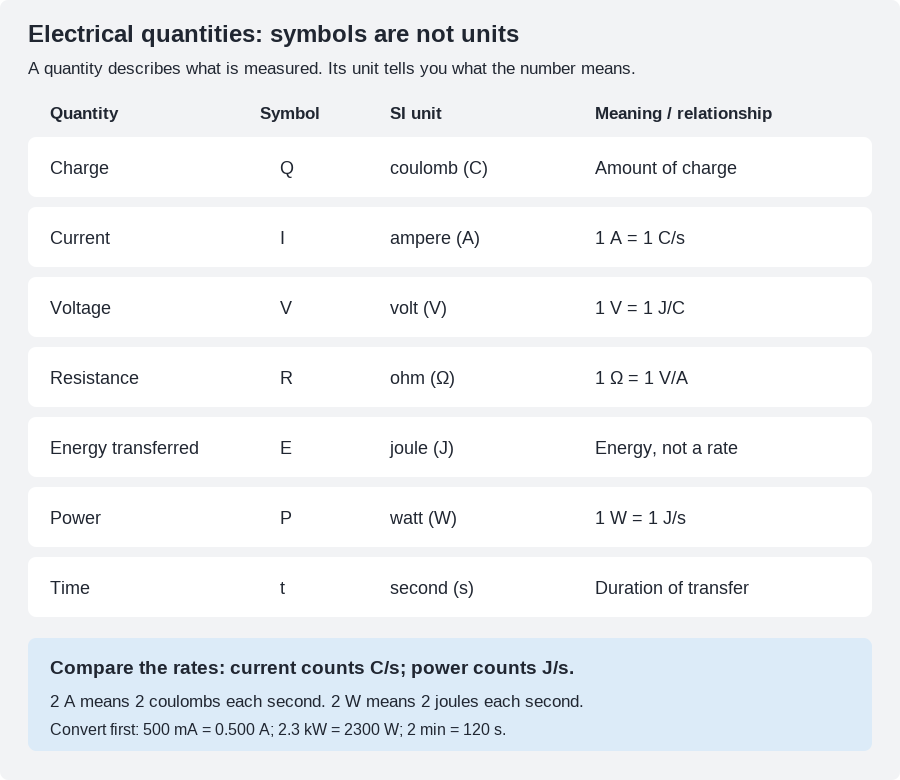
electric chargeA property of particles responsible for electrical interactions, measured in coulombs. Q is measured in coulombs (C). electric currentThe amount of electric charge passing a point per unit time, measured in amperes. I is the rate of charge flow, measured in amperes (A): 1 A means 1 C passes a point each second. potential differenceThe energy transferred per unit charge between two points, measured in volts. or potential difference V describes energyA conserved quantity transferred between stores by working, heating, electrical processes or radiation, measured in joules. transferred per unit charge, measured in volts (V): 1 V means 1 J per C.
resistanceThe ratio of potential difference across a component to the current through it, measured in ohms. R is measured in ohms (Ω) and relates voltage to current. Energy transferred E is measured in joules (J). powerThe energy transferred or work done per unit time, measured in watts. P is the rate of energy transfer, measured in watts (W), where 1 W means 1 J each second. Time t is measured in seconds (s).
Do not confuse the two rates
A electric currentThe amount of electric charge passing a point per unit time, measured in amperes. of 2 A means 2 C of electric chargeA property of particles responsible for electrical interactions, measured in coulombs. passes each second; a powerThe energy transferred or work done per unit time, measured in watts. of 2 W means 2 J of energyA conserved quantity transferred between stores by working, heating, electrical processes or radiation, measured in joules. is transferred each second. Neither value by itself gives the other. potential differenceThe energy transferred per unit charge between two points, measured in volts. supplies the link between energy and charge.
The symbol I names the current quantity, while A names its unit. Voltage happens to use V for both the quantity symbol and the unit symbol; context distinguishes them. Include the unit with every numerical answer.
Convert before substituting
The prefix milli means one thousandth: 500 mA = 500/1000 = 0.500 A. Kilo means one thousand: 2.3 kW = 2.3 × 1000 = 2300 W. Two minutes is 2 × 60 = 120 s.
Check the unit relationship as you calculate: electric currentThe amount of electric charge passing a point per unit time, measured in amperes. × potential differenceThe energy transferred per unit charge between two points, measured in volts. has units C/s × J/C = J/s, which is powerThe energy transferred or work done per unit time, measured in watts. in W. The later circuit pages explain how these quantities are measured and connected.
Equations
- 1 A = 1 C/s
- 1 V = 1 J/C
- 1 Ω = 1 V/A
- 1 W = 1 J/s
Common misconceptions
- Current is charge per second; voltage is energy per charge.
- Watts measure power, not total energy; coulombs measure charge, not current.