Learning goals
- Identify the two upward support reactions.
- Use moments to find how load position changes them.
- Check the total force and limiting positions.
The reactions share the load
A light beam has negligible weightThe gravitational force acting on an object, equal to its mass multiplied by gravitational field strength. compared with its load. For a horizontal beam at rest on two end supports, the upward reactions add to the downward load. Their individual sizes depend on the load position. A central load gives equal reactions; moving it towards one support increases the reaction there.
forceA push or pull arising from an interaction between objects, measured in newtons. balance gives their sum but cannot alone tell you how it is shared. The principle of momentsFor rotational equilibrium, the sum of clockwise moments about a point equals the sum of anticlockwise moments about that point. supplies the second relationship. Assume the beam remains rigid, at rest and in contact with both supports.
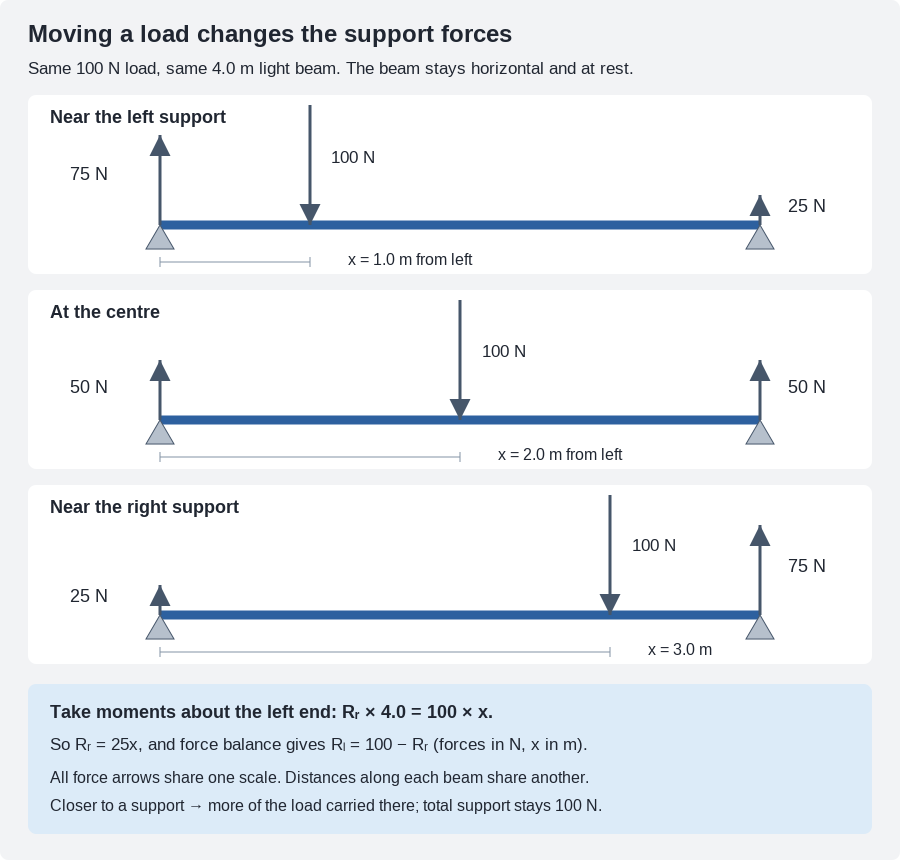
Worked example: a 4.0 m beam
Place a 100 N load a distanceThe length of a path travelled, without regard to direction. x from the left support. Take momentThe turning effect of a force about a point, equal to force multiplied by perpendicular distance from that point to its line of action. about the left end. The left reaction has zero moment there. The right reaction Rᵣ produces anticlockwise moment Rᵣ × 4.0, while the load produces clockwise moment 100 × x.
Therefore Rᵣ = 100x/4.0. When x = 1.0 m, Rᵣ = 25 N and Rₗ = 100 − 25 = 75 N. At x = 2.0 m both reactions are 50 N. At x = 3.0 m the right reaction is 75 N and the left is 25 N. These are the three positions drawn.
Check the limits of the model
As the load approaches the left support, x approaches zero and the right reaction approaches zero. At the right support the opposite occurs. At every position between the supports the reactions still sum to 100 N.
If the beam has significant weightThe gravitational force acting on an object, equal to its mass multiplied by gravitational field strength., include that weight at its centre of gravityThe point through which an object’s total weight is represented as acting. as an additional load. Moving the object does not change its weight; it changes the momentThe turning effect of a force about a point, equal to force multiplied by perpendicular distance from that point to its line of action. that the support reactions must balance.
Equations
- Rₗ + Rᵣ = W
- RᵣL = Wx; x measured from the left support
- Rₗ = W(L − x)/L for a light beam with the load between its supports
Common misconceptions
- The nearest support usually carries more load, not necessarily all of it.
- A load changing position does not change its weight.