Learning goals
- Identify u, v, a and s in a motion problem.
- Substitute values with consistent units.
- Rearrange and check the result for physical sense.
When the equation applies
The relationship v² = u² + 2as describes straight-line motion with constant accelerationThe change in velocity per unit time, measured in metres per second squared.. Here u and v are initial and final velocityThe rate of change of displacement, including the direction of motion. in m/s, a is acceleration in m/s² and s is displacementThe straight-line change in position from a starting point, with a specified direction. in m, with a consistent positive direction.
For a journey without reversal, displacement magnitude equals distanceThe length of a path travelled, without regard to direction. moved, so the equation can relate initial speedThe distance travelled per unit time, without specifying direction., final speed, acceleration and distance. It is useful when time is not known. An arbitrary average acceleration cannot replace constant acceleration in this relationship.
Worked example: accelerating from rest
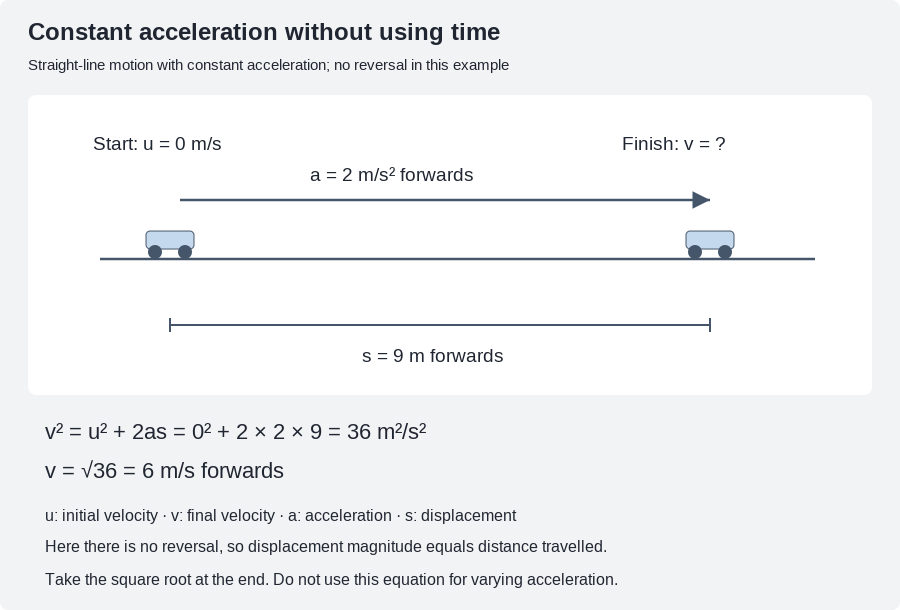
The trolley starts from rest, so u = 0. It accelerates at 2 m/s² over 9 m forwards. Substitute: v² = 0² + 2 × 2 × 9 = 36 m²/s².
Take the square root: final speedThe distance travelled per unit time, without specifying direction. = √36 = 6 m/s. A result of 36 m/s would forget the square root. The forward direction selects +6 m/s for velocityThe rate of change of displacement, including the direction of motion.; the equation by itself gives a squared value.
Worked example: braking distance
Take forward as positive. A vehicle has u = +20 m/s, v = 0 and constant a = −5 m/s². Rearrange to s = (v² − u²)/(2a).
Substitute: s = (0 − 400)/(2 × −5) = 40 m forwards. The two negative signs give a positive stopping displacementThe straight-line change in position from a starting point, with a specified direction.. This model describes braking only; any reaction distanceThe length of a path travelled, without regard to direction. must be added separately.
Check assumptions and units
Convert lengths to metres and speedThe distance travelled per unit time, without specifying direction. to m/s before calculating. For example, 72 km/h = 72 × 1000/3600 = 20 m/s.
Check that the physical situation can reach the specified endpoint. A negative calculated v² means the stated constant-acceleration model cannot reach that position with a real velocityThe rate of change of displacement, including the direction of motion.; it is not a negative speed.
Equations
- v² = u² + 2as
Common misconceptions
- The equation contains v², so take a square root at the end when finding v.
- This relationship requires constant acceleration. An arbitrary time-averaged acceleration cannot generally be substituted when acceleration varies.