By the end of this lesson
- Describe squatter settlements and the informal economy in Lagos and explain why they have grown.
- Explain urban pollution and low quality of life using located Lagos detail without inventing precise slum percentages.
- Compare these specified challenges with London’s without ranking the two cities as simply “bad” and “good”.
Why Lagos is the named city
This course uses Lagos, Nigeria, as the urban environment in a named developing or emerging country. Nigeria’s large commercial city sits on a maze of islands, mainland and lagoonA shallow body of water separated from the open sea by a reef, spit or other barrier. along the Gulf of Guinea. It grew as a port and administrative centre and remains the country’s main commercial hub even though the political capital is Abuja. Population figures vary with the boundary: what matters for the specification is that Lagos is a megacityAn urban area with a population of at least ten million people. and that a very large share of daily life happens outside fully planned, fully serviced neighbourhoods.
The specified challenges are squatter settlementAn area of housing built on land occupied without legal permission, often with limited services and insecure tenure., the informal economyEconomic activity outside full official registration, taxation or regulation, often offering insecure incomes and limited worker protection., urban pollutionContamination of air, water or land in towns and cities by transport, industry, waste or other activities. and low quality of life. Those headings overlap on the ground — an unplanned waterside settlement may combine insecure housing, informal employmentPaid work that is not fully registered, regulated or protected through formal employment arrangements., polluted water and poor health access — but your written answers should still peel them apart so an examiner can tick each one.
Exam tip: first sentence {In Lagos, Nigeria…}, then the heading you are about to explain. Do not spend half a page repeating the informal-employment lesson without using the words on this specification list.
Squatter settlements
A squatter settlementAn area of housing built on land occupied without legal permission, often with limited services and insecure tenure. (often also called an informal or unplanned settlement) is housing built without formal permission on land the occupiers do not legally own or have not been granted through the formal planning system, usually with inadequate official services at the start. Roofs and walls may be improved over time; the defining issues are insecure tenure and the missing or delayed planned infrastructureThe basic networks and facilities, such as roads, water supply and electricity, that support an economy and daily life. — piped water, sewerage, durable roads, official electricity connections and recognised addresses.
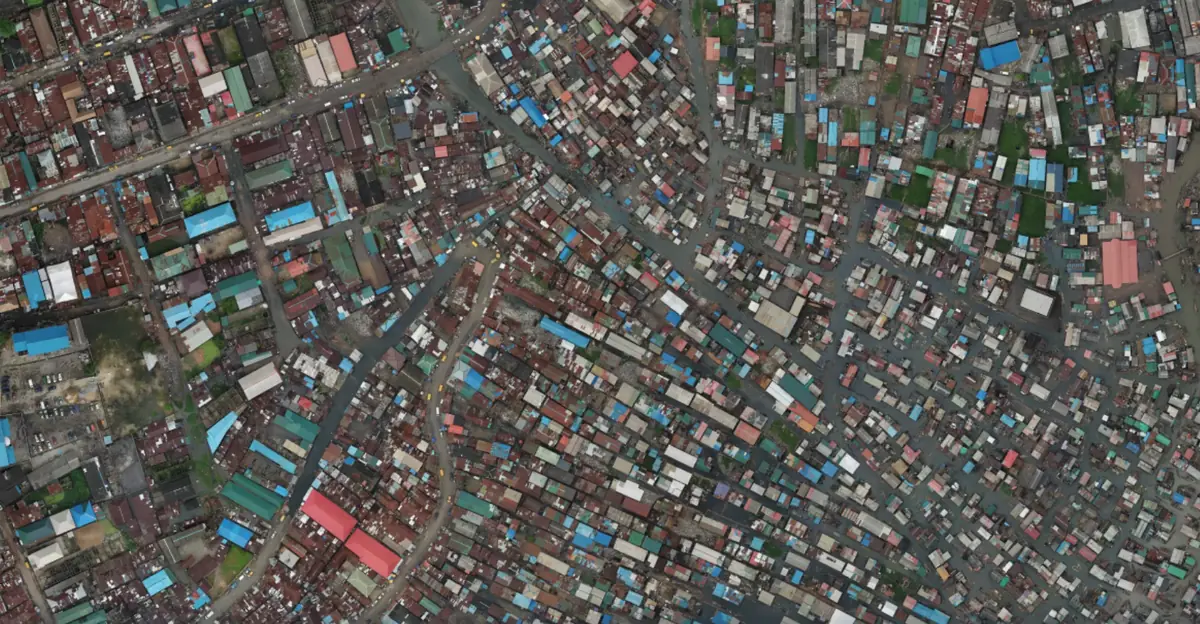
In Lagos such settlements have grown because formal housing production and formal plot allocation have not kept pace with migrationThe movement of people from one place to another to live for a significant period. and natural increasePopulation growth resulting from births exceeding deaths, excluding migration., and because land valueThe monetary worth of land, influenced by demand, accessibility and the activities permitted there. on well-serviced ground are far beyond many arrivals’ means. People occupy leftover or hazardous sites: lagoonA shallow body of water separated from the open sea by a reef, spit or other barrier. edges, marshy ground, land beside industry or waste sites, and leftover plots inside already dense mainland districts. Makoko, a well-known settlement built largely on stilts over the lagoon, is a located example of water-edge informal housing linked to fishing and other informal employmentPaid work that is not fully registered, regulated or protected through formal employment arrangements.. It should be taught as one real place among many, not as a nickname for the whole city. Most Lagosians do not live in Makoko; many do live in informal or self-built housing of various types across the mainland and islands.
Do not invent a percentage of “slum dwellers”. Published estimates disagree because definitions and boundaries disagree. In an exam, “a large share of residents live in informal or self-built housing that originally lacked planned services” is safer and more honest than a fake precise figure. If the paper prints a percentage, use that figure and name the source year in the booklet.
The informal economy
You have already defined informal employmentPaid work that is not fully registered, regulated or protected through formal employment arrangements. as work without formal contracts or social protection. In this topic it reappears as a city-wide challenge and as a livelihood strategy. Markets, roadside trading, danfo minibuses, repairs, construction day-labour, domestic work and waste picking are visible parts of how Lagos functions. Formal offices and ports on Lagos Island, Victoria Island and in mainland districts such as Ikeja depend on cheap food, transport, cleaning and maintenance that informal workers often provide.
As a challenge, informality means insecure incomes, exposureThe presence of people, property or livelihoods in places where a hazard can occur. to traffic and weather, periodic crackdowns on traders or motorcycle taxis, lost tax revenue for the state, and planning conflicts over who may occupy a pavement or a bus route. As a resource, it means the city can absorb newcomers without an equivalent number of factory or office vacancies. A balanced answer holds both sides, just as the Topic 4 lesson asked you to do, and then links informal work to housing: people who earn irregular cash cannot easily enter a formal mortgage market, which feeds demand for informal shelter.
Urban pollution
urban pollutionContamination of air, water or land in towns and cities by transport, industry, waste or other activities. in Lagos is a bundle of air, water and land problems concentrated by rapid growth, road traffic, industry and gaps in waste and wastewater systems. Air quality is affected by aged vehicle fleets, congestionOvercrowding of a transport network that slows movement as demand approaches or exceeds capacity., and widespread private generators used when mains electricity is unreliable. Water pollution affects the lagoonA shallow body of water separated from the open sea by a reef, spit or other barrier., creeks and open drains where sewage treatment and drainage have not kept up with housing, and where solid waste blocks channels. Land pollution includes uncollected household rubbish and large dumps that have served the city over the years, such as the mainland Olusosun site, whose role has changed as the waste system has been reorganised — describe dump-edge work and hazardA potential source of harm to people, property or the environment. as part of a changing landscape, not as a single frozen landmark.
Flooding after heavy rain is both a hazard and a pollution event: dirty water enters homes and informal workplaces. Building on wetlandLand permanently or seasonally saturated with water, supporting plants adapted to waterlogged conditions. and paved surfaces reduces natural storage, a physical-geography link back to urbanisationAn increase in the proportion of a population living in urban areas. as a flood factor. Photographs of waste in a drainage channel support a pollution point; they do not prove that “the city has no waste collection anywhere”. Maps of flood-prone islands and mainland hollows support an environmental-quality point if you describe them carefully.
Low quality of life
quality of lifeThe overall wellbeing of people, including health, security, access to services and satisfaction with their surroundings. is broader than income. In this specification it includes the housing, environmental health, services and security that let people live rather than only survive. Low quality of life in parts of Lagos can mean overcrowded or flood-prone rooms, irregular water that must be bought from vendors, shared or inadequate sanitation, long and unsafe journeys, unreliable electricity, and limited access to affordable healthcare and good schools. These conditions are uneven. Planned estates and guarded apartments exist in the same city as informal waterside neighbourhoods; averages hide that contrast just as borough averages hide London’s contrasts.
Socio-economic data still help, even if official figures under-count informal residents. Look for indicators of access to improved water and sanitation, room density, travel time, school attendance and health if the paper provides them. Qualitative evidence — annotated photographs, resident interviews in an unfamiliar fieldwork-style insert — can show what a percentage cannot: how a household storeA part of a system in which water or other material is held for a period of time. water, or how a stallholder uses a generator.
Exam workshop — four headings and no invented statistics
A typical question asks you to explain two challenges of urban growth in a named developing or emerging country, or to assess the difficulties of improving quality of lifeThe overall wellbeing of people, including health, security, access to services and satisfaction with their surroundings.. Name Lagos at once. Take squatter settlements and one other heading, or pollution and quality of life, and give a because chain plus a located detail (Makoko or another water-edge settlement for housing; generators and traffic for air; lagoonA shallow body of water separated from the open sea by a reef, spit or other barrier. and blocked drains for water; informal employmentPaid work that is not fully registered, regulated or protected through formal employment arrangements. linking income to housing). If the question wants evaluation, judge how far the challenge is caused by the speed of growth, by governance and infrastructureThe basic networks and facilities, such as roads, water supply and electricity, that support an economy and daily life. gaps, and by inequality inside the city rather than by “povertyA condition in which people lack sufficient income or resources to meet basic needs or participate fully in society.” as a single word.
Compare cautiously with London when asked. Both cities show congestionOvercrowding of a transport network that slows movement as demand approaches or exceeds capacity., unequal neighbourhoods and consumption that the local environment cannot supply unaided. Lagos’s specified list emphasises informal housing and informal work; London’s emphasises concentrated consumption and segregationThe spatial separation of groups within a population, often linked to income, ethnicity or access to housing. inside a mostly formal housing market. Using the wrong list for the wrong city loses easy marks.
Worked outline: define the heading; locate it in Lagos; explain one cause linked to rapid megacityAn urban area with a population of at least ten million people. growth; explain one consequence for people or environment; add one uncertainty (data, intra-city variation). That five-part paragraph can be reused for each of the four headings.
Environmental quality and quality of life are cousins, not twins. A neighbourhood can have relatively solid houses and still suffer generator fumes and noisy roads; a waterside informal settlement can have strong community networks and still face dangerous water quality. When an 8-mark question says “assess variations in quality of life”, look for more than one indicator and more than one district. Skill (5) in the next key idea will ask you to judge environmental-quality variation with quantitative and qualitative information; start practising that habit here by pairing a map with a photograph and saying what each cannot show.
Rural connections still run under the city. Many residents keep ties to villages in other Nigerian states, send remittancesMoney sent by migrants to people in their place of origin, often supporting household spending and investment., or arrived recently enough that rural droughtA prolonged period of unusually low precipitation that creates water deficits for ecosystems and people., inheritance or schooling decisions are part of their urban story. That link back to rural environments stops you from treating Lagos as a closed island. It also explains why cityward migrationThe movement of people from one place to another to live for a significant period. continues even when urban problems are well known: the expected chance of work and education still outweighs the known hardships for many households.
Avoid two tones that weaken answers. One is pity without geography (“people live terrible lives”) with no mechanism. The other is boosterism without evidence (“Lagos is a modern megacity so these problems are exaggerated”). The geographical tone names processes, places and unevenness, and it leaves room for residents’ own strategies — saving to improve a dwelling, organising local security, running a stall — without pretending those strategies replace piped water.
How the four headings feed one another
It is worth drawing the four challenges as a loop so you do not treat them as a shopping list. Insecure housing on poorly drained land increases exposureThe presence of people, property or livelihoods in places where a hazard can occur. to polluted floodwater, which harms health and therefore quality of lifeThe overall wellbeing of people, including health, security, access to services and satisfaction with their surroundings.. Irregular informal incomes make it harder to rent formal rooms, which sustains demand for squatter and self-built housing. Uncollected waste and generator fumes are environmental problems and also quality-of-life problems, especially for children and for traders who work in the street all day. An 8-mark answer that shows two of those links, without losing the named headings, reads as synoptic rather than messy.
Governance belongs in the explanation even though the “who manages the city” lesson comes later. Lagos State Government, local government areas, federal agencies, traditional land authorities, large developers and resident associations do not always pull in the same direction. Evictions or trading bans can remove a visible informal use without providing an alternative; upgradingImproving existing informal housing and services while allowing residents to remain, rather than clearing the settlement. programmes can improve services if tenure and drainage are taken seriously. You do not need a full political history in this lesson, but you should avoid the implication that problems persist only because residents have not tried to improve their own streets.
When an unfamiliar insert is about another rapidly grown African or Asian city, reuse the headings and change the located detail. Squatter settlements on steep slopes rather than stilts, informal employmentPaid work that is not fully registered, regulated or protected through formal employment arrangements. in garment workshops rather than danfo buses, pollution from brick kilns rather than generators — the structure still works. What you must not do is paste a Makoko paragraph onto a photograph that is clearly an inland grid of self-built houses. Match the evidence in front of you, then add one Lagos comparison if the question asks for a named example.
A final data caution: aerial photographs of dense roofscapes are powerful, but they flatten differences in tenure, income and services. Two similarly dense patches may have very different access to water or schools. That is why the specification later asks for quantitative *and* qualitative judgement of environmental quality. Start writing sentences such as “the map shows variation in X, while the photograph suggests Y, and together they still cannot tell us Z”.
Common misconceptions
Not quite: Almost everyone in Lagos lives in one famous stilt settlement.
Instead: Informal and self-built housing is widespread and varied; named examples should not become a stereotype of the whole megacity.
Not quite: The informal economy is separate from the “real” city.
Instead: Formal offices, ports and homes rely on informal food, transport, repairs and construction labour.
Not quite: Pollution is only caused by household litter.
Instead: Traffic, generators, industry, missing sewerage and dumps all contribute, and flooding spreads contaminated water.
Exam tips
Use the four headings
Build Lagos answers around {squatter settlements, informal economy, urban pollution and low quality of life}.
Locate, but do not sensationalise
{Makoko} is one water-edge example; most informal housing is not that single settlement.
Do not invent slum percentages
Say that {a large share} of residents live in informal or self-built housing unless the paper prints a figure.