By the end of this lesson
- Locate the Great Barrier Reef and describe the abiotic conditions that allow it to grow.
- Describe key biotic features of the reef, including the coral–zooxanthellae partnership.
- Interpret a simple nutrient-cycle diagram and a food-web diagram for this ecosystem.
Locating the named ecosystem
Your named coastal ecosystemA system of organisms interacting with each other and with their non-living environment. for this course is the Great Barrier Reef, off the north-east coast of Australia in the Coral Sea. It runs for about 2,300 kilometres along Queensland, from the Torres Strait region in the north towards Bundaberg in the south, and it is the world’s largest coral-reef system — a chain of about 3,000 individual reefs and many islands rather than a single wall of coral. It was inscribed as a UNESCO World Heritage Site in 1981. Much of it lies within the Great Barrier Reef Marine Park, for which the Great Barrier Reef Marine Park Authority (GBRMPA), created in 1975, is the main manager.
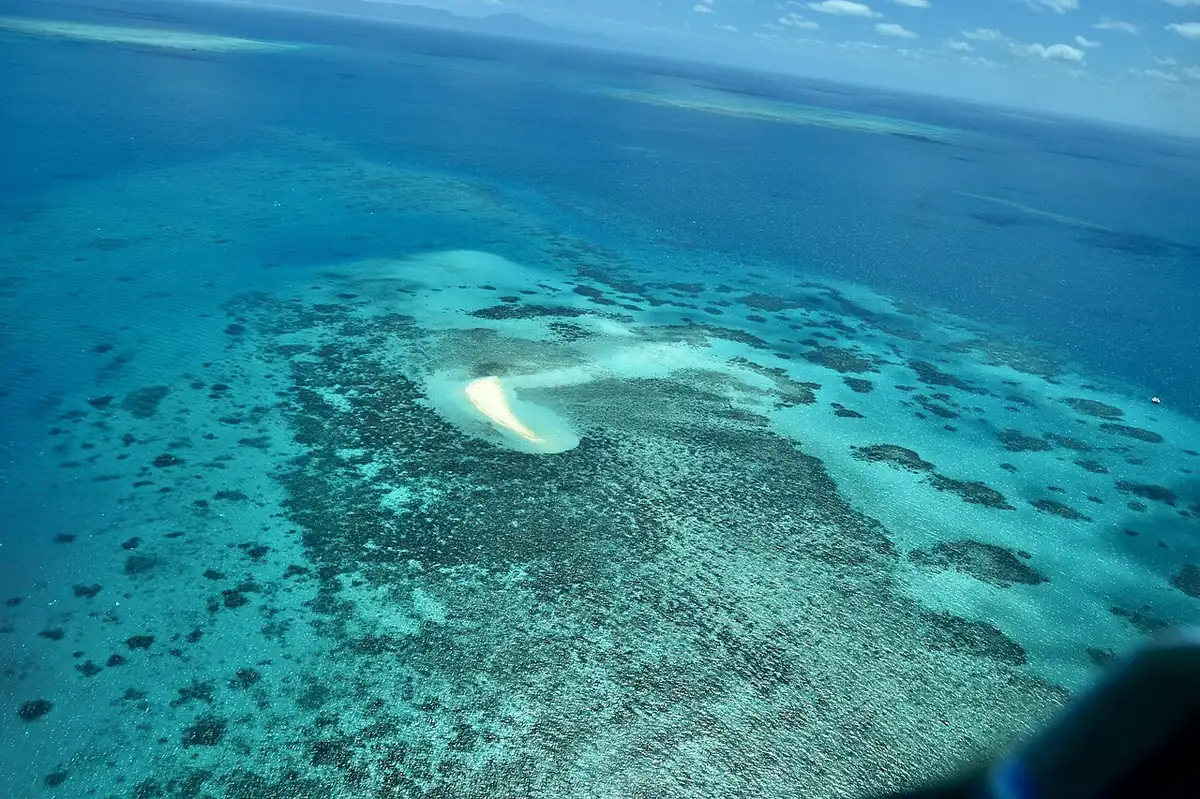
Those facts give you an exam-ready locate sentence: “The Great Barrier Reef is a coral-reef ecosystem off Queensland, north-east Australia, stretching about 2,300 km through tropical and subtropical waters of the Coral Sea.” Do not waste marks on a vague “reef in Australia”. The specification wants a named ecosystem with abioticDescribes the non-living parts of an ecosystem, including light, temperature, water and sediment. and bioticDescribes the living parts of an ecosystem and their interactions. characteristics you can apply, plus the skill of reading {nutrient-cycle and food-web diagrams}. Management detail belongs mainly in later lessons; here you need the ecosystem itself.
The reef is not uniform. Northern sections are more tropical; southern sections are closer to the subtropical limit of comfortable reef growth. Inner reefs, closer to the Queensland coast, feel river plumes and sediment more than outer reefs facing the open Coral Sea. When a resource booklet shows one island or one bleaching map, treat it as a part of the system, not as the whole 2,300 km.
Abiotic characteristics: the non-living framework
abioticDescribes the non-living parts of an ecosystem, including light, temperature, water and sediment. characteristics are the non-living conditions. For the Great Barrier Reef the most important are water temperature, light, water clarity, salinity, wave energy and the calcium-carbonate substrate that earlier corals have already built. Sea-surface temperatures over much of the reef are typically in the mid-twenties Celsius, within the range reef-building corals can tolerate. Growth slows if water becomes too cold in the south or too hot during a marine heatwave. Light must reach the symbiotic algae inside the coral, so productive reef-building is concentrated in relatively shallow water — often discussed as the upper tens of metres — where sunlight is still strong enough for photosynthesis.
Water clarity matters because suspended mud cuts out light and can smother polyps. That is why the reef grows best away from the muddiest river mouthThe point where a river enters the sea, a lake or another river., and why river floodAn event in which river discharge exceeds channel capacity and water spreads onto surrounding land. on Queensland rivers are an abiotic disturbance as well as a human-influenced one when they carry extra sediment and nutrients from farmland. Salinity is close to normal seawater (around 35 parts per thousand). Heavy freshwater floods can locally lower salinity and stress corals. Waves and currents bring oxygen and plankton but very high energy can smash delicate branching colonies; different coral shapes therefore occupy different energy zones on the same reef.
The reef’s own limestone is both a product and a condition. Generations of corals, calcareous algae and shells have built a hard substrate that new larvae can settle on. Sea-level change over geological time has drowned or exposed these platforms, helping to create the present pattern of barrier reefs and lagoonA shallow body of water separated from the open sea by a reef, spit or other barrier.. You do not need a full geological history in the exam, but you should be able to say that today’s living thin veneer of coral sits on a much older carbonate structure.
Worked example: a table lists monthly sea-surface temperatures at two stations, one in the far north and one near the southern end. Describe the contrast (the northern station is warmer and has a smaller annual range). Then link to coral: both may lie within a tolerable range in an average year, but a summer anomaly of one or two extra degrees is more dangerous where temperatures are already close to the bleaching threshold. That is an abiotic reading of a data table, which Unit 1 loves to set.
Exam tip: start abiotic answers with {temperature, light, clear water and salinity}, then add {waves, substrate or river influence} if the resource shows them.
Biotic characteristics: living links on the reef
bioticDescribes the living parts of an ecosystem and their interactions. characteristics are the living components and how they interact. The foundation is the partnership between coral polyps and their zooxanthellae. The algae photosynthesise and pass organic compounds to the coral; the coral’s waste nutrients help the algae. This tight recycling allows a highly productive ecosystemA system of organisms interacting with each other and with their non-living environment. to exist in seawater that is often low in dissolved nutrients — a point the nutrient-cycle diagram will make visually. Around that partnership live calcareous algae that also add limestone, sponges, molluscs, crustaceans, countless species of fish, marine turtles, seabirds, and mammals such as dugongs in seagrass areas associated with the wider reef province.
Feeding relationships are diverse. Some fish graze algae and actually help corals by preventing algae from overgrowing them. Others prey on coral itself. Crown-of-thorns starfish are natural predators of coral; at normal densities they are part of the web, but outbreak populations can strip large areas of living coral. Seabirds and predatory fish sit high on the web. Dead organic matter is broken down by bacteria and other decomposers, returning nutrients to the water and to the sediments of lagoonA shallow body of water separated from the open sea by a reef, spit or other barrier..
biodiversityThe variety of living organisms, including differences within species, between species and among ecosystems. is part of the biotic character you should be able to state without inventing false precision. The Great Barrier Reef supports a very large number of coral species (hundreds) and fish species (more than a thousand), together with many other invertebrates. If an exam question asks for “biotic characteristics”, “high biodiversity / complex food web / coral–algae mutualism” is more useful than an unreliable memorised headcount. Use a number only if you are confident and it is relevant.
Misconception check: the colourful “plant-like” surface of a living coral colony is not a seaweed growing on dead rock. It is an animal colony whose colour and food supply depend heavily on the algae living inside its tissues. When those algae are expelled during bleaching, the white limestone skeleton shows through and the coral begins to starve.
Reading a nutrient-cycle diagram
Integrated skill (4) asks you to {use and interpret nutrient-cycle diagrams}. A teaching diagram for a reef usually shows storeA part of a system in which water or other material is held for a period of time. — seawater, coral tissue, zooxanthellae, fish, seagrass or algae, and seabed detritus — linked by transferMovement of water or other material between stores within a system. such as photosynthesis, feeding, excretion, death and decomposition. Because tropical reef water is often nutrient-poor, the striking feature is how little leaks away: waste from the polyp is taken up by the algae, and vice versa. The cycle is leaky only when something disrupts it, for example a flood pulse of extra nitrogen and phosphorus from the land.
That leak is not automatically “more food, more reef”. Extra nutrients can encourage fleshy algae and phytoplankton blooms that cloud the water, compete with corals for space, and change which fish dominate. So a cycle diagram with a thick extra arrow labelled “agricultural runoff” is asking you to evaluate a change in stores and transfers, not to celebrate fertiliser. Point to the arrow (AO4), then explain the consequence for the coral–algae partnership (AO3).
Worked example: “Using Figure 1, explain how nutrients are recycled within a coral colony.” A good answer names the two living stores (polyp and zooxanthellae), names photosynthesis as the transfer that produces organic matter, and names excretion or waste uptake as the return transfer. Then, if the figure shows decomposers, add that dead tissue is broken down and nutrients re-enter the water or are taken up again. You are reading the diagram, not reciting a chemistry textbook.
Reading a food-web diagram
A food-web diagram for the Great Barrier Reef might show phytoplankton and zooxanthellae or benthic algae as producers, coral polyps and zooplankton as consumers that can sit at more than one position, grazing fish, predatory fish, sharks or seabirds as higher consumers, and decomposers linked to all dead material. Arrows show the direction of energy flow — from the organism being eaten to the consumer — which students often reverse. If the web includes crown-of-thorns starfish, an outbreak can be shown as a thickening of that feeding link at the expense of coral.
Exam questions will ask you to identify a producer, name a predator of coral, or suggest what happens if one species declines. Follow the arrows. If coral dies over a wide area after bleaching, species that depend on live coral for food or shelter decline, algae may occupy the bare limestone, and grazer populations may change. That is a cascade you should be able to narrate from the diagram rather than from a memorised disasterA serious disruption causing losses beyond an affected community's ability to cope using its own resources. paragraph.
People sit on the web too, as fishers and as a source of disturbance, but try not to leap straight to “tourism destroys the reef” in this lesson. The next lesson is about threats. Here, a human can appear as a top predator (fishing) or as an extra nutrient input, both of which you can show as changed links or arrows.
Using the named example in an 8-mark answer
The Great Barrier Reef is your located example for 2.2b, not automatically your coastal-management case study (those are Holderness and the Maldives). In an 8-mark resource item you should reach for it when the figure is about a coral reefA marine ecosystem built from the calcium carbonate skeletons of reef-forming corals, usually in warm, shallow tropical seas.’s conditions, bleaching, a food web or a nutrient cycle. Blend: “Figure 2 shows sea temperatures several degrees above the monthly average; on the Great Barrier Reef such marine heatwaves have triggered mass bleaching because stressed polyps expel their zooxanthellae, breaking the mutualism that supplies them with food.” That sentence names the place, uses the figure, and applies an abioticDescribes the non-living parts of an ecosystem, including light, temperature, water and sediment.–bioticDescribes the living parts of an ecosystem and their interactions. link.
If two diagrams appear together — a nutrient cycle and a food web — look for the shared storeA part of a system in which water or other material is held for a period of time.. Zooxanthellae appear in both: as a nutrient-recycling partner and as a producer. Coral polyps appear as a living store and as a consumer that also provides habitat. Decomposers close both diagrams. Commenting on that overlap shows you understand the ecosystemA system of organisms interacting with each other and with their non-living environment. as one system drawn in two ways, which is a mature way to use skill (4) and is exactly the kind of link an 8-mark AO3/AO4 mark scheme rewards.
Named numbers should stay conservative. About 2,300 km of reef province, World Heritage status since 1981, a Marine Park authority dating from 1975, water typically warm enough year-round in the north, and a mutualism that can break during marine heatwaves: those points are enough. If you have seen headlines about a particular bleaching year, you may use one carefully in the next lesson as a threat example; do not let a news memory replace the abiotic–biotic framework this page is teaching.
Do not dump every fact you know. Distance (about 2,300 km), country (Australia / Queensland), ecosystem type (coral reef), one abiotic set (warm, clear, shallow water), one biotic partnership (coral and zooxanthellae), and one diagram-reading point will usually do more work than a page of species names. If the figure is a dune transectA line across an area along which observations or measurements are collected to investigate spatial change., leave the reef in your bag — examiners are not awarding marks for the wrong named ecosystem.
Exam tip: a locate-and-characterise sentence should include {Great Barrier Reef / Queensland, Australia}, {coral reef}, and at least one {abiotic} and one {biotic} point.
Common misconceptions
Not quite: The Great Barrier Reef is one continuous wall of coral you could walk along.
Instead: It is a huge province of thousands of separate reefs and islands, with lagoons and passages between them.
Not quite: Reefs are rich because the surrounding ocean is full of nutrients.
Instead: Many reefs thrive by recycling scarce nutrients inside the coral–algae partnership. Extra nutrients from land can harm that balance.
Not quite: Bleached coral is a different species of white coral.
Instead: Bleaching is the loss of colourful zooxanthellae from stressed polyps, exposing the white skeleton. The coral is alive but starving and may die if the stress lasts.
Exam tips
Locate before you characterise
Write {Great Barrier Reef, Queensland, Australia, about 2,300 km} and then {coral–zooxanthellae mutualism} plus {warm, clear, shallow water}.
Read arrows on diagrams
On a food web, arrows show {energy flow to the consumer}. On a nutrient cycle, name the {store at each end} of the arrow you are describing.
Keep abiotic and biotic in separate sentences at first
Examiners reward both. A mixed sentence that only lists fish names has missed the {temperature, light and salinity} side.