By the end of this lesson
- Describe how waves form and distinguish constructive waves from destructive waves.
- Explain the four marine erosion processes and the main ways sediment is transported, including longshore drift.
- Distinguish weathering and mass movement from marine erosion, and name sliding and slumping as the mass movements on the specification.
Waves: the engine of the coastal system
A coast is the meeting zone of land, sea and atmosphere. The sea does not hit that zone with a single kind of energy. Wind blowing across a water surface transferMovement of water or other material between stores within a system. energy into ripples that grow into waves. The distance of open water over which the wind blows is the fetchThe distance over which wind blows across open water to generate waves.. A longer fetch, a stronger wind and a longer time spent blowing all tend to produce larger waves. That is why an Atlantic-facing shore often receives more energy than a sheltered inlet a few kilometres away.
A wave is a moving pulse of energy, not a solid block of water travelling from mid-ocean to the beachAn accumulation of sand, shingle or other sediment along the shore between the land and the sea.. In deep water, water particles move in an almost circular orbit. As the wave enters shallow water it begins to feel the bottom. Friction slows the base, the orbit becomes elliptical, the wavelength shortens and the wave height grows. Eventually the crest topples and the wave breaks. Water then rushes up the beach as swashThe movement of water up a beach after a wave breaks. and returns down the slope as backwashThe movement of water back down a beach under gravity after swash..
Two families of breaking wave matter for landforms. constructive waveA wave with stronger swash than backwash that tends to deposit sediment and build a beach. have a low height and a long wavelength. They break gently, with a strong swash and a weaker backwash, so they tend to deposit sediment and build a wide, berm-rich beach. destructive waveA wave with stronger backwash than swash that tends to remove sediment from a beach. are steeper and closer together. They crash with a weaker swash and a stronger backwash, so they tend to comb sediment back down the beach and erode it. The same stretch of coast can receive constructive waves in calm summer weather and destructive waves during a winter storm. Do not treat “constructive” and “destructive” as permanent labels for a place.
Misconception check: a large wave is not automatically a destructive wave. What matters is the wave’s steepness and the balance between swash and backwash, not a single height number in isolation.
Exam tip: define waves by {fetch, swash and backwash}, then contrast {constructive (strong swash, weak backwash, depositionThe laying down of sediment when the transporting water or wind loses the capacity to carry it.)} with {destructive (weak swash, strong backwash, erosionThe wearing away and removal of rock or sediment by moving water, ice or wind.)}.
Marine erosion: four named processes
Once a wave breaks against rock or loose sediment, four erosionThe wearing away and removal of rock or sediment by moving water, ice or wind. processes do the work. hydraulic actionThe erosion of rock by the force of moving water, including pressure in cracks. is the force of water itself, including the compression of air in cracks. As a wave slams into a joint, air is trapped and pressurised; when the water retreats the air expands explosively and widens the crack. Over many storms this can prize blocks from a cliffA steep coastal rock face maintained by marine erosion and weathering. face. abrasionThe wearing away of a bed, bank or cliff by sediment carried against it by water. (sometimes called corrasion) is the sandpaper effect of sediment hurled or dragged against the rock. Pebbles spun in a hollow can even drill potholes in a shore platform.
attritionThe reduction and rounding of sediment as transported particles collide with each other. is different: it is the wearing down of the sediment itself as particles collide. Angular fragments become smaller and rounder as they travel. That is why beachAn accumulation of sand, shingle or other sediment along the shore between the land and the sea. material often becomes finer and more rounded with distance along a drift alignment, a point you will use when you study depositional landforms. solutionThe dissolving of soluble rock minerals in water, allowing them to be carried as dissolved material. (corrosion) is the chemicalDescribes the breakdown of rock through reactions that change or dissolve its minerals. dissolving of minerals, especially calcium carbonate in chalk and limestone, by slightly acidic seawater. It is usually slower than hydraulic action or abrasion on a stormy cliff, but it matters on carbonate coasts.
The four names are the same family you met in fluvial processes, and examiners expect you to keep them separate. Students often write “the waves corrode the cliff” when they mean hydraulic action or abrasion. Corrosion/solution is chemical. Abrasion needs a tool — sand, shingle or pebbles. Hydraulic action can attack even a sediment-free crack, though sediment usually makes the attack faster.
Worked example: “Explain one way destructive waveA wave with stronger backwash than swash that tends to remove sediment from a beach. erode a cliff.” A developed 3-mark answer names the process and follows the chain. For hydraulic action: destructive waves break with high energy against the cliff / air is compressed in joints / repeated compression and expansion widens the cracks / blocks are loosened and removed. One named process, fully chained, scores better than a list of four names with no mechanism.
Exam tip: for “explain one” questions, {name one process} and then {give a sequenced mechanism}. A list of hydraulic action, abrasion, attrition and solution without developmentImprovement in people's living conditions and opportunities, assessed through economic, social and political measures. usually caps at one or two marks.
Transport and deposition, including longshore drift
Eroded material and sediment brought in by rivers do not stay put. The sea transports them by the same loadThe sediment and dissolved material carried by a river. styles you know from rivers, plus one uniquely coastal pathway. tractionThe rolling or pushing of large sediment particles along a river bed or seabed. rolls the heaviest pebbles along the bed. saltationThe bouncing of small sediment particles along a river bed or seabed. bounces sand grains. suspensionThe transport of fine sediment held within moving water rather than on the bed. carries silt and clay in the water column, which is why breaking waves often look brown after a storm. solutionThe dissolving of soluble rock minerals in water, allowing them to be carried as dissolved material. carries dissolved load. When wave energy falls — in the shelter of a headlandA projection of land into the sea, often formed from rock more resistant than neighbouring coastal rocks., in an estuary, or as a constructive waveA wave with stronger swash than backwash that tends to deposit sediment and build a beach.’s swashThe movement of water up a beach after a wave breaks. dies — the water can no longer move that sediment and depositionThe laying down of sediment when the transporting water or wind loses the capacity to carry it. occurs.
longshore driftThe net movement of sediment along a coast as angled swash and downslope backwash move material in a zigzag pattern. (also called littoral drift) is the net zigzag movement of sediment along the shore. Waves usually approach at an angle because the wind is rarely exactly perpendicular to the beachAn accumulation of sand, shingle or other sediment along the shore between the land and the sea.. Swash carries sediment up the beach at that angle; backwashThe movement of water back down a beach under gravity after swash., pulled by gravity, returns straight down the steepest slope. Repeat that thousands of times and pebbles migrate along the coast. The direction of drift is therefore a product of the prevailing wind, the fetchThe distance over which wind blows across open water to generate waves. and the orientation of the shoreline, not a mystery arrow printed on a textbook map.
Longshore drift is the process that feeds spits, bars and many beaches. It is also the process that coastal managers interrupt when they build groyneA barrier built across a beach to interrupt longshore drift and retain sediment.. A groyne is a sediment trap: it slows the alongshore conveyor on its updrift side and starves the downdrift side. That idea will return in hard and soft engineering and in the Holderness case study.
Worked example: a resource booklet photograph shows wooden groynes with a higher beach on the left of each groyne and a lower beach on the right. Describe first: sediment is piled against one side. Then explain: longshore drift is moving material from right to left (or whichever way the photograph shows); each groyne interrupts that movement; the updrift side gains a wider beach, which absorbs wave energy; the downdrift side is sediment-starved and may erode faster. Always state the drift direction from the evidence, not from memory of a different coastline.
Weathering: preparing the cliff before the wave arrives
Marine processes attack from the sea. weatheringThe breakdown or decay of rock in place without its removal by an erosional agent. attacks rock in situ, without a moving wave having to carry the debris away. The specification asks for three groups. mechanicalDescribes the physical breakdown of rock without changing its chemical composition. (physical) weathering breaks rock into smaller pieces. freeze–thawThe breakdown of rock as water repeatedly freezes and expands in cracks, then thaws. matters on coasts that drop below 0 °C: water in cracks expands as it freezes and pries the crack wider. Salt weathering is more widespread: seawater soaks into pores, evaporates and leaves salt crystals that grow and exert pressure, producing honeycomb pits known as alveolar weathering. Wetting and drying can also weaken clay-rich rocks as they swell and shrink.
chemicalDescribes the breakdown of rock through reactions that change or dissolve its minerals. weathering changes the minerals themselves. carbonationChemical weathering in which weak carbonic acid in rainwater reacts with carbonate rocks such as limestone. is the reaction of rainwater or spray that has dissolved carbon dioxideA greenhouse gas released by processes including fossil fuel combustion and deforestation that contributes to warming when its concentration rises. (forming a weak carbonic acid) with calcium carbonate in chalk and limestone, producing soluble calcium hydrogen carbonate. Oxidation rusts iron-rich minerals, staining and weakening some sandstones and till. On tropical coasts, chemical weathering can be rapid because warmth and moisture speed reactions.
biologicalDescribes rock breakdown caused by living organisms, such as roots widening cracks or lichens producing acids. weathering is the action of living things. Marine organisms bore into rock; limpets and other grazers rasp surfaces; plant roots widen cracks on the cliffA steep coastal rock face maintained by marine erosion and weathering. top; rotting seaweed and bird droppings add organic acids. None of this requires a storm wave, which is why a sheltered cliff can still crumble.
Weathering and marine erosionThe wearing away and removal of rock or sediment by moving water, ice or wind. work as a pair. Weathering weakens the face and enlarges joints; waves then remove the loosened blocks and expose a fresh surface. If you write “weathering erodes the cliff”, you are mixing two terms. Weathering prepares; erosion (and later mass movementThe downslope movement of rock or soil under gravity.) relocates.
Mass movement: sliding and slumping
mass movementThe downslope movement of rock or soil under gravity. is the downhill transferMovement of water or other material between stores within a system. of rock and soil under gravity. At the coast it often delivers far more material to the beachAn accumulation of sand, shingle or other sediment along the shore between the land and the sea. in a single failure than a month of ordinary wave attack. The specification names two types you must be able to define and apply: slidingThe downslope movement of material along a relatively straight slip surface. and slumpingThe rotational movement of material downhill along a curved slip surface, often after saturation..
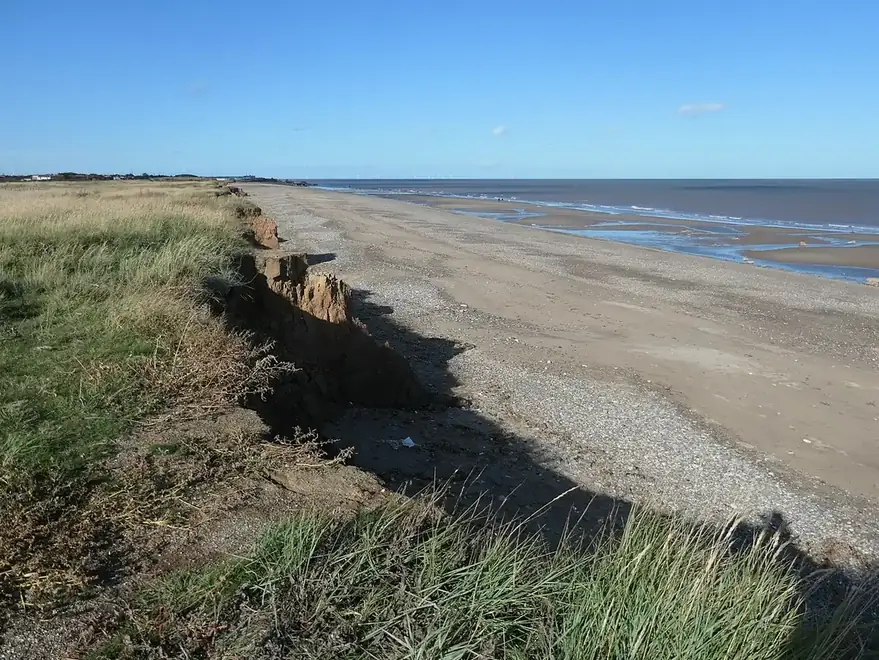
A slide (or rock slide / landslide) is a relatively straight movement of a mass along a flat or gently inclined failure surface. After heavy rain, or after waves have over-steepened the base of a cliffA steep coastal rock face maintained by marine erosion and weathering., a slab of rock or compacted sediment may suddenly slip seaward. The face left behind can look planar. A slump is a rotational movement: the mass fails along a curved surface, tilts backward as it moves, and leaves a curved scar with a toe of jumbled debris on the beach. Slumping is especially common in weak, clay-rich materials such as glacial tillUnsorted sediment deposited directly by glacier ice, ranging from clay to boulders., because water increases the weight of the slope and lubricates the failure surface.
Waves and people both prepare these failures. Marine erosionThe wearing away and removal of rock or sediment by moving water, ice or wind. removes support at the cliff foot (undercutting). Rainwater infiltrationThe entry of water from the ground surface into the soil., leaking drains, extra loading from buildings or the removal of vegetation can all reduce shear strength at the top. That is why a cliff of boulder clay can retreat during a wet week even if the sea is relatively calm: the failure is a mass movement triggered by pore water, not a single wave tearing clay away grain by grain.
Misconception check: mass movement is not a fifth marine erosion process. It is gravity acting on a weakened slope. Waves may trigger it by undercutting, but rain, geologyThe rocks and geological structures of an area that influence its landscape and drainage. and people are equally part of the explanation. You met the same idea on river valley sides in fluvial processes.
Worked example: a photograph shows a curved scar in glacial till, a rotated block of grass still facing partly inland, and a fan of mud on the beach. Identify slumping (rotational failure), not sliding. Then explain: till is weak and impermeable in places, so rainwater increases pore pressure; waves may have removed the supporting toe; the mass rotates along a curved shear plane. An 8-mark resource item would then ask you to blend that process reading with whatever the figure shows about geology or housing on the cliff top.
Exam tip: if the question says {mass movement}, write {sliding} or {slumping} with a mechanism. “The cliff collapsed” is not a process name.
Putting the processes together on one stretch of coast
It helps to follow the processes in time rather than as a memorised list. weatheringThe breakdown or decay of rock in place without its removal by an erosional agent. attacks the cliffA steep coastal rock face maintained by marine erosion and weathering. face between storms. A wet week raises pore-water pressure in clay or till. A destructive waveA wave with stronger backwash than swash that tends to remove sediment from a beach. storm then undercuts the foot by hydraulic actionThe erosion of rock by the force of moving water, including pressure in cracks. and abrasionThe wearing away of a bed, bank or cliff by sediment carried against it by water.. A slumpingThe rotational movement of material downhill along a curved slip surface, often after saturation. delivers a pulse of debris onto the beachAn accumulation of sand, shingle or other sediment along the shore between the land and the sea.. attritionThe reduction and rounding of sediment as transported particles collide with each other. and longshore driftThe net movement of sediment along a coast as angled swash and downslope backwash move material in a zigzag pattern. begin to sort and move that debris alongshore. In calmer weather, constructive waveA wave with stronger swash than backwash that tends to deposit sediment and build a beach. rearrange what is left into a fuller beach, which itself becomes a temporary storeA part of a system in which water or other material is held for a period of time. of energy-absorbing sediment.
People step into that sequence at several points. Removing beach sediment for construction thins the natural buffer and lets waves reach the cliff more often. Building on the cliff top adds weight and may leak water into the slope. A sea wallA coastal barrier designed to resist wave attack and protect land from erosion or flooding. can protect a promenade yet reflect wave energy onto the beach in front, lowering it and exposing the wall’s foundations — a reminder that management choices rearrange processes; they do not switch them off.
When an exam resource shows a coastline, ask three questions in order. What is the wave environment suggested by beach width, storm debris or fetchThe distance over which wind blows across open water to generate waves.? What rock or sediment is being attacked, and are there scars that look like slidingThe downslope movement of material along a relatively straight slip surface. or slumps? Where is sediment going, and is anything interrupting longshore drift? Those three questions turn a photograph into an answer that blends the resource (AO4) with process understanding (AO3), which is exactly how the 8-mark items in Unit 1 are marked.
Common misconceptions
Not quite: Destructive waves are simply the biggest waves.
Instead: Destructive waves are steep, with a weak swash and strong backwash. A tall but gently spilling wave can still be constructive.
Not quite: Attrition wears away the cliff.
Instead: Attrition wears down the sediment particles themselves. The cliff is worn by hydraulic action, abrasion and solution, then often by mass movement.
Not quite: Longshore drift is a current that flows parallel to the coast like a river.
Instead: It is the net zigzag of sediment moved by angled swash and gravity-driven backwash, although longshore currents can assist.
Not quite: Mass movement is just another wave-erosion process.
Instead: Sliding and slumping are gravity-driven failures. Waves may undercut the slope, but water in the cliff and weak geology are part of the cause.
Exam tips
Separate the process families
Examiners want {marine erosion}, {transport including longshore drift}, {deposition}, {weathering} and {mass movement} kept distinct. Mixing them loses definition marks.
Develop one process fully
For 3-mark “explain one” items, write a chain such as {air compressed in cracks} or {swash at an angle, backwash straight down}. Lists of names without mechanisms stay thin.
Read wave type from evidence
Use {steepness, swash and backwash}, not a guess from the place-name. The same beach can receive both constructive and destructive waves in different weather.